Inverting summing amplifier help please?

WBahn

Joined Mar 31, 2012
32,905
You're just being pedantic.....you know full well what I mean on my drawing.
It's not at all clear -- multiple people, myself included, didn't realize that you were referring to your midpoint voltage as your reference (even though you stated it verbally) because schematics are the primary means of communicating circuits in electronics. You will do yourself a big favor if you make the effort to be as precise and complete as you can -- it is YOUR responsibility to communicate what you mean, not your audience's.
 

ericgibbs

Joined Jan 29, 2010
21,459
hi H,
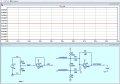
As you are not familiar with LTSpice I have added more detail on this attached asc file.
Download this asc file and run it, in LTSpice.
If you need any guidance, just ask.
E
EG 2077.jpg
 

Attachments

LvW

Joined Jun 13, 2013
2,030
hi H,
OK, I see you have created a virtual ground/common.
Eric - because the discussion up to now was about "split supply yes or no"
Do you think that the concept of "virtual ground" is the same as "split supply"?
I think, for the sake of accuracy (and to avoid misunderstandings like the one here), we should point out the difference between single and split/dual supply.
 

LvW

Joined Jun 13, 2013
2,030
As i stated in my original post, i am running a split supply.
No - you were running the circuit with single supply and an additional bias voltage.
Remember: The bipolar transistor with single supply voltage also needs a proper biasing for operation in its (quasi)-linear operation range.
 

WBahn

Joined Mar 31, 2012
32,905
I need to learn how to run simulations in LTS sometime...

Thanks
There's a learning curve, but it's not bad if you focus on the basics. Don't try to learn more than you absolutely need to at the moment, otherwise you'll get swamped in the vast sea of its capabilities and nuances.

You already know how to add components to a schematic and change their attributes and how to connect them using wires. You're actually most of the way there to being able to run your first simulations. You just need to do things like adding a ground symbol, setting up the transient simulation to run for a specific amount of time (a couple of mouse clicks), running the simulation (a mouse click or two), and adding the traces you are interested in to a plot (a few mouse clicks). There are LOTS of tutorials out there (some better than others). Beyond that, you'll want to learn how to label nodes so that your plots are FAR more meaningful. With just those things, you will be able to do simulations appropriate to the kinds of circuits that you are currently working with. You can then build on those skills as you progress.

Oh, and if you think people here are pedantic because they don't want to have to guess what you meant versus what you said, I can assure you that simulators are FAR more pedantic. Don't put a ground symbol in your schematic, and it will refuse to simulate it. You might like to insist that others should "know" that the negative side of your battery is "obviously" ground, but the simulator will demand that you explicitly indicate that. Put 1M as the value of a resistor, and it will be off by nine orders of magnitude -- you must put 1Meg. Put 1F for the size of a one farad supercap and you are off by fifteen orders of magnitude, since it will be seen as 1f. This is because the simulator is case-insensitive and the value stops being parsed at the first character that isn't part of a valid magnitude designation. The rules are simple and consistent, but they are also inflexible.
 
Top