Insufficient Power on my Load

Thread Starter

michael29angelo

Joined Jul 24, 2015
2
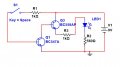
Hi! I have this simple circuit that activates a load, whenever the switch is pressed (shorted). When the switch is released from being pressed, the load will power down slowly. I have already put this up on a breadboard. When the load is an LED, it works! But the actual load that I will use is a 2W MP3 Decoder. The load only receives 17.4 mW (based on my schematic diagram below) but before reaching the LM317, the power is 4.11 W. How can I make the load receive at least 2W. Please help! Thank you!
 

Thread Starter

michael29angelo

Joined Jul 24, 2015
2
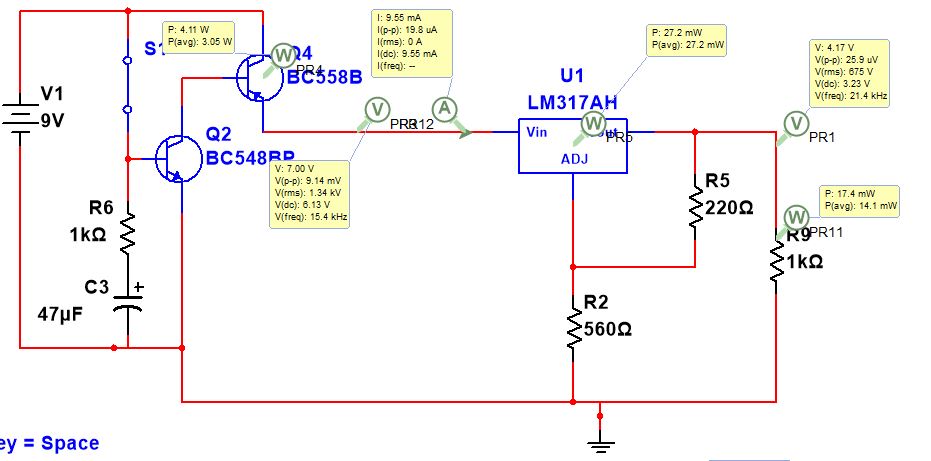
Just made a big change, sorry for ignorant use of devices. So my new simulation makes the LED light up at 4.17V. If I will replace the LED with an MP3 Decoder Module with 2W and 3.7 to 5V requirement, how can this circuit activate the said module? See attached file.

Forgot to explain the 'switch'. So the 'switch' is composed of a bolt and a nut on which when bridged by a finger, the "switch" closes.
 

Attachments

ebp

Joined Feb 8, 2018
2,332
The collector and emitter of the PNP transistor are reversed and there is nothing to limit the base current. Bipolar transistors will usually work in reverse, but very poorly, with almost no current gain. If the power supply could deliver adequate current, the NPN would be destroyed by excessive base current in the original schematic when the switch was closed. That would result in unlimited base current in the PNP, which would also be destroyed.

The base current of the PNP (collector current of the NPN) must be limited by a resistor. The optimal value for the resistor depends on the PNP transistor characteristics, but typically it would be chosen to provide base current of 5 to 10% of the PNP collector current (load current). The voltage across the resistor can be taken to be around 1.5 to 2 V less than the supply voltage (supply voltage minus saturation voltage of the NPN minus base-emitter voltage of the PNP). If the supply is a battery, use the lowest voltage expected from the battery for the calculation.

To get best effect from the capacitor, it should connect directly between the switch and circuit common, perhaps with a small resistor to limit peak current (perhaps 100 ohms). Use a resistor of about 10k between the positive of the cap and the base of the NPN. This scheme allows the capacitor to charge to the full supply voltage, whereas in the original circuit it would be charged to no more than the base-emitter voltage of the transistor (normally about 0.7 V, but with gross overcurrent it would be considerably higher). A 47 µF capacitor is probably far too small for the intended ON time after the switch is released.

A 555 timer circuit is a much better choice for the application. The timing will be well-defined and not change with supply voltage and switching of the load will be "clean" instead of slowly dropping near the end. You will still need a transistor to switch the load current if the MP3 player really requires about 500 mA (2 W from 4.4 V, as would be expected from the regulator).
 
Top