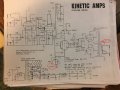
My old OT transformer was dead so i ordered a new one and still... no sound. checked plate votlage and its at 950 on en el34... that cannot be good. what could be wrong? ignore the red circles on the diagram
Are you using an analogue or digital meter to read the voltage? Have you got the feedback correctly phased? maybe the thing is one huge oscillator if you've wired it with positive feedback which could give very strange readings on the anodes (plates)
Also what is the voltage on the grids? I would expect to see a negative voltage of around 46Volts, the two 270k resistors are Point E should connect to the -46V supply.
Are you using an analogue or digital meter to read the voltage? Have you got the feedback correctly phased? maybe the thing is one huge oscillator if you've wired it with positive feedback which could give very strange readings on the anodes (plates)
Well... Clearly so large an over-voltage condition cannot owe merely to under-loading -- ergo the power supply transformer is either defective ('non circular' short in primary) or misapplied...
I think I found it. If you look at the switch in the amp some genius took a wire that connects to the bottom left pin of the power switch and connected it to 3 pins on that switch. That surely would argue missapplied rather than shorted
I think I found it. If you look at the switch in the amp some genius took a wire that connects to the bottom left pin of the power switch and connected it to 3 pins on that switch. That surely would argue missapplied rather than shorted
Good deal! A simple problem is the best sort! --- That said, I recommend you take a moment to correct the schematic (to show the the multi-tap primary) - Believe me! You'll thank yourself in future!
Take the EL34's out and the 12ax7 phase splitter and then measure the voltage, if its correct, then you have probably wired the feed back the wrong way round. digital meters can give strange readings when a large AC signal is present on a DC setting.
Also, double, (even treble) check that you have connected the output transformer primary taps to screen grads correctly and that the Anodes (plates) are connected as per the original. even if you have got the secondary correctly wired, with the feedback point the same as original, by reversing the primary connections, it would cause positive feedback and make it oscillate, probably at a frequency above audible range.
Also, double, (even treble) check that you have connected the output transformer primary taps to screen grads correctly and that the Anodes (plates) are connected as per the original. even if you have got the secondary correctly wired, with the feedback point the same as original, by reversing the primary connections, would cause positive feedback and make it oscillate, probably at a frequency above audible range.
Oh yes thanks, for some reason the posts had not updated until just now and I had not seen the other replies. Probably my slow internet here. All good as long as he's got it fixed now
With my hearing at my age, i doubt I would hear it ha ha. But like I said earlier, if you remove the valves (tubes) and the voltage is correct, then It is a fair indication that it's oscillating when they are in.
Oscillation was a possible cause of the excessive voltage readings PRIOR to discovery of the real problem! - There is no longer any reason to suspect oscillation even in the event the amp fails to function!
Also - Inasmuch as the over-voltage condition will have significantly abused the filter capacitors, 'preemptive' replacement of same is advisable...
Oscillation was a possible cause of the excessive voltage readings PRIOR to discovery of the real problem! - There is no longer any reason to suspect oscillation even in the event the amp fails to function!
Also - Inasmuch as the over-voltage condition will have significantly abused the filter capacitors, 'preemptive' replacement of same is advisable...
Not true in some amplifiers. Certain Fender amps are famous for cutting out (going silent) during play and the reason is that they are hard slammed in ultrasonic oscillation. One look at your schematic and I thought, "Fender Deluxe Reverb...without the reverb section". That's why an amp repairman is sure to fail on those problems if he doesn't own an oscilloscope.
Not true in some amplifiers. Certain Fender amps are famous for cutting out (going silent) during play and the reason is that they are hard slammed in ultrasonic oscillation. One look at your schematic and I thought, "Fender Deluxe Reverb...without the reverb section". That's why an amp repairman is sure to fail on those problems if he doesn't own an oscilloscope.

 Facebook
 Google
 GitHub
 Linkedin