Input Resistance on Op Amp

Thread Starter

SamR

Joined Mar 19, 2019
5,491
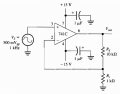
Am I on the right track here? A bit of brain fog this morn.
1601476588665.png
1601476651166.png
Meas Vin = 163.77 mVrms from 463.18 mVpp (unable to adj this sig-gen any closer)
Meas R = 982.5kΩ
V across R =
Here is where I am puzzled. Placing the meter directly across the R, +lead at the sig-gen input and -lead at pin 3 I get 1.217 Vrms? More voltage out than in? Swapping the leads I get 60.5 mV?

So... Moving the -lead to common gnd with +lead at sig-gen input I get 163.77mV and moving the +lead to pin 3 side of the resistor I get 140.55mV? So there was a 23.22mV drop? I am missing something here. Why is measuring directly across the resistor so high? And with the op amp input resistance near infinite why is there a voltage drop across it at all? So I am a bit at sea here.
 

Thread Starter

SamR

Joined Mar 19, 2019
5,491
It works fine and what I calculated that it should do is exactly what I measured. This last little bit of putting a 1MΩ resistor on the input to determine it's input impedance is what is throwing me off.

EDIT: Using the 23.22 mV drop and calculating the current, then dividing that current into the supply V, I get ~6MΩ. So I'm satisfied with that. What I don't understand is why I am getting the voltages that I am by measuring directly across the resistor?
 
Last edited:

ci139

Joined Jul 11, 2016
1,989
use j-Fet input opamp as buffer.. (that requires the pre-calibration of it . . . and it adds an additional error into the measurement chain)
..to your AC Vm (most DMM-s have the input impedance near blow the 1MΩ)

there are also difference in differential input impedance and the one of the single input . . . with ac input the differential input impedance (as it is way lower the non-dif.) likely dominates . . . ( . . . as the open loop voltage gain of op Amp s are from several thousands to few millions the differential impedance gets compensated by such . . . also it gets compensated by the near 0V relative potential on the Op Amp's input)
 
Last edited:

Thread Starter

SamR

Joined Mar 19, 2019
5,491
I thought it might be an artifact of the sig-gen but with it set for 0.5Vpp my meter reads that directly connected to it as 163.78 Vrms. So that is not it.
 

Thread Starter

SamR

Joined Mar 19, 2019
5,491
Indeed it is. My FLUKE 8050A is rated for 0.5dBm @ 1kHz. That thought crossed my mind but knowing FLUKE I didn't question it. Turns out it is not as high as I thought it would be after checking the spec.
 

OBW0549

Joined Mar 2, 2015
3,566
Here is where I am puzzled. Placing the meter directly across the R, +lead at the sig-gen input and -lead at pin 3 I get 1.217 Vrms? More voltage out than in?
Be careful when attempting to measure voltages in high-impedance circuits; remember, your meter has its own internal resistance (often 1 MΩ or 10 MΩ) and when you connect it into a circuit that resistance becomes part of the circuit and will influence the measured voltages. My guess is that that's probably what you're seeing.

A better technique would be to make your measurement at the output of the op amp, with and without the 1 MΩ input resistor, then divide by 11 (the gain of the op amp stage) to evaluate the result.
 

Thread Starter

SamR

Joined Mar 19, 2019
5,491
Sounds to me like the meter is in current mode maybe?
Nope, it is in AC Volts. And the Vrms does agree with the sig-gen which is a bit off. Sidebar, I did have to go with my old sig-gen as for some reason I have noticed that my newer one is noisy on low voltages. The older one only goes to 1 decimal place but has less noise on the signal. Both have plastic cases and sit next to each other so it is not external I think. Thought about building a voltage follower op amp module to use to remove it.
 

OBW0549

Joined Mar 2, 2015
3,566
Another thing to consider is the meter's input capacitance, which for this meter can be up to 100 pF. Interacting with a 1 MΩ resistance, it could cause significant additional error at 1 kHz.
 

Thread Starter

SamR

Joined Mar 19, 2019
5,491
I noted the 100pF spec in the manual. I don't have the same edition lab manual as the text which did go into calculating both the input and output resistances as you suggested. So this adding a 1MΩ series resistor kinda came out of left field.
 

ci139

Joined Jul 11, 2016
1,989
but you can also use the 1M as ... say : GND to 15kΩ to 985kΩ to gen to opamp and measure the drop on 15kΩ
the error would be 0.015M || ?10M? Ω ≈ -0.15% error (such of course requires determining the resistor values and the voltmeter input impedance at high precision)
there is something about the input impedance at Pg.43 of the https://www.ti.com/lit/an/sboa092b/sboa092b.pdf
——————
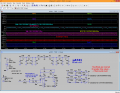
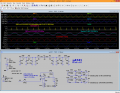
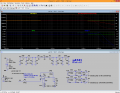
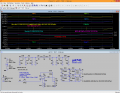
EDIT :: i did a quick (poorly designed ... as "top-down programming") test to get the apx. value
a lot of "unexpected" offsets popped out (sure this is bipolar input device does some rectification by it's PN input junctions ... (surpriiise) )
the differential input impedance is referred to be about 2MΩ
the common mode input impedance ((83.4MΩ at my experiment) i can't find www values for) ...
... it seems to be "internally magnified" a cite from : "following negative feedback (bootstrapping) increases virtually the effective op-amp common-mode input impedance."
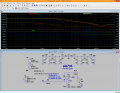
+dif. inp. imp. -- has likely a wrong method considering the bode plot v. (last fig.) of it gives about 740kΩ impedance
uA741 - TEST - 2-U.pnguA741 - TEST - 2-W.pnguA741 - TEST - 2-W-f.png
.
.
.
.
EDIT.2 : some things verified ...
uA741 - TEST - 2-Wp.pnguA741 - TEST - 2-U-f.png
 
Last edited:

BobaMosfet

Joined Jul 1, 2009
2,211
@SamR - I think it's a trick question. I'm speculating that because the impedance at the OpAmp is nearly infinite, and is NOT ground. Adding a 1M-Ohm resistor doesn't change that- it just becomes part of the conductor and floats along with it- there should be almost no voltage drop across the resistor- I mean, it's so small at this point that your meter may not be able to accurately register what's going on at this point.

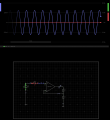
Just a thought. Does this make sense to anyone, or am I off in left field? I tried simulating this and this is why I came to this conclusion.

1601570253303.png
 

MrAl

Joined Jun 17, 2014
13,704
Hello,

You could do some tests on the meter itself first.
For example, one test would go as follows...

Measure the generator output by itself with just the meter connected.
Then, insert a 1Meg resistor in series with the meter and take another measurement.
Compare the two results to see how much the meter reading went down when the 1Meg resistor
was added.

Again set up the same test but this time also place a second 1 Meg resistor in parallel with the meter. See how much lower the reading goes with the extra resistor in parallel.
Two equal resistors in series makes up a voltage divider that has output 1/2 of the generator output. With the meter in parallel with the lower 1 Meg resistor the reading will decrease somewhat and you can calculate the drop caused by the meter.

We could also test the input capacitance of the meter by doing similar tests. With with the meter in series with a variable resistor with variable capacitor in parallel, when the upper resistor and parallel cap are adjusted to the same values as the meter (and possibly a parallel 1 Meg resistor) we will get exactly 1/2 of the output of the generator. Knowing the test setup we could calcualte the meter capacitance and resistance.

Tests similar to these can be used to get an idea of what the characteristics of the meter are.
 

WBahn

Joined Mar 31, 2012
32,847
@SamR - I think it's a trick question. I'm speculating that because the impedance at the OpAmp is nearly infinite, and is NOT ground. Adding a 1M-Ohm resistor doesn't change that- it just becomes part of the conductor and floats along with it- there should be almost no voltage drop across the resistor- I mean, it's so small at this point that your meter may not be able to accurately register what's going on at this point.

Just a thought. Does this make sense to anyone, or am I off in left field? I tried simulating this and this is why I came to this conclusion.
Is your simulation using a realistic model for an opamp? If not, then it is useless for saying anything about how real opamps behave. Many older opamps had input resistances that where in the megaohm range. You also have input bias currents that complicate things.
 

Thread Starter

SamR

Joined Mar 19, 2019
5,491
Apparently, it was an issue of adding the meter in parallel with the circuit. Measuring the voltage before and after the resistor relative to GND gave me what I needed.
 

BobaMosfet

Joined Jul 1, 2009
2,211
Is your simulation using a realistic model for an opamp? If not, then it is useless for saying anything about how real opamps behave. Many older opamps had input resistances that where in the megaohm range. You also have input bias currents that complicate things.
@WBahn- The OpAmp parameters are configurable to some degree, so I matched as much as possible, but I'm not going to say it's 100%. My next step was to do it on a breadboard and compare, but I think SamR identified the issue.
 
Top