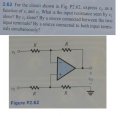
The four input resistances can be described this way:
1. The driving point resistance at V1
2. The driving point resistance at V2
3. The differential resistance between V1 and V2.
4. The common mode input resistance; that is, the driving point resistance with V1 and V2 connected together.
For number 3, connect a floating 1 amp current source between V1 and V2 and calculate the voltage difference between V1 and V2. To do this, you just inject +1amp at V2 and simultaneously inject -1amp at V1. Solve the circuit with these two currents applied and calculate V2-V1; that voltage will be equal to the differential input resistance.
For number 4, connect V1 and V2 together and calculate the input resistance in the same way you did numbers 1 and 2.
The four input resistances can be described this way:
1. The driving point resistance at V1
2. The driving point resistance at V2
3. The differential resistance between V1 and V2.
4. The common mode input resistance; that is, the driving point resistance with V1 and V2 connected together.
For number 3, connect a floating 1 amp current source between V1 and V2 and calculate the voltage difference between V1 and V2. To do this, you just inject +1amp at V2 and simultaneously inject -1amp at V1. Solve the circuit with these two currents applied and calculate V2-V1; that voltage will be equal to the differential input resistance.
For number 4, connect V1 and V2 together and calculate the input resistance in the same way you did numbers 1 and 2.
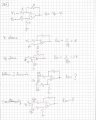
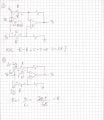
Here's my attempt at what you've told me to do. I'm not sure whether I've done it right or not.
I think I misunderstanding how we obtain the input resistance. Don't we simply take the current going into the negative input terminal and the voltage across the resistor before the negative input terminal and divide the two?
If not, can someone further clarify?
EDIT: I'm still confusing myself in the simple cases... I don't understand what I'm supposed to do to find the input resistance in different cases. Can someone clarify?
In general, when you want to find the input resistance of a terminal, you either apply a test voltage and find the current it draws, or you apply a test current and find the voltage it produces. In either case Rin=V/I.
Also make it a habit to use arbitrary variables for test input and voltage, like you did in the fourth question and don't use fixed numbers like in the third (Itest=1mA).

 Facebook
 Google
 GitHub
 Linkedin