Inductors and resistance

Thread Starter

sunny1982

Joined Dec 27, 2012
41
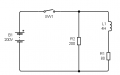
Hi folks back again, I've answered a question here just wanted one of you kind folks to check it and see if its correct. Bare in mind this circuit has a 200 ohm resistor with negligible inductance.

A coil of inductance 4H and resistance of 80Ω is connected in parallel with a 200Ω of resistor of negligible inductance across a 200v dc supply. The switch connecting these to the supply is then opened; the coil and resistor remain connected together. State in each case one for immediately before and one for immediately after opening the switch;

a) The current Through the resistor
Immediately before Switch opening
200v/ 200Ω= 1a
Immediately after Switch opening
-200v / 80Ω= -2.5a

b) The current through the coil
Immediately before Switch opening
200v / 80Ω = 2.5a
Immediately after Switch opening
200v / 80Ω = 2.5a

c) The e.m.f induced in the coil
Immediately before Switch opening
2.5a * 80ohms -(200v) = 0v
Immediately after Switch opening
-2.5a *(200Ω + 80Ω) = -700v

d) The voltage across the coil
Immediately before Switch opening
2.5a * 80Ω = 200v
Immediately after Switch opening
-2.5a * 200Ω = -500v
 
Last edited:

WBahn

Joined Mar 31, 2012
32,823
Ask if your answers make sense!

Since they are in parallel, is it not true that the voltage across the resistor and the voltage across the inductor are always the same? If so, then are your answers consistent with this?

Is it really likely that 200V/80Ω and 200V/200Ω result in the same current? According to your answers to the first question, you seem to think so.

Ask if your answers make sense!
 

Thread Starter

sunny1982

Joined Dec 27, 2012
41
Ask if your answers make sense!

Since they are in parallel, is it not true that the voltage across the resistor and the voltage across the inductor are always the same? If so, then are your answers consistent with this?

Is it really likely that 200V/80Ω and 200V/200Ω result in the same current? According to your answers to the first question, you seem to think so.

Ask if your answers make sense!
Thats why I love comming on here Mr WBAHN, so ok it was meant to be 1 amp, apart from that where have I gone wrong?
 

WBahn

Joined Mar 31, 2012
32,823
Thats why I love comming on here Mr WBAHN, so ok it was meant to be 1 amp, apart from that where have I gone wrong?
At the risk of repeating myself:

Ask if your answers make sense!

Since they are in parallel, is it not true that the voltage across the resistor and the voltage across the inductor are always the same? If so, then are your answers consistent with this?

Ask if your answers make sense!
What does your answer to (a) say about the voltage across the resistor just after the switch is opened?

What does your answer to (d) say about the voltage across the inductor just after the switch is opened?
 

Thread Starter

sunny1982

Joined Dec 27, 2012
41
At the risk of repeating myself:


What does your answer to (a) say about the voltage across the resistor just after the switch is opened?

What does your answer to (d) say about the voltage across the inductor just after the switch is opened?
OK so I think I've got it now I've corrected it I think, the current that is meant to be flowing in the resistore this also meant to be flowing in the coil so thats why both are -2.5a, and because we know that there is 200v but the switch is not open that 200v becomes -200v when the switch is not open. Is this correct?

a) The current Through the resistor
Immediately before Switch opening
200v/ 200Ω= 1a
Immediately after Switch opening
-200v / 80Ω= -2.5a

b) The current through the coil
Immediately before Switch opening
200v / 80Ω = 2.5a
Immediately after Switch opening
200v / 80Ω = 2.5a

c) The e.m.f induced in the coil
Immediately before Switch opening
2.5a * 80ohms -(200v) = 0v
Immediately after Switch opening
-2.5a *(200Ω + 80Ω) = -700v

d) The voltage across the coil
Immediately before Switch opening
2.5a * 80Ω = 200v
Immediately after Switch opening
-2.5a * 200Ω = -500v
 
Last edited:

WBahn

Joined Mar 31, 2012
32,823
The thing to work from is that the current in the coil is the same just before and just after the switch is opened. Anything and everything else can be different.

Also, you need to define your polarities, both for the currents and the voltages. A diagram would be very useful.
 

WBahn

Joined Mar 31, 2012
32,823
and what happen if the source is ac with v =220 (r m s) and f=50
What happens... when? In steady state? When the switch is opened?

If you want to make changes to the problem, then you need to be more clear about what you are asking? Also, try to tread lightly on someone else's thread. If you want to push the OP's question this way or that but it is still essentially the same question, that's one thing. But if you are completely changing the scope and intent of the discussion, that is better served by starting your own thread.
 

Thread Starter

sunny1982

Joined Dec 27, 2012
41
Ah, but to be that young and naive again.... :D;):p
Thankyou Mr WBahn thats good enough for me lol, You don't have to say it but from what I gathered is that my answers are correct, because usually you give me alot to think about so they must be right hahaha;) I'l be opening another thread shortly on lovely kirchoffs I hope you around because I've got something to show you I've done a complete kirchoffs circuit myself which I learnt from here:D
 

WBahn

Joined Mar 31, 2012
32,823
Yes, the answers in the diagram are correct. I don't know if the answers to some of your questions are correct or not because the diagram didn't indicate the polarities of the voltages across the components and so the meaning of positive and negative voltage across those components is ambiguous, but I'm pretty sure you got them correct.

I've seen many a "solution" set that was incorrect -- and sometimes you learn the most from working a problem hard enough to convince yourself that YOUR answer is correct and the BOOK answer is wrong! One of the texts I am currently using is atrocious. I always work the problems I assign myself, but it is nice to be able to sanity check them with the author's solution manual when possible. But for this text about a quarter of the answers are demonstrably wrong.
 
Top