Facebook
 Google
 GitHub
 Linkedin
Hi,
So a brief backstory, I know just enough about electronics to be dangerous, but to be honest I have stayed away from RC/LC circuits, Q-power, resonance, and the like unless I'm following a schematic where the magic is already done for me. The second thing is I'm damn near deaf. This brings me to the the reason why I'm here.
Due to my hearing regular headphones don't do squat. I buy "loops" that are quite expensive that use inductive coupling to change the audio to an EMF signal that is picked up by a coil in my hearing aids. They are as small or smaller than standard headphones, and typically loop around my neck instead of speakers over my ears. They come in active and passive designs. I have an expensive active "loop" that is magic. sounds incredible, powerful, high fidelity, etc. I use that at home. I also have an entirely passive "loop" that I use for any work, sweat, outdoors, water, etc. You get the idea. It is still expensive.
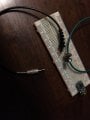
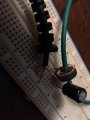
After having many issues with the passive loop and tired of ghetto repairs I finally put it out of it's misery and tore it open to see what was inside and was completely shocked. I could make this myself, for a mere minute fraction of the cost. In fact I did make one. I copied the original design with components I had lying around, and it sounds okay. I want to better understand the design so I know what parts to tweak and my main goal here is to remain PASSIVE and have as high of FIDELITY as possible. This is hard for me because I don't have a true L meter or a legit way of measuring impedance. I also don't quite understand how the components affect the circuit and where my tweaking should start. Additionally, with my hearing it is hard to tell what is wrong, I can just tell I need to change components. I have tweaked quite a bit but still land just below the retail version in terms of fidelity. I could be satisfied with what I've brewed up, but I know there is a science behind here that with the right information I could make something that sounds as good as, if not better than the expensive retail version, that judging by the soldering alone is a hack job..
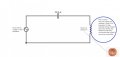
So at the input is a 3.5mm mono jack usually plugged into my phone. Can you help me understand this bare bones circuit? I assume the cap is used as a standard DC blocking cap and anything from 20uf-100uf is preferable to block DC but still give me adequate lower response. In my toying around, a direct short gives me horrible audio distortion, but it still works. I honestly cant tell much difference between 100uF and 470uF except that it starts to sound muffled if I go higher than 100uF, and anything lower than 10uF has some audio issues, but I don't have a huge assortment of electrolytic caps to try. The toroid coil I hand wound a few times, seems like more coils equal more amplitude, and there is a finite zone of effectiveness. Too small and it doesn't couple well enough for me to pick up the audio unless I hold the loop by my ear. Same goes for too large, and/or too few wraps. Does the loop's wire play into this? Should I be trying a different gauge? What is the balance here? Are there other PASSIVE electronics you think I should try? Is there a magic impedance I need to shoot for? Essentially it seems like a voice coil but instead of moving a magnet I'm moving electrons in a wire. How can I get this to have as high fidelity as possible, with adequate power? Where should I start to deconstruct this circuit? Thanks for reading my wall of text and looking at my paint drawing The coil at the bottom right is pretty much identical to what I've wound and works well. Your input is much appreciated!

So a brief backstory, I know just enough about electronics to be dangerous, but to be honest I have stayed away from RC/LC circuits, Q-power, resonance, and the like unless I'm following a schematic where the magic is already done for me. The second thing is I'm damn near deaf. This brings me to the the reason why I'm here.
Due to my hearing regular headphones don't do squat. I buy "loops" that are quite expensive that use inductive coupling to change the audio to an EMF signal that is picked up by a coil in my hearing aids. They are as small or smaller than standard headphones, and typically loop around my neck instead of speakers over my ears. They come in active and passive designs. I have an expensive active "loop" that is magic. sounds incredible, powerful, high fidelity, etc. I use that at home. I also have an entirely passive "loop" that I use for any work, sweat, outdoors, water, etc. You get the idea. It is still expensive.
After having many issues with the passive loop and tired of ghetto repairs I finally put it out of it's misery and tore it open to see what was inside and was completely shocked. I could make this myself, for a mere minute fraction of the cost. In fact I did make one. I copied the original design with components I had lying around, and it sounds okay. I want to better understand the design so I know what parts to tweak and my main goal here is to remain PASSIVE and have as high of FIDELITY as possible. This is hard for me because I don't have a true L meter or a legit way of measuring impedance. I also don't quite understand how the components affect the circuit and where my tweaking should start. Additionally, with my hearing it is hard to tell what is wrong, I can just tell I need to change components. I have tweaked quite a bit but still land just below the retail version in terms of fidelity. I could be satisfied with what I've brewed up, but I know there is a science behind here that with the right information I could make something that sounds as good as, if not better than the expensive retail version, that judging by the soldering alone is a hack job..
So at the input is a 3.5mm mono jack usually plugged into my phone. Can you help me understand this bare bones circuit? I assume the cap is used as a standard DC blocking cap and anything from 20uf-100uf is preferable to block DC but still give me adequate lower response. In my toying around, a direct short gives me horrible audio distortion, but it still works. I honestly cant tell much difference between 100uF and 470uF except that it starts to sound muffled if I go higher than 100uF, and anything lower than 10uF has some audio issues, but I don't have a huge assortment of electrolytic caps to try. The toroid coil I hand wound a few times, seems like more coils equal more amplitude, and there is a finite zone of effectiveness. Too small and it doesn't couple well enough for me to pick up the audio unless I hold the loop by my ear. Same goes for too large, and/or too few wraps. Does the loop's wire play into this? Should I be trying a different gauge? What is the balance here? Are there other PASSIVE electronics you think I should try? Is there a magic impedance I need to shoot for? Essentially it seems like a voice coil but instead of moving a magnet I'm moving electrons in a wire. How can I get this to have as high fidelity as possible, with adequate power? Where should I start to deconstruct this circuit? Thanks for reading my wall of text and looking at my paint drawing
The coil at the bottom right is pretty much identical to what I've wound and works well. Your input is much appreciated!