Inductance in function of frequency

Thread Starter

leo0001

Joined Sep 30, 2018
79
Hi,

I'm trying to estimate the inductance @ 200 KHz of a transformer. For this I know the inductance @ 10 KHz which is 4 mH. (The inductance is dependent also on the excitation signal applied on it (100mVAC probably a sinusoidal signal ...) You will find the datasheet attached. It would be good if I could know if the inductance will be higher at higher frequency or if it will be lower... The other solution is to estimate the inductance by doing an LTspice simulation. Nevertheless, it is possible to estimate the inductance in function of the frequency only if the LTspice model include this kind of informations. The model is provided by the manufacturer itself. The solution to estimate the inductance is based on the following formula U(L) = Ldi/dt. By knowng di/dt and U(L), I can estimate L in function of the frequency. I attached you the LTspice model of the transformer if you have motivation. What do you think of this idea ? Is this seems to be realistic for you ? Do you have any idea of what would be the inductance variation in function of frequency ?

(I can't do measurement on the transformer)

Thank you and have a nice day :)
 

Attachments

Jony130

Joined Feb 17, 2009
5,598
Well, I doubt that this SPICE model includes the frequency dependence of a core. And of course in the real world, the inductance will drop at 100khz.

But you can play with it yourself. See the attached file.
 

Attachments

Bordodynov

Joined May 20, 2015
3,431
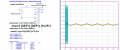
I did the calculation using the first voltage harmonic.
Fr 10kHz and 200kHz, ix=100mA, 340mA and 600 mA
Here is the result:
.step fr=10000 ix=0.1
Harmonic Frequency Fourier Normalized Phase Normalized
Number [Hz] Component Component [degree] Phase [deg]
1 1.000e+04 3.774e-03 1.000e+00 83.57° 0.00°

.step fr=200000 ix=0.1
Harmonic Frequency Fourier Normalized Phase Normalized
Number [Hz] Component Component [degree] Phase [deg]
1 2.000e+05 4.358e-03 1.000e+00 83.05° 0.00°

.step fr=10000 ix=0.34
Harmonic Frequency Fourier Normalized Phase Normalized
Number [Hz] Component Component [degree] Phase [deg]
1 1.000e+04 3.726e-03 1.000e+00 83.49° 0.00°

.step fr=200000 ix=0.34
Harmonic Frequency Fourier Normalized Phase Normalized
Number [Hz] Component Component [degree] Phase [deg]
1 2.000e+05 4.240e-03 1.000e+00 83.15° 0.00°
Total Harmonic Distortion: 0.000000%(9.475642%)

.step fr=10000 ix=0.6

Harmonic Frequency Fourier Normalized Phase Normalized
Number [Hz] Component Component [degree] Phase [deg]
1 1.000e+04 3.263e-03 1.000e+00 82.68° 0.00°

.step fr=200000 ix=0.6
Harmonic Frequency Fourier Normalized Phase Normalized
Number [Hz] Component Component [degree] Phase [deg]
1 2.000e+05 3.122e-03 1.000e+00 79.01° 0.00°
 

Attachments

Last edited:

MisterBill2

Joined Jan 23, 2018
27,504
While inductive reactance will certainly vary with the frequency, it does n0ot seem reasonable that the actual inductance would change. The effective inductance may change because of the capacitive reactance between turns increases with frequency.
 

Bordodynov

Joined May 20, 2015
3,431
I totally agree with you. Adding a small parallel capacitance to the inductance increases the equivalent inductance. At 200 kHz, the increase in inductance will be greater than at 10 kHz.
But it is not quite clear to me why to ask the question of the inductance dependence on frequency, if there is a transformer model. It's just curiosity. Although theoretically inductance should decrease with frequency increase. It happens because of the frequency properties of the ferrite core.
 

MisterBill2

Joined Jan 23, 2018
27,504
I totally agree with you. Adding a small parallel capacitance to the inductance increases the equivalent inductance. At 200 kHz, the increase in inductance will be greater than at 10 kHz.
But it is not quite clear to me why to ask the question of the inductance dependence on frequency, if there is a transformer model. It's just curiosity. Although theoretically inductance should decrease with frequency increase. It happens because of the frequency properties of the ferrite core.
There are losses associated with magnetizing the core, no matter what the material being magnetized. As the frequency increases those losses also increase. With ferrite materials the magnetizing is a bit different in ways that I don't have an adequate grasp of. I am aware that there are quite a few different ferrite materials and that each is suitable for different frequency ranges. Hopefully somebody else can explain the actual physics of how and why it is that way.
 

Thread Starter

leo0001

Joined Sep 30, 2018
79
Thank you for all your replies ! :D

Why i'm asking how the inductance vary in function of the frequency is because I want to do a discontinuous flyback and for this I have to know if there would be or not a dead time during each cycle. This deadtime is dependant on the primary inductance value.

2nd question : Someone say that the inductance should drop at 100 KHz in comparaison to the inductance at 10 KHz and the LTspice simulation made by Bordodynov shows that the inductance is higher at 200 KHz than at 10 KHz. Do you think the LTspice model provided by the manufacturer is correct ?

3rd question : What are your textbooks :D ? I m not sur to understand the method to compute the inductance. The method is to apply an exciting current signal into the inductance and then you observe the voltage accros the inductance and from it you determine the inductance. You say " I did the calculation using the first voltage harmonic", so it means that if you apply a current at a certain frequency into the inductance, the resulting voltage accros the inductance is not at the same frequency, at least there are other frequencies than the frequency applied on it ?
 

MisterBill2

Joined Jan 23, 2018
27,504
Thank you for all your replies ! :D

Why i'm asking how the inductance vary in function of the frequency is because I want to do a discontinuous flyback and for this I have to know if there would be or not a dead time during each cycle. This deadtime is dependant on the primary inductance value.

2nd question : Someone say that the inductance should drop at 100 KHz in comparaison to the inductance at 10 KHz and the LTspice simulation made by Bordodynov shows that the inductance is higher at 200 KHz than at 10 KHz. Do you think the LTspice model provided by the manufacturer is correct ?

3rd question : What are your textbooks :D ? I m not sur to understand the method to compute the inductance. The method is to apply an exciting current signal into the inductance and then you observe the voltage accros the inductance and from it you determine the inductance. You say " I did the calculation using the first voltage harmonic", so it means that if you apply a current at a certain frequency into the inductance, the resulting voltage accros the inductance is not at the same frequency, at least there are other frequencies than the frequency applied on it ?
Measuring the voltage developed across an inductor will allow you to know the impedance, which is the vector sum of inductive reactance plus the resistance. And if there are harmonics or other distortion present then that also contributes to the voltage developed. So measuring inductance by that method ACCURATELY is difficult. And the magnetic material must not be magnetized so much that it's characteristics change, which means not driving it even close to saturation, at least not until you know the inductance below saturation. Then you can drive it harder and observe the effect of saturation, and realize what effect that will have on your design. Selecting an inductor for a switching mode power supply is not a simple task.

I do not trust simulations because it has been shown that the models most of them use are simplified and do not always come close to reality. So with a model that is not accurate how can the results be accurate? If the manufacturer supplies a model for a simulator they should also be able to tell you what conditions that model is accurate for. That is, what current and what frequency range. Models often are not applicable for all conditions.
 

Thread Starter

leo0001

Joined Sep 30, 2018
79
Thank you for your reply !

According to you what would be the best way to know the inductance at 200 KHz ? I could do some measurments on it if I order it :D
 

MisterBill2

Joined Jan 23, 2018
27,504
Thank you for your reply !

According to you what would be the best way to know the inductance at 200 KHz ? I could do some measurments on it if I order it :D
I suggest contacting the manufacturer of the inductors and having a discussion with an applications engineer. They are often quite willing to provide additional information on using their products, and if this is a product that you are working on designing they will certainly want it to work well using their products. There will also be additional information, including applications information, on the website, at least a whole lot of companies want to help folks use their products successfully, and so they are happy to help. And they know more about their particular products than I know.about them.
 
Top