Assignment is:
Make an inc/dec circuit using 4 SR flipflops with cascade generated transmission signal.
Any help will be highly appreciated, but I would rather like if someone could give me explanation/idea, not a solution to my problem.
I've just figured out that I made few huge mistakes.
At this moment I am figuring out how to use few tools for this, and learning about how to understand 1 ff. for starters. As soon as I fix this, I'll post my progress.
And thanks a lot for fast response!
PS. I should've read FAQ before posting, do apologize about my noobishness.
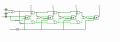
On the other hand, I probably shouldn't be ashamed by my lack of knowledge. So in attachment is my current progress, in form of screen capture of logisim schema . ^^
Edit:
C0 - control signal for incrementer
E0 - control signal for decrementer
Signal Takta - is just Clock signal
I still haven't figured out how to do this. But, there was a slight change. I've notice that I didn't create input bits (I0, I1, I2, I3) which should be incremented/decremented...
In some of your diagrams en0 is an input and in others it is treated as an output.
So first things first. What, exactly, is the S-R Flip Flop block you are using? Please provide either its internal diagram or a complete Truth Table for its behavior.
Second, please describe the specified behavior for the overall problem. What is supposed to happen in response to each of the input signals? Each of your diagrams has a different set of input signals, so we are left guessing what the real story is. Don't make us guess -- engineering is NOT about guessing.
In some of your diagrams en0 is an input and in others it is treated as an output.
So first things first. What, exactly, is the S-R Flip Flop block you are using? Please provide either its internal diagram or a complete Truth Table for its behavior.
Second, please describe the specified behavior for the overall problem. What is supposed to happen in response to each of the input signals? Each of your diagrams has a different set of input signals, so we are left guessing what the real story is. Don't make us guess -- engineering is NOT about guessing.
Tnx for response. And I do apologize if I'm not using correct tools to show all this...
I don't know what am I doing. So, ignore my diagrams. I need to create up/down asynchronous counter using SR ff . C0 should be used to indicate that I want it to increment(up), vice versa E0 should point to decrement(down). I0 to I3 should be bits of my number represented in binary (ie. 0001 should be 0010 after first clock of inc).
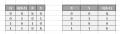
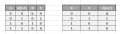
This is truth table:
And it's freaking hard translating engineering homework into English, so my hopes are that I'm forgiven.
Point of an assignment is to do exactly what are you asked for And, btw, I wouldn't be doing this at all, if it wasn't necessary for enough ECTS to pass the quota.
WOW!
I didn't even notice the whole "tutorials" section.
I am, indeed, falling in love with this forum. This experience might even change my mind about electronics. Thanks a lot Eric )
If all you want are solutions to your homework that have been done by someone else, then there are plenty of places on the web where you can pay someone to do that.
If all you want are solutions to your homework that have been done by someone else, then there are plenty of places on the web where you can pay someone to do that.
Solution is holding first position, but on second is if I find an explanation or suggestion. And you sound like an angry nerd that was pushed around for homework, and now has his 5mins of revenge -- chillout :=)
I meant the truth table that shows how you derived the logic in the circuit you posted.
A description of how up and down control is to be implemented would also help. You show 2 inputs for controlling direction. As mentioned in post #8, two separate controls could complicate things.
I meant the truth table that shows how you derived the logic in the circuit you posted.
A description of how up and down control is to be implemented would also help. You show 2 inputs for controlling direction. As mentioned in post #8, two separate controls could complicate things.
Thanks for trying to help me, but I think at this point I'm giving up.
The counter I posted doesn't do anything I wanted it to do.
Member at posts #10 and #12 pointed me towards few good sources for learning this, so I'll start there. And when my knowledge is sufficient enough to understand what anyone is trying to say to mi in circuit-language, I might even post a question again.

 Facebook
 Google
 GitHub
 Linkedin