Here is a possible answer.
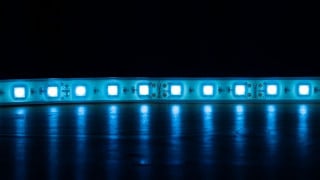
If the LEDs are powered by half-wave rectification of 50Hz line voltage, they will flicker at 50Hz.
Incandescent lamps do not show flicker at line frequency. With the incandescent lit at the same time, it reduces the visual effect of the flicker from the LEDs.
For the ones I dealt with in the past, the LEDs actually did not flicker once the filament bulb was added. It wasn't just the extra light that swamped out a changing LED light level, the LED light level actually stayed constant after that.
An interesting effect is incandescent bulbs actually do flicker, but their brightness level only varies a little bit with each half cycle. We might not call that a flicker though. You can measure the line frequency using a photocell and an oscilloscope if you divide the frequency measured by the scope by 2. The variation is not noticeable by eye in most cases though. If I remember right, fluorescent light bulbs flicker more as their light level changes more than a filament bulb. That's also not usually a problem.
I understand that when fluorescent lighting was introduced in factories, machinists lost their digits because lathes and other machinery would sometimes appear to be not running.
So I looked at the switch internals and there is nothing that seems anything like a dimmer or solid state device. Just to repeat and add a bit more info, I'm using 4.5W LEDs in a standard 240v circuit (E14 fittings). The lights do NOT glow at all when off. Incandescent bulbs aren't sold here anymore, and I have a limited supply. So I'll have to deal with the problem sooner or later. And I'm a bit concerned about flaky wiring. From what I can tell, electrical equipment in Italy is 10-15 years behind what I expected in the US , and this apartment was re-fitted around 1990. So, early 80's technology, and some practices that would probably make you shudder. Most of the light fixtures have no apparent wiring box. The connection wire extrudes directly from the concrete wall. The fitter was rather crazy about multi-pole circuits, many with 3 switches and long runs of wire. One circuit in another room was flickering on incandescent bulbs when we arrived. The electrician "fixed" it by disconnecting one of the poles (but the circuit now runs LEDs with no problems).
At this point one possible option will be to rectify and filter the AC feed to those affected lights, and run them on filtered DC. With adequate capacitors that should work. I do not claim this as the best choice, but maybe it is.
What it would do is to completely remove any waveform distortion that was causing the problem. And certainly it is waveform distortion from some source that is causing the flicker. Of course, DC operation may not work, and it might not even be applicable. Certainly it might not physically fit .
Some dimmer switches require 3 wires while some require only 2.
The ones that have 3 wires require a hot AND a neutral wire, meaning they have (in the US) 120vac supplied to them at all times, whether the bulb is turned on or turned off.
Since it is more rare to see 120vac supplied in the light switch electrical box itself (because regular mechanical switches do not need that) dimmers that only require 2 wires came about. These do not work on voltage they work on current for their power source. They have to have at least some current (even if very low like 1ma or even 100ua) flowing or else they do not work right and can cause flickering. Now a regular filament bulb (which they were originally designed for) allows this because the filament never breaks the current completely. When the filament is hot, a large current flows and the bulb lights up brightly. When the filament is cold, a small current can still flow but it's so small that the bulb will not light up or even come close to lighting up. That small current though is enough to keep the dimmer circuit working properly because the dimmer converts that small current into a voltage that can drive the circuitry. With an LED bulb however, the on/off current profile can be very different. With the LED bulb 'off' it may not supply enough current, which can charge the dimmer circuit to the point of normal operation, but then as soon as the dimmer circuit starts up again, it loads its own voltage down again and thus the LED flickers.
Here is a possible answer.
If the LEDs are powered by half-wave rectification of 50Hz line voltage, they will flicker at 50Hz.
Incandescent lamps do not show flicker at line frequency. With the incandescent lit at the same time, it reduces the visual effect of the flicker from the LEDs.
I highly respect your opinions, points of view and very educated answers, but I think I disagree with your assessment on this. Remember, the lights would not shut off. In the "OFF" mode they would flicker. In MY case, I had LED can lights that would flicker at about half brightness and at a rate I would guess to be around 3 to 5 hertz when they were supposed to be OFF. Adding an incandescent 60W bulb solved MY problem. This sounds like the same situation the TS is experiencing. I think MrAl hit it spot on in this case. That's where I'm laying my money down.
Has some smart switching been introduced on some of those circuits?
The power outlet socket you describe, could be a straight switched power outlet and the 'unswitched' socket intended for a standard lamp controlled by a remote control, for example.
Some of the lighting circuits also having a facility to be controlled by a remote control.
These would then have triac controllers (embedded somewhere after the circuit breakers) which would give what you are seeing occur.
So I looked at the switch internals and there is nothing that seems anything like a dimmer or solid state device. Just to repeat and add a bit more info, I'm using 4.5W LEDs in a standard 240v circuit (E14 fittings). The lights do NOT glow at all when off. Incandescent bulbs aren't sold here anymore, and I have a limited supply. So I'll have to deal with the problem sooner or later. And I'm a bit concerned about flaky wiring. From what I can tell, electrical equipment in Italy is 10-15 years behind what I expected in the US , and this apartment was re-fitted around 1990. So, early 80's technology, and some practices that would probably make you shudder. Most of the light fixtures have no apparent wiring box. The connection wire extrudes directly from the concrete wall. The fitter was rather crazy about multi-pole circuits, many with 3 switches and long runs of wire. One circuit in another room was flickering on incandescent bulbs when we arrived. The electrician "fixed" it by disconnecting one of the poles (but the circuit now runs LEDs with no problems).
Yeah, sounds like you have to do some troubleshooting with some test equipment, at least a multimeter. Sometimes it takes a lot of measurements and some careful thinking to figure out what is going on.
I understand that when fluorescent lighting was introduced in factories, machinists lost their digits because lathes and other machinery would sometimes appear to be not running.
That's why MOST (if not all) machine shops use DC lighting. Something can appear to be standing still while spinning a deadly blade or other tool.
Was working on my brother-in-law's car, working with a timing light. Meanwhile there was a fan spinning keeping a breeze on us while we toiled. Just for fun I turned the timing light at the fan. Adjusting the speed of the engine I could make the fan look like it was standing still. He was amazed. I knew long time ago this strobe effect is why machine shops use DC lighting. Fluorescent - and now LED lighting can be a huge problem. All the lighting in my shop is LED panel lighting. They have a power supply internally that converts AC to the proper DC voltage and is filtered with a capacitor. The lights are steady and there's no strobe effect.
Ever look at video from dash cam's? You see traffic lights appear to be flashing? That's because of the strobe of the light and the shutter speed. If you've ever been behind someone and their brake lights were lit and you glanced to the left or right and you saw a series of dots - that's because the brake lights are DC strobed. I think that's how they get brighter LED lighting; the light is not constantly on. The human eye perceives a steady light even though, and this is purely a guess, the light may be on for 10mS and off for 20 or 30mS. Like I said, I don't know the numbers, I'm just making something up to aid in understanding of what I'm trying to say.
The reason I believe the TS is experiencing strobing lights is because of an electronic switch that is trying to turn on but not seeing the proper loading, and it flickers. The introduction of an incandescent lamp provides the necessary draw to keep the lights on steady.
This thread is not about how lights flicker, it's about "WHY" does an incandescent bulb stop LED flicker. The TS is asking for a clearer understanding of what's going on. Nothing more.
That's why MOST (if not all) machine shops use DC lighting. Something can appear to be standing still while spinning a deadly blade or other tool.
Was working on my brother-in-law's car, working with a timing light. Meanwhile there was a fan spinning keeping a breeze on us while we toiled. Just for fun I turned the timing light at the fan. Adjusting the speed of the engine I could make the fan look like it was standing still. He was amazed. I knew long time ago this strobe effect is why machine shops use DC lighting. Fluorescent - and now LED lighting can be a huge problem. All the lighting in my shop is LED panel lighting. They have a power supply internally that converts AC to the proper DC voltage and is filtered with a capacitor. The lights are steady and there's no strobe effect.
Ever look at video from dash cam's? You see traffic lights appear to be flashing? That's because of the strobe of the light and the shutter speed. If you've ever been behind someone and their brake lights were lit and you glanced to the left or right and you saw a series of dots - that's because the brake lights are DC strobed. I think that's how they get brighter LED lighting; the light is not constantly on. The human eye perceives a steady light even though, and this is purely a guess, the light may be on for 10mS and off for 20 or 30mS. Like I said, I don't know the numbers, I'm just making something up to aid in understanding of what I'm trying to say.
The reason I believe the TS is experiencing strobing lights is because of an electronic switch that is trying to turn on but not seeing the proper loading, and it flickers. The introduction of an incandescent lamp provides the necessary draw to keep the lights on steady.
This thread is not about how lights flicker, it's about "WHY" does an incandescent bulb stop LED flicker. The TS is asking for a clearer understanding of what's going on. Nothing more.
The common solution for the stroboscope effect has been for many years a multi-tube fixture with the lights out of phase. That greatly reduced the strobe effect, which I have not observed.
Also, I have operated both lathes and mills and it is difficult to imagine not being aware that some part is moving, given the noise and vibration of the machining process. Especially with a lathe. Different shafts spin at different speeds.
Besides that, a basic rule is to deliberately bring the work to a stop before reaching for it. And as soon as the slowing down process begins the strobe effect would change.
while number of different scenarios are explored, i do not think the TS is dealing with strobe effect. there is no mention of any motion.
the issue is more likely to be tied to the type of bulb. incandescent bulbs are not efficient but electrically behave like resistor. other types of lights often use ballasts which manipulate voltage/current and can interfere with other devices - including other sources of lights. adding single incandescent lamp can restore balance (dampen interference) since they draw more current.
some of LED bulbs i encountered had issues too. some would not fully turn off. some would flicker. changing brand solved the problem.
things to try:
check if there is a lamp problem.
check if there is a wiring problem.
etc.
for example connect the lamps to a single powerbar (just for test) rather than having them scattered throughout apartment and connected to separate circuits. then try plugging/unplugging individual ones till you find the culprit(s). connect powerbar with lamps to different outlets in the home to see if problem is on specific circuit or not..
The fitter was rather crazy about multi-pole circuits, many with 3 switches and long runs of wire. One circuit in another room was flickering on incandescent bulbs when we arrived. The electrician "fixed" it by disconnecting one of the poles (but the circuit now runs LEDs with no problems).
Sounds like they didn't connect or use the correct switches, but I think there is more data to this like all or some are lighted too.
Because there is several wrong ways to connect three switches to one light and only one correct way of doing it.
The common solution for the stroboscope effect has been for many years a multi-tube fixture with the lights out of phase. That greatly reduced the strobe effect, which I have not observed.
Also, I have operated both lathes and mills and it is difficult to imagine not being aware that some part is moving, given the noise and vibration of the machining process. Especially with a lathe. Different shafts spin at different speeds.
I run a table saw, compound miter saw and a band saw. Most always with the dust collectors running. It's quite noisy. Hearing protection does a great job at saving what's left of my hearing. But that also means I might not know when a machine is running. My saws run quite smoothly. Aside from the miter saw, mostly the machine is hands off, meaning I'm only handling the materials. It's possible to finish a cut and think I bumped the stop switch. If I had AC lighting there could be a scenario where the saw appears to have stopped and I ever so confident in the knowledge I shut the machine off, reach into a spinning blade. Fortunately my lighting is AC powered LED light panels that have power converter supply internally which changes the lights to DC. Along with a charged capacitor the lights can't flicker. Not unless the cap fails. Something to deal with another day.
a basic rule is to deliberately bring the work to a stop before reaching for it. And as soon as the slowing down process begins the strobe effect would change.
So true. One I almost always follow. However, there have been plenty of times I've reached into a danger zone knowing the blade is still spinning just to extract a cut-off piece of wood. Not smart, but like I said before I have too much confidence in myself. One day I WILL pay the price. Hopefully it'll be just a knick, but there's the possibility of stitches or even amputation.
I don't recall when I first learned machine shops use DC lighting but it definitely goes way way back. I think even Dinosaurs may have been using DC lighting. Well, maybe not. But if I had to guess I'd say I learned of that over 4 decades ago.
Really, a cheap trick to reduce the apparent strobe effect would be to operate half of the lights from each phase of the 120/240 volts line. That would reduce the depth of the lights flickering. Which many LED bulbs do take a finite time to completely extinguish. Almost a whole second.
My lesson on the value of caution around machines came when I was introduced to a person who was missing portions of several fingers.
That's why MOST (if not all) machine shops use DC lighting. Something can appear to be standing still while spinning a deadly blade or other tool.
Was working on my brother-in-law's car, working with a timing light. Meanwhile there was a fan spinning keeping a breeze on us while we toiled. Just for fun I turned the timing light at the fan. Adjusting the speed of the engine I could make the fan look like it was standing still. He was amazed. I knew long time ago this strobe effect is why machine shops use DC lighting. Fluorescent - and now LED lighting can be a huge problem. All the lighting in my shop is LED panel lighting. They have a power supply internally that converts AC to the proper DC voltage and is filtered with a capacitor. The lights are steady and there's no strobe effect.
Ever look at video from dash cam's? You see traffic lights appear to be flashing? That's because of the strobe of the light and the shutter speed. If you've ever been behind someone and their brake lights were lit and you glanced to the left or right and you saw a series of dots - that's because the brake lights are DC strobed. I think that's how they get brighter LED lighting; the light is not constantly on. The human eye perceives a steady light even though, and this is purely a guess, the light may be on for 10mS and off for 20 or 30mS. Like I said, I don't know the numbers, I'm just making something up to aid in understanding of what I'm trying to say.
The reason I believe the TS is experiencing strobing lights is because of an electronic switch that is trying to turn on but not seeing the proper loading, and it flickers. The introduction of an incandescent lamp provides the necessary draw to keep the lights on steady.
This thread is not about how lights flicker, it's about "WHY" does an incandescent bulb stop LED flicker. The TS is asking for a clearer understanding of what's going on. Nothing more.
There are two different power conditioning units. One for incandescent bulbs and one for LED bulbs. If you try to use the one meant to power incandescent bulbs with LED bulbs you will have problems. This is clearly noted when looking for these power conditioning units on line. An incandescent bulb provides a minimum power loading that the LED bulbs do not provide when you attempt to use a LED bulb with a power conditioning designed for incandescent bulbs. If you want to use LED bulbs make sure you replace the power supply of the correct type.
Looking back through the posts it appears you have two circuits with LED bulbs that flicker. I'll repeat myself - BOTH circuits appear to have the same issue.
You also said that you've examined the switches and don't appear to have any electronic circuitry. I'm "Assuming" you have simple contact switches. IF that's the case then I feel a bit baffled by the situation. Going purely off what you report you shouldn't be seeing any kind of flickering. When MY LED lights (on an electronically controlled switch) were flickering they flickered at a rate of somewhere around 5Hz. Meaning five times per second they'd flicker. AND in my case they would flicker when the circuit was supposed to be OFF. When ON they were stable. When OFF they would flicker.
Now, if your lights are flickering like a candle with no apparent consistency then I'd suspect a wiring problem. Since you report no electronics it can only be wiring. Or a defective switch. So do your lights flicker with a regular and constant pattern or do they flicker randomly? If randomly then it's a connectivity problem. Bad wiring or bad switch.
Of course this is only guesswork. Your ACTUAL circumstance needs to be fully diagnosed BEFORE you start throwing money at the problem.
Since you basically asked "WHY" do my lights flicker until I put an incandescent bulb on the line, we shouldn't be seeking to answer a question not asked - such as "How to resolve the flickering?".
But are the simple contact switches actually switching the lighting circuit? Or does it go back to a circuit box that controls that lighting circuit?
Some investigation could be done on that with a meter.

 Facebook
 Google
 GitHub
 Linkedin