Inaccuracy in LMC555 Timer 50% duty cycle astable multivibrator.

dl324

Joined Mar 30, 2015
18,362
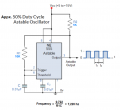
Data on the output stage is a bit scarce in that data sheet! But I think you can infer from "CMOS" that the output stage consists of two complementary MOSFETs in common source configuration. Each will have a different Rds(on) especially as it seems that the low output is far more capable than the high, but if all it is driving is the timing resistor then the ratio of Ton to Toff will be (Rtiming+Rds(on)Pch)/(Rtiming+Rds(on)Nch) which will tend to unity as Rtiming increases.
I wouldn't expect it to maintain accuracy if it was driving a load in addition to the timing resistor.
I still don't understand how people can think that that circuit would deliver a 50% duty cycle. Granted that CMOS variants would have outputs that swung closer to the rails, but people have been claiming that bipolar variants delivered a 50% duty cycle. I believed them. That's a mistake I don't plan to repeat.
 

AnalogKid

Joined Aug 1, 2013
12,158
The Nat Semi LMC555 datasheet doesn't specify a symmetrical output voltage swing.
True, but it comes close. The Output Voltage values in the table are not for symmetrical conditions, but it is clear that if the output (especially the high output) is lightly loaded, it is close to symmetrical; certainly closer than the bipolar version.

ak
 

sparky 1

Joined Nov 3, 2018
1,218
guptamridul477 said " I am using STMicroelectronics CHN NE555N KJW949 timer for it. " LMC being different.

If I have the right ST NE555, the temperature stability starts out good, anyway I think the NPO capacitor above was a good recommendation.
data sheet shows duty cycle in figure 14 however there is a different subheading for 50% duty cycle that has a formula given.
The timing inaccuracy in astable mode given in table 3 shows the SE555 has twice the temperature stability over the NE555.
The summary says the Temperature stability of 0.005% per °C but table 3 at 15V is 150ppm per Volt/ degree C
The thing to do is try running cool at 5V using the resistors and capacitors listed and warm it up to check if that is acceptable.
The resistors temco, the power source stability, the board and thermal design. I compare test of a 9 volt battery and LM7805 with alum heat sink.
Most frequency determining circuits only need a 3-4 mA just to take the chill off, the LM7805 output might read 5.xxx Volts after it warms up. You only want to sample a small output if accuracy is the goal. A driver will take the frequency and follow for a given load. As stated before, don't load the frequency oscillator. I know the data sheet says it will drive 200mA, however the application has some issues about accuracy.
General-purpose single bipolar timers (octopart.com)
 
Last edited:

panic mode

Joined Oct 10, 2011
5,015
that is good as it gets for an RC oscillator..
.
btw. if someone told me decades ago that 555 will still be discussed and sought after product more than a half a century after it was introduced, i would have hard time believing it... but obviously i would be wrong since RC timing is so simple and still sufficient for many uses. so it is amazing but not really surprising that legendary 555 is still kicking...
 

panic mode

Joined Oct 10, 2011
5,015
and that IS really nice... did not mean to let your design down, my comment was strictly based on part count and how close it got to required duty using 555 to generate "clock", without knowing load type.

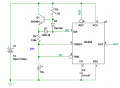
for circuit in #24 it was measured as 51.5% while LTspice shows 50.1%. but being analog, anything within 1% or so is "on the target" and i would not count on more.

to get really stable and accurate clock one need to move up from RC oscillator and use crystal oscillator and counter.
 

Ian0

Joined Aug 7, 2020
13,158
If you want a 555-type circuit that is guaranteed to be between 48% and 52% duty cycle, have a look at the IR2153. It does have symmetric on-resistances on its “output” pin, and also has UVLO, two handy outputs capable of 180mA (but with 1.2us switch-on delay), and the frequency is accurate within 6%
[edit] Now replaced by IRS2153
 

dl324

Joined Mar 30, 2015
18,362
Welcome to AAC!
but to be very clear no electronic circuit in this world will be ideal to generate 50% duty cycle
That's not true. All you have to do is make an oscillator at twice the desired frequency of what you want at 50% DC and use a flip flop to give a 50% DC.

Friendly suggestion. Try using paragraphs to organize your thoughts and use proper capitalization to make your posts easier to read.
 

MrChips

Joined Oct 2, 2009
34,871
Dear my name is liji I never used cmos circuits in my life seek some professional and sit next to him to understand how multivibrators are I have learnt op amp and oscillators but to be very clear no electronic circuit in this world will be ideal to generate 50% duty cycle you know why when you work with smt chips you need to have solid knowledge about p channel and n channel mosfets as whatever frequency such circuits make 3 - 12% of the frequency is drained through collector terminal of transistor yes you can get an ideal 50% duty cycle but for that you have to break your head with some good books all those stupid Data sheets which you go through are never used by any professional engineer anywhere it's just a tool to inculcate knowledge in novice people it's not that I am saying some bad words some 17 years back when I was in some school I happen to ask the same question to such professional and he scolded me I know dear that is your interest my project was fingerprint recognition system using Matlab (matrix laboratory) but the same teacher told me dear take this as an advice dear wherever you go anywhere all those gadgets they make they use intelligent people who know mathematics , vlsi and c assembly language what all things you see as smart watch android phone,iphones , satellite they do not use visual studio or Matlab it's as good as you use smartphone of 4k rs inr and you need to play games like what your friend is playing on sony ps console portable take this as an advice dear invest some time of yours learn books and seek some professional guy or lady who can really save your life when I was child like you teacher will not teach anything go library learn on your own and do not copy paste anyone's knowledge use your own brain atleast
More friendly suggestions, use periods, capitalize first letter of sentence, use paragraphs.
I am a professional engineer and I have to read datasheets all the time!
I also use MATLAB for many of my projects.
 

sparky 1

Joined Nov 3, 2018
1,218
you have to break your head with some good books all those stupid Data sheets which you go through are never used by any professional engineer anywhere it's just a tool to inculcate knowledge in novice people it's not that I am saying some bad words some 17 years back when I was in some school I happen to ask the same question to such professional and he scolded me I know dear that is your interest my project was fingerprint recognition system using Matlab (matrix laboratory)
The problem with accuracy on this NE555 can be addressed by following the information on the correct datasheet (lab notes).
Datasheets do not inculcate novice individuals into a conspiracy. Those who follow blindly came in with issues.
Advise about not using a datasheet is not very smart for someone claiming to be a math lab fingerprint theory guru.
Not seeing that it is not an LMC555 is further bad advise, when you lay your own trip on others, that has bad effects on individuals.

When it's time to work on the bench where accuracy is determined, the datasheet has information to test specifications
which are relevant to bench testing. Here it is not about how to climb the academic ladder to success by ignoring hardware.
The discovery, enthusiasm starts on basic projects. Have fun, reading engineering notes, patents and biographies
is like getting to know the engineer a little, it shows that you are balanced and not extreme, able to adapt. able to write technical articles.

Hans Camenzind - Wikipedia

What kind of bench instruments did he use? Are these technical instruments complimentary to viewpoint of microcontroller accuracy ?
Hans says: "I did it on the bench with a soldering iron" which is putting those lab notes into practice.
 
Last edited:

MisterBill2

Joined Jan 23, 2018
27,652
The solution for the exact 50% duty cycle was given in post #7, and I repeat it here: Use a flipflop, such as the CD4013, and operate the oscillator at twice the frequency. Why waste any time doing what at best is only good for one supply voltage and one temperature, and only for a while???
And why the nasty remark about reading data sheets?? GOOD ENGINEERS always reference the data sheets for whatever they do not know. Only fools guess. REAL ENGINEERS know when to read the data sheets.
AND why in the world waste time when the better solution is at hand???
 

MisterBill2

Joined Jan 23, 2018
27,652
The solution for the exact 50% duty cycle was given in post #7, and I repeat it here: Use a flipflop, such as the CD4013, and operate the oscillator at twice the frequency. Why waste any time doing what at best is only good for one supply voltage and one temperature, and only for a while???
And why the nasty remark about reading data sheets?? GOOD ENGINEERS always reference the data sheets for whatever they do not know. Only fools guess. REAL ENGINEERS know when to read the data sheets.
AND why in the world waste time when the better solution is at hand???
 
Top