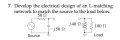
Please note , the frequency for this design problem is 900MHz
Here is my approach
1. To begin with, how to interpret the source impedance here . Is the cap in parallel or in series to the 50ohm resistor. Is it appropriate to consider the source impedance as 50-j50 .
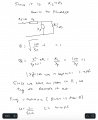
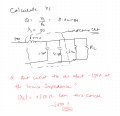
2. In my solution i am trying to resonate out the inductor on the load side because its in shunt and we cannot really absorb it given we need a L match network with Source->series->shunt->load . But i don't understand how one can absorb or resonate out the -j50ohm at the source
1. To begin with, how to interpret the source impedance here . Is the cap in parallel or in series to the 50ohm resistor. Is it appropriate to consider the source impedance as 50-j50 .
Think of it in terms of putting a black box around the source circuitry such that the terminals of the box are the outputs you are interested in. Then model this as an ideal voltage source in series with an impedance. That should give you the answer to your question.
This seems like an unusual problem because both the source and the load are complex.
You should really think about what you have been taught in the past for these problems first.
First, you need to figure out what kind of matching you want to do here. There are different solutions for different types. You may have been taught to do this in a certain way so you should look back at your notes. I'll assume you want to match the two exactly as they are shown in the diagram, without considering the complex conjugate for the load impedance.
To start, you need to figure out what the source impedance is and what the load impedance is. You can do that by considering the Thevenin equivalents. Call them zii and zoo, which will both be complex.
Since there are two L networks, you would have to consider both types and decide which is the best, if any.
The first we can call L1 would be with the first impedance Z1 in series with the source and the second impedance Z2 in parallel to the load. The second, L2, would be with the first impedance Z1 in parallel with the source and the second Z2 in series with the load. Note these are complex impedances and one or both could have both a real part and a complex part. This also implies that there will be some loss of signal at the output due to the real parts, if any, of both Z1 and Z2. Because the source and load impedances are both complex, I would think (but not prove) that Z1 and Z2 would have to be complex also with both real and imaginary parts for both.
Next, you could write an equation for the input impedance looking into the network of Z1 and Z2, with the load still connected but the source disconnected. Call that Zi. Then, write an equation for the input impedance looking into the network in reverse (looking into the output of the network of Z1 and Z2) with the source connected and the load disconnected. Call that Zo.
Now equate Zi=zii and Zo=zoo and you have two equations in two unknowns with the unknowns Z1 and Z2. The solutions will be complex.
You can go back and use the values you found to figure out the attenuation.
Since there will be two solutions for both L1 network and L2 network, you may end up with four solutions from which you can pick the one that you deem the best for your application.
You do have to realize here that when the questions get a little more involved, the instructor may want you to do this in a certain, set way, and that way may not be this way. That means if the instructor sees you doing it a different way it may be considered as simply wrong even though it perfectly matches the input to the output. This is one reason why we always ask for the student to provide some background information and if possible at least one attempt to solve it.

 Facebook
 Google
 GitHub
 Linkedin