Impedance calculation

Status
Not open for further replies.

crutschow

Joined Mar 14, 2008
38,549
If you drive the BASE with an IDEAL voltage source, then the output impedance is low.
However, if you drive the BASE with an IDEAL current source, then the output impedance is roughly the value of the 600 Ohm resistor.
Okay, that's an interesting point.
But the ideal source would have to drive the exact base current to give a current output, and that depends upon the variable Beta of the transistor.
And I've never seen an emitter-follower circuit driven by one.

If you use a collector output with a 600 ohm resistor in both collector and emitter, than the collector output will have a gain of 1 with a 600Ω output impedance, since the collector has a high dynamic impedance, looking like a current-source.
But the TS said he wanted an emitter follower circuit.
 
Last edited:

LvW

Joined Jun 13, 2013
2,031
If you drive the BASE with an IDEAL voltage source, then the output impedance is low.
However, if you drive the BASE with an IDEAL current source, then the output impedance is roughly the value of the 600 Ohm resistor.
Yes - that`s correct. However, in this case the circuit cannot be regarded as an emitter follower (as required in the original question).

Here is the expression for the output resistance at the emitter node when the base is NOT driven by an ideal voltage source:

r_out=Re||[(1/gm_e)+(R_b/β)]
with:
emitter resistor: Re,
transconductance: gm_e=d(Ie)/d(Vbe),
effective source resistance at the base node: R_b (including bias voltage determining resistors).

Comment: To me, it sounds like a contradiction to require an "emitter follower" (which, normally, is intended to use it as a buffer with a very low output resistance) together with an effective output resistance of 600 ohms.
Therefore, I think that the questioner eventually has misunderstood the specification:
Either he needs
* a unity gain amplifier (phase inversion allowed) with r_out=600 ohms , or
* an emitter follower with a fixed ohmic emitter resistor Re=600 ohms
 
Last edited:

MrAl

Joined Jun 17, 2014
13,722
Yes - that`s correct. However, in this case the circuit cannot be regarded as an emitter follower (as required in the original question).

Here is the expression for the output resistance at the emitter node when the base is NOT driven by an ideal voltage source:

r_out=Re||[(1/gm_e)+(R_b/β)]
with:
emitter resistor: Re,
transconductance: gm_e=d(Ie)/d(Vbe),
effective source resistance at the base node: R_b (including bias voltage determining resistors).

Comment: To me, it sounds like a contradiction to require an "emitter follower" (which, normally, is intended to use it as a buffer with a very low output resistance) together with an effective output resistance of 600 ohms.
Therefore, I think that the questioner eventually has misunderstood the specification:
Either he needs
* a unity gain amplifier (phase inversion allowed) with r_out=600 ohms , or
* an emitter follower with a fixed ohmic emitter resistor Re=600 ohms
I like your "Comment" that makes a lot of sense. This sounds like a school project though so it may just be for the pure exercise value which sometimes doesnt equate to anything truly practical. I like discussing all these aspects nonetheless so thanks for that comment. I'll explain my other points in the next post.
 

MrAl

Joined Jun 17, 2014
13,722
Okay, that's an interesting point.
But the ideal source would have to drive the exact base current to give a current output, and that depends upon the variable Beta of the transistor.
And I've never seen an emitter-follower circuit driven by one.

If you use a collector output with a 600 ohm resistor in both collector and emitter, than the collector output will have a gain of 1 with a 600Ω output impedance, since the collector has a high dynamic impedance, looking like a current-source.
But the TS said he wanted an emitter follower circuit.
As to your first paragraph, i anticipated you saying that because yes after all we dont usually drive a transistor with a current source, but that was just an experimental point, not a practical one per se, that shows us that something else might be happening. It doesnt mean we will drive it with an ideal current source.
Also, when you say you have never seen one driven by one, you are right again, but again that's not really the point the point is why does it behave so differently with a current source.

The amazing truth behind this is that we ALWAYS drive the transistor with a current source, just not an ideal current source. What i mean by this is that every source we use to drive a transistor has some impedance (or just resistance for this discussion) and so the complete picture of the output impedance depends on the drive source output impedance.
It's quite interesting and actually i think a very practical point because we often use voltage followers as a 'buffer' to buffer a higher impedance down to a lower impedance. The output impedance is actually lower, but it's interesting that it depends a lot on the drive source impedance.

The expression for this is as follows....
Zout=Rout=(R1*R2)/((B+1)*R2+R1)
where
R1 is the series base resistor value, and R2 is the emitter to ground resistor value.

A couple quick examples are with R1=0 where we see the output resistance go to zero.
The other is with very high R1 where we see the output resistance go to the value of R2.
So a quick table with R4=600 Ohms:
R1,Rout
0, 0.0 Ohms
100, 0.99 Ohms
1000, 9.7 Ohms
10k, 85 Ohms
100k, 374 Ohms
1Meg, 566 Ohms
infinite, 600 Ohms

Those are all with Beta=100 for example. With lower B, Rout goes up, with higher B, Rout goes down except for R1 infinite or R1 zero.

Of all of these i would say that the 1k, 10k, and 100k input resistor values are of a more practical concern.

One of the main points you brought out though was that R4=600 Ohms does not mean the output impedance is 600 Ohms.
 

crutschow

Joined Mar 14, 2008
38,549
Zout=Rout=(R1*R2)/((B+1)*R2+R1)
That expression doesn't include the variation in intrinsic emitter output resistance with current (≈26mV/Ie).
we ALWAYS drive the transistor with a current source, just not an ideal current source.
That's a matter of definition, of course.
Using the Thevenin equivalent, it can be a voltage-source with a series resistance or a current-source with a parallel resistance, take your pick.

Certainly, from a practical viewpoint, we need to consider the source resistance if it gets above a few kΩ, if you want the minimum output impedance.
For a high source resistance, you could use a Darlington or Sziklai complementary-pair to reduce the effect of the input impedance by a factor roughly equal to the Beta of the second transistor.
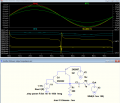
Of those two options, the Sziklai pair gives the lowest output impedance (simulation below for an Ie of 1mA).
And. of course, a MOSFET source-follower circuit is largely unaffected by the source resistance for DC or low frequency signals.

Generally the parallel equivalent impedance of the usual input bias network, would not be much more a few tens of kΩ for good bias stability, so that would be the upper limit on the input resistance.

1641668869859.png
 
Last edited:

MrAl

Joined Jun 17, 2014
13,722
That expression doesn't include the variation in intrinsic emitter output resistance with current (≈26mV/Ie).
That's a matter of definition, of course.
Using the Thevenin equivalent, it can be a voltage-source with a series resistance or a current-source with a parallel resistance, take your pick.

Certainly, from a practical viewpoint, we need to consider the source resistance if it gets above a few kΩ, if you want the minimum output impedance.
For a high source resistance, you could use a Darlington or Sziklai complementary-pair to reduce the effect of the input impedance by a factor roughly equal to the Beta of the second transistor.
Of those two options, the Sziklai pair gives the lowest output impedance (simulation below for an Ie of 1mA).
And. of course, a MOSFET source-follower circuit is largely unaffected by the source resistance for DC or low frequency signals.

Generally the parallel equivalent impedance of the usual input bias network, would not be much more a few tens of kΩ for good bias stability, so that would be the upper limit on the input resistance.

View attachment 257151
Yes that expression is a network analysis using the current controlled current source model of transistor. There is no base emitter diode in that model, and if you do some simulations you should see something similar to that except at the small resistance values. That's how i can state Rout=0 for some R base resistors.

It doesnt matter if you select series resistance and voltage source or parallel resistance and current source, we know that. None of that matters here. What matters is what the output resistance is. I was trying to make it clear that even with the simpler model there is variation due to base series resistance, and there is always some series base resistance, and on top of that, it is a practical concern because these circuits are often used as buffers to get a larger current drive from a smaller current drive (current gain).

You can include the 'extra' resistance you talked about if you like, no problem, but i dont believe it is necessary in order to understand the influence of the base series resistance or output impedance of the previous stage or drive circuit. I have a complete writeup of the circuit including re elsewhere on this forum i can probably find it and include that too, but it would just change the small end resistance values i believe and not add much to the discussion about how the series base resistance affects the output resistance, it will just get more precise. So instead of (maybe) 1 Ohm we might see 1.1 Ohm (LOL).
You can go ahead and quote some values if you like should be interesting too.

But hey thanks for bringing all this up i think that helped everyone understand this better.

[LATER]

Here are some measured values using a 2N2222A and various base resistor values and compared with the calculations using the simple model and constant Beta=240...

With series base resistor values 10 Megohms down to 10 Ohms.

Base resistor values used:
[10M,1M,100k,10k,1k,100,10]

Results using the same order...

Measured Rout:
[592,520,246,47.7,9.01,2.49,0.982] (Ohms)

Calculated Rout with B=240 constant:
[593,535,272,45.9,4.93,0.497,0.0497] (Ohms)

Note that B the measured Beta goes down as the series base resistor value goes down but that is not included in the calculation part.
Supply voltage 20v, Vin=20v.

Hey anybody see WBaln? He usually likes to get in on these discussions but havent seen him post for some time now.
 
Last edited:

LvW

Joined Jun 13, 2013
2,031
You can include the 'extra' resistance you talked about if you like, no problem, but i dont believe it is necessary in order to understand the influence of the base series resistance or output impedance of the previous stage or drive circuit.
Sorry - I cannot agree. Let`s take a simple example:

* Series base resistor (driving voltage source): Rs=5k
* Voltage divider (DC bias) at the base node Ra||Rb=5k (realistic values)
* Effective base resistor: RB=5k||5k=2.5k
* Current gain beta=100
* Emitter DC current Ie=1mA and 1/gm=Vt/Ie=26 Ohms
* Output resistance at the E-node: r_out=(1/gm)+RB/100=(26+25) Ohms.

Neglecting the contribution of 1/gm would cause a 50% error.

(Comment: As you have mentioned the problem of understanding "the influence of the base series resistance", it is interesting to ask why we have to divide this resistance by the current gain. Using the rules of system theory, we can explain this fact with a feedback effect caused by the effective series resistance RB when analyzing the circuit from the emitter node. That means: We can consider the circuit as common-base).
 
Last edited:

MrAl

Joined Jun 17, 2014
13,722
Sorry - I cannot agree. Let`s take a simple example:

* Series base resistor (driving voltage source): Rs=5k
* Voltage divider (DC bias) at the base node Ra||Rb=5k (realistic values)
* Effective base resistor: RB=5k||5k=2.5k
* Current gain beta=100
* Emitter DC current Ie=1mA and 1/gm=Vt/Ie=26 Ohms
* Output resistance at the E-node: r_out=(1/gm)+RB/100=(26+25) Ohms.

Neglecting the contribution of 1/gm would cause a 50% error.

(Comment: As you have mentioned the problem of understanding "the influence of the base series resistance", it is interesting to ask why we have to divide this resistance by the current gain. Using the rules of system theory, we can explain this fact with a feedback effect caused by the effective series resistance RB when analyzing the circuit from the emitter node. That means: We can consider the circuit as common-base).
Didnt you read my entire post or at least try to understand the point i was making?

I already provided test data and compared it to calculated data using the simple model and it showed that not only can the error be 50 percent, it can even be greater than that. However, that is for certain conditions and those conditions are not always practical. Compare the measurements and calculated data at Rin=10Meg and at Rin=10 Ohms. For high Rin the output resistance (impedance) is greatly affected but for low Rin the output is very low. That's the main point i was making. The explicit accuracy is moot.

Again, it is not about the explicit accuracy of the model or formula, it is about the general theory of how the base series resistance affects the output impedance and this is especially interesting in the case of a buffer amplifier. These kinds of approximations are typical for understanding certain aspects of a circuit without having to calculate every single effect to get a 0.1 percent result all the time.

If you care to reread my previous post, look for the Rout measurements and compare to the calculated results for Rout and see the difference which should be pretty darn clear :)
After that if you care too, think about how the series base resistor value affects the Rout for both measurements and calculated data in a general way. That is, high Rin results in higher Rout, and low Rin results in lower Rout. I used a constant 600 Ohm load from emitter to ground because that was one of the things that we were talking about doing previously.

Also, feel free to add your own calculated data. I used the following values:
20v Vcc, 20v Vin.
For all measurements, a 2N2222A transistor spice model.
For all calculations Beta=240 constant (that is 'B' in the formula) and the following base series resistor values:
10M, 1M, 100k, 10k, 1k, 100, and 10 Ohms.
600 Ohm emitter to ground resistor for both measurements and calculated data.
BTW the formula for the calculated Rout is based on the transistor model as a current controlled current source with gain factor 240. There is nothing special about this calculation it was gleaned from a regular network analysis using that simple transistor model. That means that anyone using that model would always come up with the exact same formula.

Lastly, using the same formula for a series base resistor of 2.5k results in Rout=23.8 Ohms with Beta=100,
and using a series base resistor of 5k results in Rout=45.7 Ohms. These results will not and are not expected to match a more 'exact' calculation. However, going up in base resistor value the results get closer.
The trend in Rout however follows the same basic characteristic for either formula.
 
Last edited:

LvW

Joined Jun 13, 2013
2,031
Didnt you read my entire post or at least try to understand the point i was making?
I'm sorry if you misunderstood my contribution - but I probably also expressed myself in a very misleading way.
And you are right, I did not analyze all the numerical examples in your post, because they cannot tell me anything new.
This is , because the formula I mentioned in my previous post ( r_out=Re||[(1/gm_e)+(R_b/β)] ) says it all and shows under which conditions the contribution of resistors acting at the base node dominates.
In summary: I misinterpreted your statement (" You can include the 'extra' resistance you talked about if you like, no problem, but i dont believe it is necessary ....") and took it as a general statement. My mistake - I am sorry.

Back to the technical discussion: As one of your examples you have mentioned a resistor at the base as large as 10 MegOhms. In this case its contribution to the output resistance would be in the range of (50...100k). That means: It would be the task of the emitter resistor Re alone to provide a voltage buffer function. Hence, the resistor Re should be as low as possible.

Comment: May I make another comment (I know I am addressing a critical issue) ?
The approach of the calculation via a negative feedback loop (see the last comment to my post #27) clearly shows again that the transistor is a voltage controlled device.
 
Last edited:

MrAl

Joined Jun 17, 2014
13,722
I'm sorry if you misunderstood my contribution - but I probably also expressed myself in a very misleading way.
And you are right, I did not analyze all the numerical examples in your post, because they cannot tell me anything new.
This is , because the formula I mentioned in my previous post ( r_out=Re||[(1/gm_e)+(R_b/β)] ) says it all and shows under which conditions the contribution of resistors acting at the base node dominates.
In summary: I misinterpreted your statement (" You can include the 'extra' resistance you talked about if you like, no problem, but i dont believe it is necessary ....") and took it as a general statement. My mistake - I am sorry.

Back to the technical discussion: As one of your examples you have mentioned a resistor at the base as large as 10 MegOhms. In this case its contribution to the output resistance would be in the range of (50...100k). That means: It would be the task of the emitter resistor Re alone to provide a voltage buffer function. Hence, the resistor Re should be as low as possible.

Comment: May I make another comment (I know I am addressing a critical issue) ?
The approach of the calculation via a negative feedback loop (see the last comment to my post #27) clearly shows again that the transistor is a voltage controlled device.
Ok thanks for making that clearer i understand your point much better now.
Maybe you could specify what you are using for gm_e and Beta.

I'll quote something else now...
The approach of the calculation via a negative feedback loop (see the last comment to my post #27) clearly shows again that the transistor is a voltage controlled device.
I am not entirely sure what you mean here. Are you saying that with your calculation approach that the transistor is taken to be a voltage controlled device, or are you stating categorically that a transistor is a voltage controlled device?
I ask because there are different views on the model of the transistor in general im pretty sure you know this though. The model i used was a current controlled current source, but the more advanced model uses that as well as a bunch of other stuff which im sure you know includes diodes and other things and even models the saturation characteristics.
Physically, sometimes it is stated categorically that a transistor is a voltage controlled device and sometimes a current controlled device. The voltage controlled device idea is good because it more or less expounds on the idea that a field starts all the action, and that is probably a good view. There is current involved also during the ramp up time, but i think maybe during that time the voltage action is more responsible for any reaction although strictly speaking it takes both voltage and current because the voltage can not build up without a flow of at least some current, no matter how small, so it's really a matter of energy. I can still envision however a tiny tiny current (1pa maybe?) that causes the voltage to ramp up to 0.5v or so and start conduction, and so we would be comparing 0.5 unit to 1p unit which is several orders of magnitude lower, and in many cases like that we like to state the higher value is most responsible for any reaction. So to recap just a little, we would be using 0.000000001 amp to ramp the voltage up (albeit very slowly) to 0.5 or 0.6v so the unit values are different by a factor of billions or something, so the larger one would be deemed the most important. Nevertheless, the current controlled view is very handy and i can include a few other things too to match up pretty well with simulations even the DC biasing part and saturation part of the response.

Up next: The tiny programmable transistors being developed could change a lot because each transistor can be programmed. There's a few articles on the web that can explain this better than i can.
Really though there are so many new ideas coming out i cant keep up anymore. Transistors that work by magnetic fields, transistors that work with light instead of electron flow, who knows what future computers are going to have. AMD has a 4.5nm process now (i think it is 3d too), Intel trying to keep up, it's amazing.
 
Status
Not open for further replies.
Top