Impedance calculation

Status
Not open for further replies.

Thread Starter

naluhat

Joined Dec 17, 2021
2
Hey, can anyone help me with this?

I have to make a emitter follower circuit.

I have to have a 600 ohm output impedance
10k input impedance
12V DC
20Hz
With BC547B transistor

I have to decide how much the resistors have to be.
I only know how to find impedances with the help of the resistors, not the other way around.

If someone just can help me with math formulas, I would be happy
 

Papabravo

Joined Feb 24, 2006
22,058
Hey, can anyone help me with this?

I have to make a emitter follower circuit.

I have to have a 600 ohm output impedance
10k input impedance
12V DC
20Hz
With BC547B transistor

I have to decide how much the resistors have to be.
I only know how to find impedances with the help of the resistors, not the other way around.

If someone just can help me with math formulas, I would be happy
You know how to work the problem when there is a unique solution. That is the resistors determine the impedances. Your problem has many solutions, and a particular solution requires the independent choice of one or more component values. When you make the appropriate choices you can find the remaining values with algebra. The formulas you will use depend on the independent choices you make so that the number of unknowns is equal to the number of equations.
 

MrAl

Joined Jun 17, 2014
13,672
Hey, can anyone help me with this?

I have to make a emitter follower circuit.

I have to have a 600 ohm output impedance
10k input impedance
12V DC
20Hz
With BC547B transistor

I have to decide how much the resistors have to be.
I only know how to find impedances with the help of the resistors, not the other way around.

If someone just can help me with math formulas, I would be happy
Some questions come up as to what you are allowed to do.
For one, you quote the transistor "With BC547B transistor" so do you have to use some advanced model or can you get away with just using an approximate Beta for the transistor?

I ask because it gets pretty simple if you can assume a fixed Beta. Using ErorGibbs's idea i can come up with an approximate calculation that gives be some resistor values, then when it test it with the network equations i find the input impedance to be within 0.2 percent, and that is 2 tenths of 1 percent which is pretty good for a quick approximation knowing a little about how the currents in a transistor work out mathematically.
If you wanted to, you could get an exact value of 10k input impedance but you probably dont need that.

So i guess the main point is, try using EricGibbs's idea which he mentioned in his post.
 

Thread Starter

naluhat

Joined Dec 17, 2021
2
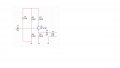
I made it like this and it worked.
When I made the circuit and solder it, it had some PS noise but corrected it with a capacitor on the PS.
Thanks for the help, I appreciate it
 

Attachments

MrAl

Joined Jun 17, 2014
13,672
I made it like this and it worked.
When I made the circuit and solder it, it had some PS noise but corrected it with a capacitor on the PS.
Thanks for the help, I appreciate it
Hello,

I also have to ask what R3 is for. That may drop the collector voltage too low you might check that.

Also just wondering if you calculated the approximate input impedance using that 1uf input capacitor.

I was surprised to see that the Beta for that transistor has quite a spread. They quote 110 to 800. That will have an effect on the input impedance.
 

crutschow

Joined Mar 14, 2008
38,336
assume the emitter resistor is 600R
The output impedance for that would be much less then 600Ω, since it is in parallel with the emitter-follower output impedance.
You need to determine the emitter output impedance at its operating point and then add a series resistance with that to give the desired 600Ω.
 

ericgibbs

Joined Jan 29, 2010
21,397
The output impedance for that would be much less then 600Ω, since it is in parallel with the emitter-follower output impedance.
Hi Carl,
I know that the Zout will be much lower than 600R, etc. :rolleyes:

The TS was looking for some starting point, which I suggested, not as an actual Zo value.
He hopefully can derive the component values and home in on the actual value.

E
 

LvW

Joined Jun 13, 2013
2,000
The output impedance for that would be much less then 600Ω, since it is in parallel with the emitter-follower output impedance.
You need to determine the emitter output impedance at its operating point and then add a series resistance with that to give the desired 600Ω.
Yes - much much less than 600 Ohms.
The output resistance is r_out=RE||(1/gm) with transconductance gm=d(Ie)/d(Vbe)=Ie/Vt.
Example: Ie=1mA gives 1/gm=Vt/Ie=25 Ohms.
 

MrAl

Joined Jun 17, 2014
13,672
The output impedance for that would be much less then 600Ω, since it is in parallel with the emitter-follower output impedance.
You need to determine the emitter output impedance at its operating point and then add a series resistance with that to give the desired 600Ω.
If you consider the emitter follower transistor part to be a current source, then it has infinite impedance and of course that means it does not contribute to the 600 Ohms. That's theory of course so maybe you can do a simulation and see if it varies much. I did a calculation i'll can show later.
 

crutschow

Joined Mar 14, 2008
38,336
If you consider the emitter follower transistor part to be a current source,
Can't do that.
An emitter-follower is not a current source, it looks like a voltage source (the output voltage changes very little with a change in output load).
The output impedance of an emitter-follower is thus quite low.

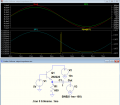
Edit: Below is the simulated output impedance for a 2N2222 running at about 7mA operating current (blue trace).
The output impedance is determined by applying a small AC voltage (red trace) to the emitter and dividing that by the resulting V3 current (green trace)
The output impedance (yellow trace) is only about 4Ω. (The spike is due to the calculation blowing up at the voltage and current zero crossing).

This totally swamps the 600Ω emitter resistor that is functionally in parallel with the emitter resistance.

I think the ideal silicon transistor emitter-follower output impedance is something like 26mV/Ie at room temperature where Ie is the emitter current.

So, if you want a 600Ω output impedance for this circuit than you need to put a 596Ω resistor in series with the output.

1641523109301.png
 
Last edited:

LvW

Joined Jun 13, 2013
2,000
An emitter-follower is not a current source, it looks like a voltage source (the output voltage changes very little with a change in output load).
The output impedance of an emitter-follower is thus quite low.
Yes - for Ie=1mA the emitter provides an output resistance of 25 Ohms only (as shown in my post#10)
 

MrAl

Joined Jun 17, 2014
13,672
Can't do that.
An emitter-follower is not a current source, it looks like a voltage source (the output voltage changes very little with a change in output load).
The output impedance of an emitter-follower is thus quite low.

Edit: Below is the simulated output impedance for a 2N2222 running at about 7mA operating current (blue trace).
The output impedance is determined by applying a small AC voltage (red trace) to the emitter and dividing that by the resulting V3 current (green trace)
The output impedance (yellow trace) is only about 4Ω. (The spike is due to the calculation blowing up at the voltage and current zero crossing).

This totally swamps the 600Ω emitter resistor that is functionally in parallel with the emitter resistance.

I think the ideal silicon transistor emitter-follower output impedance is something like 26mV/Ie at room temperature where Ie is the emitter current.

So, if you want a 600Ω output impedance for this circuit than you need to put a 596Ω resistor in series with the output.

View attachment 257011
Yeah that makes sense i'll have to look at the calculations again.
If we drive the base up by a theoretical 1v then the emitter goes up by a theoretical 1v regardless of output load, theoretically putting small quantities aside.
 

MrAl

Joined Jun 17, 2014
13,672
Which roughly corresponds to the theoretical 26mV/Ie.
Yeah except for one small detail. It's not quite that simple. Apparently why you got one result and i got just the opposite is because it is an either/or case, where both are correct depending on the entire circuit configuration.

If you drive the BASE with an IDEAL voltage source, then the output impedance is low.
However, if you drive the BASE with an IDEAL current source, then the output impedance is roughly the value of the 600 Ohm resistor.

What this means in reality is what i found out about amplifiers in general, and that is that sometimes the output impedance depends highly on the input impedance, and vice versa as well.
So what the base current source tells us is that if the circuit includes a relatively large series resistance, then the output impedance is partly determined by the 600 Ohm resistor and partly by the base resistor.
For example, if we went as high as 1Megohm for the series base resistor we would probably see the output impedance as being close to 600 Ohms.
 

crutschow

Joined Mar 14, 2008
38,336
hi,
The TS was asking for help in realizing a 600R output impedance value.

Post #5, claims he has it working.
It may "work" as an amplifier, but our point is, it doesn't have the 600 ohm output impedance he wanted.
It may have a nominal 600Ω emitter resistor but that's not the equivalent output resistance.
That's likely closer to about 5Ω for the bias conditions of his posted circuit.
Is that not clear?
 
Last edited:
Status
Not open for further replies.
Top