Image frequency in a Mixer

Thread Starter

kalemaxon89

Joined Oct 12, 2022
389
Let's talk about mixer.
A cosine wave is used in the mixer for the local oscillator, the input to RF, and of course the output.
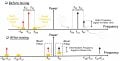
The image frequency problem of a mixer is shown in this picture:
SmartSelect_20240814_212938_Samsung Notes.jpg

As clear as the image is, I cannot fully understand it.

A variable local oscillator (synthesizer) chooses a particular input channel of the band (freq_oscill = freq_input - freq_intermediate).
In the case of the mixer in question there is only one input that needs to be down converted to lower freq.
So: local oscillator will be distant freq_intermediate from freq_input and also distant freq_intermediate from freq_image (undesired).

I don't understand where this image frequency arises ...does it exist only at RF where there is a mixer? ..if yes, it seems strange to me, since a mixer is like a "moltiplication" between signals .. I should also see it on matlab when I multiply two signals with different frequency
 
Last edited:

Ya’akov

Joined Jan 27, 2019
10,226
Both \(f_{image}+f_{IF}\) and \(f{image}-f_{IF}\) will result in \(f_{LO}\)—the phase of the LO doesn't affect this. That's why the unwanted image needs to be filtered.

I am not sure where your confusion lies.
 

MrAl

Joined Jun 17, 2014
13,667
Let's talk about mixer.
A cosine wave is used in the mixer for the local oscillator, the input to RF, and of course the output.
The image frequency problem of a mixer is shown in this picture:
View attachment 329284

As clear as the image is, I cannot fully understand it.

A variable local oscillator (synthesizer) chooses a particular input channel of the band (freq_oscill = freq_input - freq_intermediate).
In the case of the mixer in question there is only one input that needs to be down converted to lower freq.
So: local oscillator will be distant freq_intermediate from freq_input and also distant freq_intermediate from freq_image (undesired).

I don't understand where this image frequency arises ...does it exist only at RF where there is a mixer? ..if yes, it seems strange to me, since a mixer is like a "moltiplication" between signals .. I should also see it on matlab when I multiply two signals with different frequency
Hello,

Just to add to the discussion a little...

Are you talking about amplitude modulation?
If so, I think there are three basic outcomes:
-((cos(t*(w2+w1))-cos(t*(w2-w1)))*A*B)/2
((cos(t*(w2+w1))+cos(t*(w2-w1)))*A*B)/2
((sin(t*(w2+w1))-sin(t*(w2-w1)))*A*B)/2

Taking a quick look, we can see that in each case we end up with frequencies w2+w1 and w2-w1. Since the resulting amplitude is always A*B, both of these components have equal amplitude so if we only want one of those frequencies, we are stuck with filtering one of them out somehow.
One is usually called the carrier and the other one the message frequency. The carrier is usually a higher frequency than the message frequency.
Just for example, if we used a bandpass filter with center frequency of w2+w1 we could reduce the amplitude of the w2-w1 frequency.
 

Thread Starter

kalemaxon89

Joined Oct 12, 2022
389
Hello,

Just to add to the discussion a little...

Are you talking about amplitude modulation?
If so, I think there are three basic outcomes:
-((cos(t*(w2+w1))-cos(t*(w2-w1)))*A*B)/2
((cos(t*(w2+w1))+cos(t*(w2-w1)))*A*B)/2
((sin(t*(w2+w1))-sin(t*(w2-w1)))*A*B)/2

Taking a quick look, we can see that in each case we end up with frequencies w2+w1 and w2-w1. Since the resulting amplitude is always A*B, both of these components have equal amplitude so if we only want one of those frequencies, we are stuck with filtering one of them out somehow.
One is usually called the carrier and the other one the message frequency. The carrier is usually a higher frequency than the message frequency.
Just for example, if we used a bandpass filter with center frequency of w2+w1 we could reduce the amplitude of the w2-w1 frequency.
Hi.
My question refers to where and how the image frequency is created

Tell me if I understood the concept correctly:
When the RF signal is mixed with the LO signal, the nonlinearities of the latter produce two frequencies: the sum and the difference of the RF and LO frequencies. The desired signal is usually the difference frequency. However, there’s another frequency, called the image frequency, which is the same distance from the LO frequency but on the opposite side. This image frequency can also produce the same IF, leading to interference.

For example, if the LO is set to 110 MHz and the desired RF signal is at 100 MHz, the IF might be 10 MHz. However, a signal at 120 MHz (the image frequency) would also produce an IF of 10 MHz, causing interference

@MrAl
@Ya’akov
 

MisterBill2

Joined Jan 23, 2018
27,164
For starters, consider that the mixing process is a non-linear operation. It is multiplication of amplitudes, rather than summing, which is what you get in a good audio mixer, which is a totally linear system. It provides a SUM of the amplitudes as the output because it is linear.
That is why the scheme of using an analog switch as a frequency mixer works so well.
It is the multiplication of amplitudes that produces the image frequencies. So the expression is rather complex.
 

MrAl

Joined Jun 17, 2014
13,667
Hi.
My question refers to where and how the image frequency is created

Tell me if I understood the concept correctly:
When the RF signal is mixed with the LO signal, the nonlinearities of the latter produce two frequencies: the sum and the difference of the RF and LO frequencies. The desired signal is usually the difference frequency. However, there’s another frequency, called the image frequency, which is the same distance from the LO frequency but on the opposite side. This image frequency can also produce the same IF, leading to interference.

For example, if the LO is set to 110 MHz and the desired RF signal is at 100 MHz, the IF might be 10 MHz. However, a signal at 120 MHz (the image frequency) would also produce an IF of 10 MHz, causing interference

@MrAl
@Ya’akov
Hi,

That's an interesting question.

The range of FM radio frequency is 88 to 108 MHz. The IF is 10.7 MHz but I'll use 10 MHz as an example.
At 88 MHz to get an IF of 10 MHz you need either an LO of 78 MHz or 98 MHz.
At 100 MHz to get an IF of 10 MHz you either need the LO to be 90 MHz or 110 MHz.
At 108 MHz to get an IF of 10 MHz you need either an LO of 98 MHz or 118 MHz.

Thus at 88 to 108 MHz you need an LO range of either 78 to 98 MHz, or a range of 98 to 118 MHz.
That looks like there would never be an overlap as your question was addressing except for that 98 MHz.
That means the design looks like it would be using one or the other but not both.
 

MisterBill2

Joined Jan 23, 2018
27,164
Once again, in a frequency mixer it is the amplitudes that are being multiplied. That happens because of the non-linear operation. So it is not equal to sine (W1+w2), but rather (sine W1) X (sineW2). I hope that makes some sense.
 
Top