I’m bored

Thread Starter

Hymie

Joined Mar 30, 2018
1,347
You have a piece of board measuring 1.6m by 0.9m.

Your task is by using a single cut, cutting the board into two pieces - such that when the pieces are joined together they form a square board measuring 1.2m by 1.2m.
 

oz93666

Joined Sep 7, 2010
742
Dam ... I've spent to long on this already !!!

I first thought of a staircase type cut .....one piece has to be flipped

Now I think not necessary to have steps all the way .... the main cut must be 45 degrees but with step/s on the end
 
Last edited:

oz93666

Joined Sep 7, 2010
742
We must assume the cut is not straight , can go right up to the edge of the board and turn a sharp angle back to cutting again
 

cmartinez

Joined Jan 17, 2007
8,760
You have a piece of board measuring 1.6m by 0.9m.

Your task is by using a single cut, cutting the board into two pieces - such that when the pieces are joined together they form a square board measuring 1.2m by 1.2m.
o_O ... I believe the statement about the single cut, but I'm not sure about the "only two pieces" requirement ... a possible approach for me would be to fold the board into a certain figure, and then perform the single cut, so as to obtain several pieces that will form the required square.

Question, have you actually figured out a solution to the problem, or are you just teasing us?
 

Thread Starter

Hymie

Joined Mar 30, 2018
1,347
To clarify things – the single cut of the board results in two separate pieces, when these two pieces are joined together they form a square 1.2m x 1.2m.

Since the two areas (1.6m x 0.9m and 1.2m x 1.2m) are equal, no material is lost in the cut.

The cut line may take any direction over the board, but results in only cutting the board into two pieces.
 

jpanhalt

Joined Jan 18, 2008
11,087
The question about a zig-zag cut was raised, but not answered by Hymie. Most of Martin Gardner's tiling puzzles used zig-zag cuts. So long as the cuts are contiguous, changing direction does not constitute a separate cut in my view.
 

MrChips

Joined Oct 2, 2009
34,809
A "single cut" would generally be expected to mean a single straight cut.
In order to make a zig-zag cut one would require a special tool such as a key-hole or jig saw.
 

jpanhalt

Joined Jan 18, 2008
11,087
Why not simply dispel the confusion: Is a zig-zag (e.g., staircase) allowed?

As I mentioned, most of these tiling/geometry puzzles allow such cuts, and that is the only way I saw it being solved. It occurred to me that an arc cut might be considered a single cut (or a series of very small cuts that are contiguous), but I could not solve it with that either.

BTW: I do not consider a scroll/coping saw a special tool.
 

Thread Starter

Hymie

Joined Mar 30, 2018
1,347
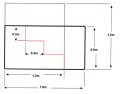
For those who have not visualised the solution I offer the attached diagram which shows the single cut as the solid red line.Board Cut.jpg
 

MrAl

Joined Jun 17, 2014
13,703
For those who have not visualised the solution I offer the attached diagram which shows the single cut as the solid red line.View attachment 158047
Hello,

Is that the right solution?
Something doesnt look right.

Oh never mind, i thought you where flipping the right side board piece but now i see that it is just a translation shift: up 0.3m and left 0.4m after the cut.
 

MrAl

Joined Jun 17, 2014
13,703
Hello again,

Hey the question comes up are there any other solutions?
If not, is there a way to prove it?

I would guess that everyone here has already seen the triangle folding into a square problem already, where you are allowed two folds. It's also an interesting geometrical way to view finding the area of a triangle with just one measurement.
 

Thread Starter

Hymie

Joined Mar 30, 2018
1,347
Hello again,

Hey the question comes up are there any other solutions?
If not, is there a way to prove it?

I don’t know if there are other solutions, there maybe – the problem did not disallow flipping one of the pieces of board.
 

WBahn

Joined Mar 31, 2012
32,823
A "single cut" would generally be expected to mean a single straight cut.
In order to make a zig-zag cut one would require a special tool such as a key-hole or jig saw.
Many puzzles like this rely heavily on ambiguous rules precisely because how most people will interpret them will preclude finding a solution. As long as a technically correct interpretation allows the solution, they are covered.
 
Many puzzles like this rely heavily on ambiguous rules precisely because how most people will interpret them will preclude finding a solution. As long as a technically correct interpretation allows the solution, they are covered.
To speak in such a manner truly implies you would know the answer to the riddle with having to impose your oratorical skills upon us. Seriously dude. Speak dumb. We like that.
 
Top