Ideas needed for power supply

Thread Starter

AlanKay

Joined Dec 25, 2010
7
Hi everyone, and ty for taking time to read this.

I have a bit of a strange one. I have an old boat with an outboard around 1960's. The motor charges a battery , normal deep cycle marine battery, but the voltage from the rectifier fluctuates to about 15V depending on revs etc.

The radio equipment goes into protection mode around 14.5V. I need to be able to give the radio 12V @ 10A, keeping in mind the battery may be at 12.6V and I cannot really afford to have a diode block to just drop the voltage to 'acceptable levels'.

Any ideas would be appreciated as I cannot really modify the charger circuit in the motor.

Many thanks
Alan
:confused:
 

Thread Starter

AlanKay

Joined Dec 25, 2010
7
The battery is good, It's just the design of the outboard motor being so old it does not have a regulator inbuit. I was hoping to have the battery/outboard supply a regulator that will sit at say 12.5V steady but have 10A for the VHF as needed. No real pics are available.

Thanks
 

R!f@@

Joined Apr 2, 2009
10,007
Without the data or specs on what you have, I cannot recommend anything.

That is why I asked you to show some pics of what you have.
 

#12

Joined Nov 30, 2010
18,224
Your voltage supply goes from .6V more than minimum required to .5 more than maximum allowed and you "cannot really afford to have a diode block to just drop the voltage to acceptable levels".

Why can't you afford to use the most obvious and cheapest method?
 

SgtWookie

Joined Jul 17, 2007
22,230
It would help to know the year, make and model/horsepower of the outboard motor.

What is the gauge of wiring from the battery to the engine? If it's too small for the length, you can wind up with surges due to the inductance and resistance of the wires.

Lead-acid batteries need to be charged at a voltage higher than their rating. 14.1v-14.5v is a typical charging voltage, and 13.5v-13.8v is a typical "float" voltage.
 

Thread Starter

AlanKay

Joined Dec 25, 2010
7
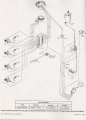
Attached is a diagram of the wiring of the outboard charge circuit. As suggested, I was thinking of adding an automotive regulator after the rectifier stage.


"Your voltage supply goes from .6V more than minimum required to .5 more than maximum allowed and you "cannot really afford to have a diode block to just drop the voltage to acceptable levels".
Why can't you afford to use the most obvious and cheapest method? " -- I did look at that as an option but figured of I introduce a voltage drop of say 2.1V so keep the 15V charge spikes at 12.9V, then at rest the battery may only give me 10V ish after the diodes. I did not want that voltage drop. I would also prefer to regulate the output and know what it is.
 

Attachments

Last edited:

#12

Joined Nov 30, 2010
18,224
MBR1635
16 amp rating at 60 volts reverse survival.
conducts 10 amps at 25 C with a forward voltage drop of .56 volts

just an idea, as requested.
 

Attachments

Last edited:

debe

Joined Sep 21, 2010
1,419
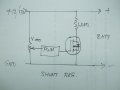
I will be watcing this thread with interest. Typical O/B charge circuits are just a set of windings & rectifier & un regulated. An automobile regulator wont work here. The problem is when the battery is fully charged the voltage will rise to 15v or more at high engine RPM. One crude way is to fit a shunt type of regulator to the circuit. Therse a challenge???
 
Last edited:

Thread Starter

AlanKay

Joined Dec 25, 2010
7
I was thinking of it is going to be a problem doing it with a stand alone regulator, to use a relay that will cut in above say 14V and introduce a few diodes in series to drop the voltage, then drop out when the voltage drops again.
 

thatoneguy

Joined Feb 19, 2009
6,359
LM5118 Buck-Boost Automotive Regulator

With the right MOSFET(s) on the output, you may be able to get 10A out of it. The demo board with SMD MOSFETs is only 3A.

You would need to provide a good deal of external circuitry, but it would supply 12VDC Regulated from Ultra-wide input voltage range from 3V to 75V

The "Catch" is that 10 Amp requirement, you'd need pretty good sized (expensive) external components.
 

marshallf3

Joined Jul 26, 2010
2,358
The LM5118 looks promising but I think a plain automotive regulator is almost a plug in 3-wire solution, it'll make things much easier on your battery too which will also help to regulate the voltage to remain within an acceptable level for anything else powered off the system. You could probably even find a good one at a "you pull it" auto salvage yard for $5 or less.
 

thatoneguy

Joined Feb 19, 2009
6,359
The LM5118 looks promising but I think a plain automotive regulator is almost a plug in 3-wire solution, it'll make things much easier on your battery too which will also help to regulate the voltage to remain within an acceptable level for anything else powered off the system. You could probably even find a good one at a "you pull it" auto salvage yard for $5 or less.
Agreed, but he didn't seem to be interested in the "plug n play" solution you posted above from Autozone, so I thought he wanted to build it or something.
 

marshallf3

Joined Jul 26, 2010
2,358
Yea, I'm that way sometimes too. Only advice I'd offer is to put anything built into a totally sealed box, anything having to do with a boat gets exposed to one of the harshest environments you can put something in - especially if it ever sees salt water duty.

My old 1965 Mercury 6 cylinder inline never missed a beat during the years I had a boat I restored from scratch but no matter how careful I was it seemed I had to replace the battery every year, I'll bet it had a similar charging circuit but it never bothered the stereo or TV I had in it.
 

Thread Starter

AlanKay

Joined Dec 25, 2010
7

marshallf3

Joined Jul 26, 2010
2,358
That one I linked to at Autozone didn't feed back to the field winding.

The eBay one is a bit expensive but it sure looks to be nice and ready made for a boat environment too.
Probably has that LM5118 or a similar chip in it for all we know.
 

Thread Starter

AlanKay

Joined Dec 25, 2010
7
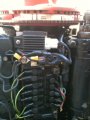
I just wanted to show the final result and pass on a bit of info. I managed to get a atv 4 wire rectifier/regulator. Made a mounting plate and fitted it where the old rectifier sat. I now have between 12.7V at idle and 14.4V at full throttle. Very happy with that.
 

Attachments

Top