Ideal Opamp current

dcbingaman

Joined Jun 30, 2021
1,065
Very interesting this point of view, I hadn't thought about it.
I also understood your example in post #17.

I would like to go back to my exercise for a moment, correct me if I am wrong.

I have the circuit I posted (at the beginning) that I want to solve with calculations, as I reported. If the feedback is negative, I can assume that V+=V- as long as Vo "allows" it (i.e., all your reasoning you explained).
Now, this exercise was given to me by a professor some time ago so I assume it works, but it may not always be true? In other words, the key point of the argument is that, in general, it is not enough to state "negative feedback .. okey V+=V-" ... but the opamp has to make sure that Vo allows for such equality V+=V-.

If I were faced with a circuit like yours where Vi=0.1V .. the gain is 21 (as calculated) but the output is fixed at 3V (and not -2.1V) .. then the equality V+=V- would no longer be true ? Am I wrong?
A more practical example of the limitation:

Say the supply rails of the op-amp are +5V and -5V. And Vin is 1V.

In that case the output would 'be' -21*1V =-21V.

But the op-amp cannot do that, at best with a 'rail to rail' op amp it could be at -5V. And that is where it will go for a rail to rail op amp. For other op-amps it may only make it to like 1.5V of the rail or -3.5V in this case. In either case the inverting input voltage will no longer equal the non-inverting input voltage. I consider this a much more practical example because you will run across this in the real world. In fact the professor may 'trick' you into thinking it is -21V if you did not closely look at the power forms that are providing power to the op-amp.
 
Last edited:

WBahn

Joined Mar 31, 2012
32,933
Very interesting this point of view, I hadn't thought about it.
I also understood your example in post #17.

I would like to go back to my exercise for a moment, correct me if I am wrong.

I have the circuit I posted (at the beginning) that I want to solve with calculations, as I reported. If the feedback is negative, I can assume that V+=V- as long as Vo "allows" it (i.e., all your reasoning you explained).
Now, this exercise was given to me by a professor some time ago so I assume it works, but it may not always be true? In other words, the key point of the argument is that, in general, it is not enough to state "negative feedback .. okey V+=V-" ... but the opamp has to make sure that Vo allows for such equality V+=V-.

If I were faced with a circuit like yours where Vi=0.1V .. the gain is 21 (as calculated) but the output is fixed at 3V (and not -2.1V) .. then the equality V+=V- would no longer be true ? Am I wrong?
But going back to your exercise, there is no point in solving anything based on the assumption that the feedback is negative because there is no feedback at all.

The output of the opamp is tied to 0 V.

The voltage at the non-inverting input is -5 V.

The voltage at the inverting input is established by the weighted averages of V1, V2, and 0 V via their respective resistors.

Perform KCL at the inverting input, the voltage at which I will call Vx, and you get a simple equation in one variable:

(Vx - V2)/R1B + (Vx)/R3A + (Vx - V1)/R2A = 0

Vx * (1/R1B + 1/R3A + 1/R2A) = V2/R1B + V1/R2A

Vx = (V2/R1B + V1/R2A)/(1/R1B + 1/R3A + 1/R2A)

The current flowing downward in R2A is then

Ix = (Vx - V1) / R2A

Plug in the numbers, and you get Vx = -4.985 V and Ix = 147.8 µA, which agrees with your simulation results.
 
The output is 0V ... not ground. I've just realised this detail.
But still I don't think it changes things, so R2A= 100 ohms I don't consider it in the circuit
There's not much point in continuing to talk about post #1. The TS said in post #8 as above that the output is not clamped to ground; the output of the opamp is free to take on whatever value the operation of the circuit causes.

In post #11 the upper circuit in the image is misleading. That circuit can be solved and the output voltage is determined by the 3 resistors and the two applied voltages. That output voltage is not 0 volts.

The circuit of post #1 can be solved using the upper circuit of post #11 by setting the voltage gain of the opamp to zero. This gives the effect of clamping the output to zero volts.
 

WBahn

Joined Mar 31, 2012
32,933
There's not much point in continuing to talk about post #1. The TS said in post #8 as above that the output is not clamped to ground; the output of the opamp is free to take on whatever value the operation of the circuit causes.
When I skimmed the thread to see if he had changed the output condition, I missed that post. But upon seeing it now, I remember seeing it before and noting that he said that the output IS 0 volts, but not ground. Could have been a typo.

In post #11 the upper circuit in the image is misleading. That circuit can be solved and the output voltage is determined by the 3 resistors and the two applied voltages. That output voltage is not 0 volts.
In post #11 he again insists that the output voltage IS zero volts, consistent with his claim in Post #8, and he attempts to solve it using superposition while imposing that condition, but using equations that only apply if the opamp is operating in it's linear region even though the conditions he is imposing ensure that it is not.

So I'm not convinced that the TS yet understands this important point.

The circuit of post #1 can be solved using the upper circuit of post #11 by setting the voltage gain of the opamp to zero. This gives the effect of clamping the output to zero volts.
Or it can be solved by simply erasing the opamp, since it is being forced to not do anything that has any effect on the result.
 
kalemaxon89,
The top circuit shows an output voltage that cannot be if the opamp is operating in its linear region with the given resistor values and the two applied voltages . Allow the output voltage to be an unknown and solve the circuit. What will the output voltage be? Do you know how to solve the circuit?

Edit: Could you possibly have the value of R3A wrong? If the output not clamped to ground, but rather free to assume whatever value the opamp drives it to in linear operation, there is a value of R3A which will give zero volts at the opamp output.
 
Last edited:

Thread Starter

kalemaxon89

Joined Oct 12, 2022
389
kalemaxon89,
The top circuit shows an output voltage that cannot be if the opamp is operating in its linear region with the given resistor values and the two applied voltages . Allow the output voltage to be an unknown and solve the circuit. What will the output voltage be? Do you know how to solve the circuit?

Edit: Could you possibly have the value of R3A wrong? If the output not clamped to ground, but rather free to assume whatever value the opamp drives it to in linear operation, there is a value of R3A which will give zero volts at the opamp output.
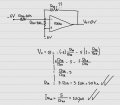
Since there has been some confusion, I enclose the final exercise with the solution provided by the professor.
Goal: find R3A and the current on it
SmartSelect_20230417_143109_Samsung Notes.jpg
(I had marked a different R3A value, apologies to you all)
Do we all agree on this solution or not?
 

BobTPH

Joined Jun 5, 2013
11,559
Wow, we have wasted all this time because you decided to change the problem given by your professor to a different problem that has no solution?
 

WBahn

Joined Mar 31, 2012
32,933
Since there has been some confusion, I enclose the final exercise with the solution provided by the professor.
Goal: find R3A and the current on it
View attachment 292329
(I had marked a different R3A value, apologies to you all)
Do we all agree on this solution or not?
This is a very different problem than the original one you posted. In that one, R3A was specified as being 20 kΩ. In this one, R3A is an unknown and the goal is to pick it such that an output of 0 V is achieved.
 

dcbingaman

Joined Jun 30, 2021
1,065
Since there has been some confusion, I enclose the final exercise with the solution provided by the professor.
Goal: find R3A and the current on it
View attachment 292329
(I had marked a different R3A value, apologies to you all)
Do we all agree on this solution or not?
Vo = -(-6V*R3A/R1B)-5V*(R3A+R1B)/R1B = -(-6V*5) + (-5V*6) = 0V

Yes that is correct. 50K with R1B at 10K with the voltages as specified will result in 0V output and R2A plays no role in that solution.
 
Last edited:

dcbingaman

Joined Jun 30, 2021
1,065
Since there has been some confusion, I enclose the final exercise with the solution provided by the professor.
Goal: find R3A and the current on it
View attachment 292329
(I had marked a different R3A value, apologies to you all)
Do we all agree on this solution or not?
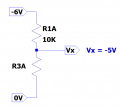
Yes but there is a simpler way to look at it. The non-inverting input is at -5V, thus the inverting input must also be at -5V if the op-amp is working correctly in which case the entire problem can be redrawn as this:

1681739415364.png

With 1V across R1A the current is 1V/10K or 100 micro-amps. With 100 micro-amps flowing through R3A the resistance then has to be 5V/100 micro-Amps = 50K.

Now I can understand at least why you wanted to 'tie' the op-amp output to ground, but there is a significant difference to assuming the output is 0V and tying it to ground changes the original circuit, so you simply can't do that.
 
Last edited:

WBahn

Joined Mar 31, 2012
32,933
Since there has been some confusion, I enclose the final exercise with the solution provided by the professor.
Goal: find R3A and the current on it
View attachment 292329
(I had marked a different R3A value, apologies to you all)
Do we all agree on this solution or not?
The professor's solution is incomplete because it does not designate a polarity for the current in R3A, so there's no way to tell (from the answer) whether the 100 µA is flowing left-to-right or right-to-left.

Other than that (and it's a big 'other'), assuming you meant for the voltage at the non-inverting input to be -5 V and not the -6 V shown, this is correct.

But it is arrived at the long way.

Since the opamp is specified as being ideal, we assume that there is 0 V difference between its inputs. That makes the voltage at the inverting input -5 V.

That means that there is a current flowing right-to-left in R1B of

I1 = (-5 V - -6 V) / 10 kΩ = 100 µA

This current has to produce a voltage drop of 5 V across R3A, making that resistor

R3A = (5 V) / ( 100 µA) = 50 kΩ
 

MrAl

Joined Jun 17, 2014
13,722
Let's assume an ideal opamp in this circuit.
R2A is 100 ohm resistor and my question is .. how does R2A affect this circuit?

Being an ideal opamp and negatively feedback .. V+=V- and therefore no current flows on R2A (zero voltage drop).
Am I wrong?
View attachment 292060

Hi,

When you say that the op amp is "ideal" you may have to specify just what kind of ideal are you talking about. Usually an 'ideal' op amp means that the input offset is zero, the input current is zero, the supply voltages are unlimited, and most importantly, the open loop gain is infinite. If the open loop gain is finite it changes things a lot as you will see.
I will also assume that the output of the op amp is not grounded because if it is then we have other things to consider, such as does the op amp burn up or does it just not work as it should and the whole thing just becomes a resistor network with some voltage supplies. So this discussion will assume that the output is not really grounded.

The best way to handle this kind of situation i think is to just do a network analysis and then change some values to see what becomes of it.

Starting with the network equation for this circuit, we have:
Vout=-(A*R2*(E2*R3-E1*R3-E1*R1))/(R2*R3+R1*R3+A*R1*R2+R1*R2)
where
Vout is the output of the op amp (not grounded),
R1 through R3 are as the schematic shows,
E1=V1, E2=V2,
A is the op amp internal open loop gain, and we will look at the case where A is infinite and a second case where A is just 1000.

To start with, let's allow A to go to infinity because what happens is this becomes very easy and very clear as to what happens...
With A going to infinity we end up with:
Vout=-(E2*R3-E1*R3-E1*R1)/R1
and clearly we can see we lost R2 completely, meaning that R2 no longer matters for the solution of what Vout is. That means that R2 is out of the picture and does nothing.
There may be one exception, and that is when R2 reaches a perfect zero. In that case, the output would be zero, but since R2 is specified as 100 Ohms we dont really have to worry too much about that case.
So in the case of the internal open loop gain going to infinity we see that R2 does not matter, as long as it is not zero.

Next we can look at A=1000 just to see what we get.
With A=1000 we end up with:
Vout=-(1000*R2*(E2*R3-E1*R3-E1*R1))/(R2*R3+R1*R3+1001*R1*R2)
and now we see that R3 is still in the mix, so it will matter what that value happens to be.
Now let's stick the values for R1 and R2 and E1 and E2 in there...we get:
Vout=-(30000000*R2)/(10030000*R2+200000000)
and you can see that R2 is important now in the determination of what the output voltage goes to.
If we let R2 go to infinity now (remove that resistor entirely) we end up with:
Vout=-3000/1003=-2.991 volts.
That would be with R2 removed and an internal open loop gain of just 1000, but usually the internal gain is more than that for DC.
If we let R2 go to the specified value of 100, we end up with:
Vout=-1000/401=-2.494 volts.

With A going to infinity and the same values we get the ideal output of -3 volts, so it is clear that R2 changes things when A is finite.

EDIT:
For the exception where R2 goes to a perfect zero, the output may be indeterminate because the internal gain goes toward infinity. We do not really have to consider this case but i thought i would mention this anyway. If you are interested in this case you could investigate.
 
Last edited:
Top