Facebook
 Google
 GitHub
 Linkedin

dcbingaman
- Joined Jun 30, 2021
- 1,065
A more practical example of the limitation:Very interesting this point of view, I hadn't thought about it.
I also understood your example in post #17.
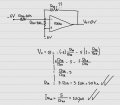
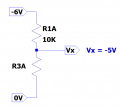
I would like to go back to my exercise for a moment, correct me if I am wrong.
I have the circuit I posted (at the beginning) that I want to solve with calculations, as I reported. If the feedback is negative, I can assume that V+=V- as long as Vo "allows" it (i.e., all your reasoning you explained).
Now, this exercise was given to me by a professor some time ago so I assume it works, but it may not always be true? In other words, the key point of the argument is that, in general, it is not enough to state "negative feedback .. okey V+=V-" ... but the opamp has to make sure that Vo allows for such equality V+=V-.
If I were faced with a circuit like yours where Vi=0.1V .. the gain is 21 (as calculated) but the output is fixed at 3V (and not -2.1V) .. then the equality V+=V- would no longer be true ? Am I wrong?
Say the supply rails of the op-amp are +5V and -5V. And Vin is 1V.
In that case the output would 'be' -21*1V =-21V.
But the op-amp cannot do that, at best with a 'rail to rail' op amp it could be at -5V. And that is where it will go for a rail to rail op amp. For other op-amps it may only make it to like 1.5V of the rail or -3.5V in this case. In either case the inverting input voltage will no longer equal the non-inverting input voltage. I consider this a much more practical example because you will run across this in the real world. In fact the professor may 'trick' you into thinking it is -21V if you did not closely look at the power forms that are providing power to the op-amp.
Last edited: