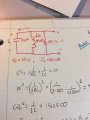
Hi,View attachment 125399
Hello!, i'm told that Ic is the negative current is the Initial current comming from the inductor....Why is this true? I would think that as Io leaves the inductor it splits and part of it goes to the capacitor and the other goes to the load. Thank you !
You need both the initial capacitor voltage and the initial inductor current. The circuit is governed by a second-order differential equation and thus you need two initial conditions to completely solve it. Those initial conditions are the values of the energy-storage parameters (the voltage for a capacitor and the current for an inductor) because these are carried across from the time just before t=0.This problem looks complicated, but it's not.
The thing to do is write an equation for the current of each element in terms of the top node voltage, which is common to each.
Just sum the three currents into the top node.
Then take the Laplace transform of each component, using the fundamental time derivative definition ... One extra step here, but you will probably catch it. ... You should see where the initial voltage condition shows up ... necessary to get the final inverse Laplace transform.
I don't actually see where the inductor initial condition is used.
... hope this makes sense. If not, I can post a worksheet.
You need both the initial capacitor voltage and the initial inductor current. The circuit is governed by a second-order differential equation and thus you need two initial conditions to completely solve it. Those initial conditions are the values of the energy-storage parameters (the voltage for a capacitor and the current for an inductor) because these are carried across from the time just before t=0.
... I seem to be missing something here. In eliminating an integral by taking the derivative of the equation, the initial inductor current. i(0)=50 ma, as a constant, is canceled out. I have posted a few preliminary equations ... any suggestions appreciated.
So you have a second order differential equation for v(t).... I seem to be missing something here. In eliminating an integral by taking the derivative of the equation, the initial inductor current. i(0)=50 ma, as a constant, is canceled out. I have posted a few preliminary equations ... any suggestions appreciated.
Hi there,So you have a second order differential equation for v(t).
When you solve this, you will need initial values for v and also dv/dt. The initial value for v is the capacitor voltage. The initial value for dv/dt comes from knowing the initial capacitor current. The initial capacitor current is dictated by the initial inductor current.