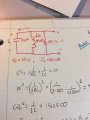
-Ic = Io when t >= 0 ,Why is the ic the negative current coming from the inductor?

Thread Starter

LadyBarfBubble

Joined Apr 24, 2017
2
IMG_2904.JPG
Hello!, i'm told that Ic is the negative current is the Initial current comming from the inductor....Why is this true? I would think that as Io leaves the inductor it splits and part of it goes to the capacitor and the other goes to the load. Thank you !
 

WBahn

Joined Mar 31, 2012
32,823
I assume that Vo and Io are the initial conditions at t = 0+ ?

If so, then:

What is the current in the inductor (flowing downward) at t = 0+?

What is the current in the resistor (flowing downward) at t = 0+?

What is the current in the capacitor (flowing downward) at t = 0+;

What would need to be true about the initial conditions in order for the initial value of ic to be -Io?
 

drc_567

Joined Dec 29, 2008
1,156
This problem looks complicated, but it's not.
The thing to do is write an equation for the current of each element in terms of the top node voltage, which is common to each.
Just sum the three currents into the top node.

Then take the Laplace transform of each component, using the fundamental time derivative definition ... One extra step here, but you will probably catch it. ... You should see where the initial voltage condition shows up ... necessary to get the final inverse Laplace transform.

I don't actually see where the inductor initial condition is used.

... hope this makes sense. If not, I can post a worksheet.
 

MrAl

Joined Jun 17, 2014
13,702
View attachment 125399
Hello!, i'm told that Ic is the negative current is the Initial current comming from the inductor....Why is this true? I would think that as Io leaves the inductor it splits and part of it goes to the capacitor and the other goes to the load. Thank you !
Hi,

So what you are saying is that if a river flowing north to south splits into two branches then in one of those branches the river must change direction and go from south to north :)

Ok, in a circuit the current can be in a different direction unlike the river, but just because it splits does not mean that it MUST change direction. The key is to solve for that current and see what way it is really going.

You can see right away that if the voltage is 10v and the inductor current is flowing out of that node, the node voltage must be decreasing. Yes part of that current will be flowing in the resistor, but there may still be some left even after we figure out how much is flowing in the resistor and that would have to flow in the capacitor.

So figure out how much is flowing in the resistor and since you already know what is flowing in the inductor you can figure out how much flows in the cap at t=0.

Note that this whole thing is based on the initial conditions so you dont need Laplace Transforms to do this, it's much much easier than that. Just concentrate on what is happening at t=0 alone, and you already have the information as given to do that.

BTW the inductor initial current is one of the key points to figuring this out. That current tells us part of how the current flows out of the top node. If it was reversed, it would be an entirely different solution.
 
Last edited:

WBahn

Joined Mar 31, 2012
32,823
This problem looks complicated, but it's not.
The thing to do is write an equation for the current of each element in terms of the top node voltage, which is common to each.
Just sum the three currents into the top node.

Then take the Laplace transform of each component, using the fundamental time derivative definition ... One extra step here, but you will probably catch it. ... You should see where the initial voltage condition shows up ... necessary to get the final inverse Laplace transform.

I don't actually see where the inductor initial condition is used.

... hope this makes sense. If not, I can post a worksheet.
You need both the initial capacitor voltage and the initial inductor current. The circuit is governed by a second-order differential equation and thus you need two initial conditions to completely solve it. Those initial conditions are the values of the energy-storage parameters (the voltage for a capacitor and the current for an inductor) because these are carried across from the time just before t=0.
 

JoeJester

Joined Apr 26, 2005
4,390
t0, is when the controlling event occurs. Reality is, the event occurs at sometime after true t0, the moment you apply power to the circuit.
 

drc_567

Joined Dec 29, 2008
1,156
You are correct about the initial condition for the inductor current. That adds an additional constant term when taking the integral of di.

You need both the initial capacitor voltage and the initial inductor current. The circuit is governed by a second-order differential equation and thus you need two initial conditions to completely solve it. Those initial conditions are the values of the energy-storage parameters (the voltage for a capacitor and the current for an inductor) because these are carried across from the time just before t=0.
 

drc_567

Joined Dec 29, 2008
1,156
... I seem to be missing something here. In eliminating an integral by taking the derivative of the equation, the initial inductor current. i(0)=50 ma, as a constant, is canceled out. I have posted a few preliminary equations ... any suggestions appreciated.
 

Attachments

MrAl

Joined Jun 17, 2014
13,702
... I seem to be missing something here. In eliminating an integral by taking the derivative of the equation, the initial inductor current. i(0)=50 ma, as a constant, is canceled out. I have posted a few preliminary equations ... any suggestions appreciated.

Hi,

This is a problem that involves only the initial conditions so you dont really need to use a DE or anything like that. It turns into a static problem because there is no evolution in time. We only need to know what the cap current is at t=0 or very very close to that time. Near t=0 we already know the inductor current, and we also know the resistor current because we know the initial cap voltage. There's only one more current left to find :)

If you do want to go after the complete time solution, then you must include both the initial inductor current and the initial cap voltage. I am not sure if you did this yet but i'll try to look over your equations soon.
The final solution will have both the initial cap voltage and the initial inductor current somewhere in it.

LATER:
I took a quick look at your equations and your last equation looks correct, but now you have to solve that DE and apply the initial conditions. So up to that point it's correct you just have to keep going. This is often done by assuming the solution is of the form:
v=A1*e^(s1*t)+A2*e^(s2*t)

where A1 and A2 are found from the initial conditions, but you can do it any way you wish.

So the initial condition may go away for the general solution but once you go to apply the initial conditions to get the final solution of course they still must be used.

I also assumed that your second term had 1/(R*C) in it and not (1/R)*C as it was a little hard to tell.
 
Last edited:

WBahn

Joined Mar 31, 2012
32,823
... I seem to be missing something here. In eliminating an integral by taking the derivative of the equation, the initial inductor current. i(0)=50 ma, as a constant, is canceled out. I have posted a few preliminary equations ... any suggestions appreciated.
So you have a second order differential equation for v(t).

When you solve this, you will need initial values for v and also dv/dt. The initial value for v is the capacitor voltage. The initial value for dv/dt comes from knowing the initial capacitor current. The initial capacitor current is dictated by the initial inductor current.
 

MrAl

Joined Jun 17, 2014
13,702
So you have a second order differential equation for v(t).

When you solve this, you will need initial values for v and also dv/dt. The initial value for v is the capacitor voltage. The initial value for dv/dt comes from knowing the initial capacitor current. The initial capacitor current is dictated by the initial inductor current.
Hi there,

I think you meant the initial capacitor current is dictated by the initial inductor current and the current in the resistor at t=0. I dont want to give away the actual signs for each yet though :)
 

WBahn

Joined Mar 31, 2012
32,823
I only mentioned the inductor current because I was addressing the why the initial inductor current is needed and how it folds into the differential equation.
 
Top