Fluke 112 DMM - negative current

Thread Starter

brianmk

Joined Dec 23, 2016
101
I want to measure the current flow to/from a rechargeable NiMh battery when it is installed in a DECT handset.
When the handset is on the cradle and being trickle charged, current flow will be into the battery.
When the handset is off-hook, the current flow will be in the reverse direction.

If I use my Fluke 112 DMM, it has a separate red coloured 4mm socket for current measurement (marked 'A').
In the past I have only measured DC current in one direction i.e. into the red 'A' socket.

I am wondering what will happen to the DMM if the current is reversed.
Does the meter simply display a -ve sign next to the reading?
Does it display zero current?
Can the DMM be damaged if the current is reversed?

The Fluke user manual is no help and I don't want to risk damaging the meter.
 

Thread Starter

brianmk

Joined Dec 23, 2016
101
Yes - I decided to try it a few minutes ago by reversing the leads. A -ve sign is shown against the current reading.
I assume internally the meter is simply measuring voltage across a low value shunt so it works in a simlar way to voltage measurements when the leads are reversed.

There are some aspects to the DECT handset measurements that 'currently' don't make much sense (pun intended).

With the handset off-hook, the initial current draw from the battery is around 80mA. After a few seconds it drops to 50mA.
During that time the handset is communicating with the remote base station, so the RF transmittter in the handset will be consuming power.
After a few more seconds, the current drops to around 4mA. This is standby mode where only the clock is displayed and the receiver is listening for incoming calls.
So far so good.

However, if I repeat the process with the handset installed on the base, the results are similar except that when it reaches standby mode, the battery is still supplying around 30mA! That doesn't make sense. The battery is not being charged at all.
At 30mA the battery would soon discharge completely.
The 'charging' LED in the base unit is on which means the base unit is supplying current.
(Previous measurements using a dummy load indicate that the base unit charging LED comes on at around 2mA).
The charger circuit in the base unit looks pretty simple - just a few discrete components. I don't think it can automatically adjust the charging current.

If I remove the batteries and seat the handset on the base, the charger alone is unable to supply sufficient current to operate the handset. In this state the handset continually resets itself. That's understandable as the base unit is only intended to provide a trickle charge. I previously measured the current from the base unit at around 50mA when the handset is in standby mode with batteries installed.

I should add that the reason I am looking into this is that I have three of these DECT phones (BT Stratus 1500).
Two of the handsets sometimes fail to charge. This often results in being woken in the middle of the night by an annoying 'low battery' alarm. It may be coincidence, but it seems to happen after the base is moved or disturbed without the handset being lifted.
I have a theory that the spring loaded contacts between the handset and base could give a glitch on the power rail which somehow results in an increase in standby current. Perhaps the glitch causes the CPU to be woken up by an interrupt and it fails to go back to standby mode.
 

Thread Starter

brianmk

Joined Dec 23, 2016
101
Yes - I decided to try it a few minutes ago by reversing the leads. A -ve sign is shown against the current reading.
I assume internally the meter is simply measuring voltage across a low value shunt so it works in a simlar way to voltage measurements when the leads are reversed.

There are some aspects to the DECT handset measurements that 'currently' don't make much sense (pun intended).

With the handset off-hook, the initial current draw from the battery is around 80mA. After a few seconds it drops to 50mA.
During that time the handset is communicating with the remote base station, so the RF transmittter in the handset will be consuming power.
After a few more seconds, the current drops to around 4mA. This is standby mode where only the clock is displayed and the receiver is listening for incoming calls.
So far so good.

However, if I repeat the process with the handset installed on the base, the results are similar except that when it reaches standby mode, the battery is still supplying around 30mA! That doesn't make sense. The battery is not being charged at all.
At 30mA the battery would soon discharge completely.
The 'charging' LED in the base unit is on which means the base unit is supplying current.
(Previous measurements using a dummy load indicate that the base unit charging LED comes on at around 2mA).
The charger circuit in the base unit looks pretty simple - just a few discrete components. I don't think it can automatically adjust the charging current.

If I remove the batteries and seat the handset on the base, the charger alone is unable to supply sufficient current to operate the handset. In this state the handset continually resets itself. That's understandable as the base unit is only intended to provide a trickle charge. I previously measured the current from the base unit at around 50mA when the handset is in standby mode with batteries installed.

I should add that the reason I am looking into this is that I have three of these DECT phones (BT Stratus 1500).
Two of the handsets sometimes fail to charge. This often results in being woken in the middle of the night by an annoying 'low battery' alarm. It may be coincidence, but it seems to happen after the base is moved or disturbed without the handset being lifted.
I have a theory that the spring loaded contacts between the handset and base could give a glitch on the power rail which somehow results in an increase in standby current. Perhaps the glitch causes the CPU to be woken up by an interrupt and it fails to go back to standby mode.
I didn't beleive the results using the Fluke DMM from yesterday so today I dug out an old analogue center zero meter
(-500 - 0 - +500)uA fitted with a scale reading (-0.6 - 0 - +0.6)dB.
Then I added a 2.4 Ohm shunt in parallel to give roughly (-100 - 0 - +100)mA.

As I suspected, the Fluke DMM was not telling the truth!
The analogue meter shows that when in standby on the base unit, the handset batteries receive a charging current of about 30mA. The DMM failed to recognise the reversal in current and did not display a -ve sign.

What is interesting (and unexpected) is that the charging current is not continuous.
It is switched on for about 5 seconds every 3 seconds.
When the charging current is off, the battery drain is about 3mA i.e. the same as when the handset is in standby when off-hook. This is current required to power the handset clock display and the receiver.

The next task is to try and figure out why the handset sometimes fails to charge.
If there is space, I am thinking of adding a 100uF capacitor across the power rails in the handset.
That may help prevent supply glitches if there is a momentary loss of contact between the handset and base unit if the base unit is jogged.
 

Thread Starter

brianmk

Joined Dec 23, 2016
101
I didn't beleive the results using the Fluke DMM from yesterday so today I dug out an old analogue center zero meter
(-500 - 0 - +500)uA fitted with a scale reading (-0.6 - 0 - +0.6)dB.
Then I added a 2.4 Ohm shunt in parallel to give roughly (-100 - 0 - +100)mA.

As I suspected, the Fluke DMM was not telling the truth!
The analogue meter shows that when in standby on the base unit, the handset batteries receive a charging current of about 30mA. The DMM failed to recognise the reversal in current and did not display a -ve sign.

What is interesting (and unexpected) is that the charging current is not continuous.
It is switched on for about 5 seconds every 3 seconds.
When the charging current is off, the battery drain is about 3mA i.e. the same as when the handset is in standby when off-hook. This is current required to power the handset clock display and the receiver.

The next task is to try and figure out why the handset sometimes fails to charge.
If there is space, I am thinking of adding a 100uF capacitor across the power rails in the handset.
That may help prevent supply glitches if there is a momentary loss of contact between the handset and base unit if the base unit is jogged.
After some further investigation I managed to get the handset into a state in which charging stops completly. This was after lifting the handset from the base for just a short time (< 1/2 sec). It seems to take about 1 sec to recognise 'off-hook'. I was unable to get back to the original pulsed charging state despite power cycling etc.

So then I swapped the batteries for some that are not fully charged. Now the charging current is switched on continually when the handset is in standby mode and on the base. My guess is that the CPU measures the battery voltage and adjusts the charging on/off cycling accordingly.

I have no idea how often the battery condition is checked or if it needs some event to trigger it (e.g. on-hook->off-hook). It may be that the handset can get into a state where charging is disabled and the battery voltage check is never carried out. It could be a firmware bug because other users have complained about the same intermittent charging problem on forums and in reviews.
 

panic mode

Joined Oct 10, 2011
4,864
thanks. that looks good... but the question was about Fluke DMM. how was it used (connected and configured)? any chance of mistake there (set to AC range)? you stated that battery current did not change polarity when charging and discharging which is obviously unexpected...
 
Last edited:

Thread Starter

brianmk

Joined Dec 23, 2016
101
Another thought...

The two handsets that exhibit the problem are fitted with Lloytron 1100mA NiMh cells.
The third handset is fitted with Panasonic 750mA cells.
Both measure 1.46V with no load when fully charged.
If the handset is measuring the battery voltage to select the charging current, is it possible for the Lloytron cells to indicate a good voltage when they are unable to maintain that voltage under load?
 

Thread Starter

brianmk

Joined Dec 23, 2016
101
thanks. that looks good... but the question was about Fluke DMM. how was it used (connected and configured)? any chance of mistake there (set to AC range)? you stated that battery current did not change polarity when charging and discharging which is obviously unexpected...
To reiterate...
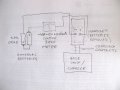
The Fluke DMM was originally connected in place of the analogue center zero meter.
It was set to Amps DC. Meter positive was connected to the handset battery positive terminal such that current flowing out of the battery should indicate a positive measurement.
The handset was seated on the base so that it can receive charging current.
It initially showed a positive current out of the battery while the handset drew current when communicating with the remote base unit over wireless. This is as expected.
After several seconds the handset went into standby mode.
I expected the direction of current to reverse as the handset entered charging mode.
When using the analogue meter, this is exactly what happens. The charge current into the battery is about 30mA.
When using the DMM in this state, it indicates 30mA but there is no -ve sign.
It only appears to update the +/- sign during the initial auto-ranging phase.
It fails to indicate the subsequent reversal of current.
Also, it does not indicate a drop in the reading during the 3 second gaps in charging current.
I imagine that's connected with the DMM sampling rate not being fast enough.
Sorry, but I am unable to make my descrption any more plain!

Anyway, as previously stated, I have given up using the DMM for these tests.
The analogue center-zero meter gives more believable results.

What I am finding is that the NiMh cell type (probably also capacity and age) makes a difference to the charging current profile:-

Lloytron 1100 mAh cells sometimes initially result in the 30mA pulsed current (5 seconds on, 3 sconds off).
The charging current subsequently switches off completely when the batteries become fully charged.

Palocell 1100 mAh cells charge at a constant 30mA, even after a few hours.

One pair of new Unitech 550 mAh cells (supplied with a different BT DECT phone) would not work at all (even after charging for a few hours using a separate external NiMh charger). When installed, the handset continually reset itself, even when on the base unit.

A second pair of fully charged Unitech cells gave more sensible results. Initially charging at a constant 30mA, then the charging current is turned off. I observed no pulsed current.

I have ordered some Eneloop 750mAh cells to try.

It could turn out that the charging profile has nothing to do with the original problem of the phone intermittently giving a low battery alarm after sitting on the base unit on charge for hours/days. As already mentioned, the problem manifests itself on two different handset + base combinations. I have never observed the problem on the third (which is fitted with Panasonic 750 mAh cells). I have yet to look at the charging profile on this handset + batteries.

The investigation continues.
 
Top