I would like to design a system that switches from primary DC source to a back up battery source.

Thread Starter

AbdBaj

Joined Oct 10, 2023
16
I would like to design a system that switches from primary DC source to a back up battery source. I would like the system to be light weight because it will be attached to a tethered drone. I also want the switching response time to be almost zero. Or is there already a component that does the following job?
 

MrChips

Joined Oct 2, 2009
34,629
I would like to design a system that switches from primary DC source to a back up battery source. I would like the system to be light weight because it will be attached to a tethered drone. I also want the switching response time to be almost zero. Or is there already a component that does the following job?
Yes, two diodes.
 

ThePanMan

Joined Mar 13, 2020
862
My mom had a radio that played via 110VAC or four 1.5V D Cell batteries. She'd leave that thing playing in the patio with her music for hours. Even when she wasn't home. I got the smart idea to shut the power off (light switch provided power to the outlet) thus silencing the radio. To my young boy surprise the radio played on without interruption. Since then I've built radios with the same feature you're asking for.

My approach:
Car radio
12 volt battery
12 volt battery charger.

The radio played directly from the battery and the charger was able to provide sufficient power to both charge the battery and play the radio. Without the battery the radio had a 60 cycle hum, very annoying. So the battery was a smaller 12V SLA (Sealed Lead Acid) battery with 20Ah rating. The radio worked just fine and had a 2 amp fuse to protect it. So IF the radio drew 2 amps one could conclude the battery could play the radio for 10 hours non-stop.

When playing and connected to 110VAC the charger could provide sufficient current for the radio. If power failed for a few seconds or even up to 10 hours, the radio had the backup power necessary.
Yes, two diodes.
Mr Chips suggests two diodes. In my case that's exactly what I did, use a diode. That way the charger doesn't act like a drain on the battery when not plugged in. All that was needed was a single diode from the charger to the battery to prevent back feeding the charger and draining the battery.

You don't specify exactly what you're doing so we can only make guesses at what best suits your needs. So the radio example is just one way to highlight one solution.
 

MrChips

Joined Oct 2, 2009
34,629
For low voltage loss, use Schottky diodes such as 1N5817 which can handle up to 1A with a forward voltage of 0.45V.
 

crutschow

Joined Mar 14, 2008
38,325
For low voltage loss, use Schottky diodes such as 1N5817 which can handle up to 1A with a forward voltage of 0.45V.
That will work, but if you want a minimum voltage drop to maximize battery time, then you would need to go to an ideal diode circuit, such as one of these.
It's voltage drop is just the on-resistance of a MOSFET times the load current.
 
Last edited:

Reloadron

Joined Jan 15, 2015
7,860
You can roll your own or buy a turn key off the shelf solution. Companies like Alarm-Saf and also Alltronix offer turn key off the shelf solutions. Most are designed around the use of SLA (Sealed Lead Acid) batteries delivering 12 or 24 volts. You make no mention of your current demands? Nice feature is units like this charge and maintain a charge on your backup battery. A Google of those names I listed will get you plenty of hits. We used them in our cypher lock systems and certain entry points. During a power failure certain things had to function and function reliably. Now if you want to roll your own I suggest you start with a list (pencil and paper, pencil having large eraser). :) List any and all features you want or nice to have and must have. A common use is security systems. Anyway you have to know your current demand and allow an overhead.
Ron
 

ThePanMan

Joined Mar 13, 2020
862
That will work, but if you want a minimum voltage drop to maximize battery time, then you would need to go to an ideal diode circuit, such as one of these.
It's voltage drop is just the on-resistance of a MOSFET times the load current.
As yet we don't know what kind of battery the TS is using, the charger being used, the load that is being maintained or its current draw. IF (Big "IF") this is for a radio similar to a car radio then the charger will likely take the battery up to a 13.6 float voltage and maintain it there. Use of a diode to prevent the battery from back feeding and draining will see a small voltage drop. If you use a standard diode a 0.6Vf will drop the voltage down to 13 volts. That's not a proper charge for the battery, but won't hurt it either. And again IF this is a car radio, seeing voltages from 14.5 down to 11 volts won't hurt the radio.

BUT AGAIN - WE KNOW NOTHING ABOUT THE BATTERY, CHARGER OR LOAD. Those are important details. Till then we're just free-wheeling.
 

Thread Starter

AbdBaj

Joined Oct 10, 2023
16
The voltage and current demands are 36V and 80A because we will be needing 6 motors. Regarding the battery that will be used, it will be a 36V drone battery and the main power unit will be providing 36V too.
 

Thread Starter

AbdBaj

Joined Oct 10, 2023
16
Do you guys think that the ATS (Automatic Transfer Switch) is a good idea? I have read that it does the switching so fast and it is used in hospital for emergency situations when there are power interruptions. I apologize for my late response.
 

crutschow

Joined Mar 14, 2008
38,325
The voltage and current demands are 36V and 80A
For that value of current, I think an ideal diode circuit thus uses low on-resistance MOSFETs to minimize voltage drop and thus the power dissipation, such as one of these would be the best solution.
Do you guys think that the ATS (Automatic Transfer Switch) is a good idea?
I believe those are large units that use relays to switch the AC power.
 

Thread Starter

AbdBaj

Joined Oct 10, 2023
16
For that value of current, I think an ideal diode circuit thus uses low on-resistance MOSFETs to minimize voltage drop and thus the power dissipation, such as one of these would be the best solution.
I believe those are large units that use relays to switch the AC power.
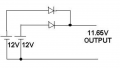
Should I use two diodes? Like the circuit below? But, of course with different values.1698415046103.png
 

MisterBill2

Joined Jan 23, 2018
27,193
For that sort of current you could even try the dual battery diode block used in some vehicle applications. Not the very best, but very reliable and easy to implement. The circuit is like the one in post # 14. The change over is instant.
 

MisterBill2

Joined Jan 23, 2018
27,193
36 volts X 80 Amps is 2880watts. That must be a rather large tethered drone. Also, wire for 80 amps is going to be very heavy. I suggest splitting the motors int series groups and raising the voltage. That must be one big heavy tethered drone.
 

ThePanMan

Joined Mar 13, 2020
862
BUT AGAIN - WE KNOW NOTHING ABOUT THE BATTERY, CHARGER OR LOAD.
The voltage and current demands are 36V and 80A because we will be needing 6 motors. Regarding the battery that will be used, it will be a 36V drone battery and the main power unit will be providing 36V too.
ONCE AGAIN - WE KNOW NOTHING ABOUT THE BATTERY, CHARGER OR LOAD.

80 amps? Is that what all the motors combined at a dead stall will draw?

"Regarding the battery that will be used, it will be a 36V drone battery "
Must be from a very big drone for that kind of power. 36V @ 80 A = 2,880 W (2.9KW). Get something wrong and you're calling the fire department. And may be rushing someone to the hospital.

"and the main power unit will be providing 36V too."
Exactly what is the "Main Power Unit?
36V? OK. What amperage? What power (wattage)?
 

MisterBill2

Joined Jan 23, 2018
27,193
for 80 amps, in open air, probably that application can get away with wire as thin as #10 copper, or equivalent. BUT the weight will be vary large. It makes much more sense at that point to step up the voltage quite a lot and use thinner wires. A step up of 20times will drop the current to 1.8 amps, while increasing the voltage to 720 volts, a voltage withing the range of normal teflon (or similar) insulation. A step-down switching supply on the drone would be much lighter. The step up on the ground would be a transformer inverter operating at a few kilohertz. The weight of the wire plus the insulation will be far less.
 

ThePanMan

Joined Mar 13, 2020
862
@MisterBill2
The voltage and current demands are 36V and 80A because we will be needing 6 motors. Regarding the battery that will be used, it will be a 36V drone battery and the main power unit will be providing 36V too.
Far cry from
It makes much more sense at that point to step up the voltage quite a lot and use thinner wires. A step up of 20times will drop the current to 1.8 amps, while increasing the voltage to 720 volts
Somewhere I think I read but can't find it - the TS has stated he inherited this project and these are the parameters he has to work with.
That must be one big heavy tethered drone.
I'm thinking it's intended to carry a person. Or a very heavy load.
I suggest splitting the motors into series groups and raising the voltage.
Not possible because each motor has to be controlled individually to control Pitch, Roll, Yaw, thrust and braking. If all motors operate from the same voltage one motor is going to be slightly stronger than the others and the drone will pitch over, flip and crash. But your points about heavy gauge wiring and the weight needed to lift a drone of significant size is something that can not be ignored. Since it's tethered, I'd assume (ASS-U-ME) altitude is going to be just a few feet above the ground.

But we still have heard nothing specific about the battery(ies). Nor have we heard anything about the charging plans.
 
Top