Advice needed: Low-power mobile uplink detection system design (RF beginner)

Thread Starter

jeanbab

Joined Nov 29, 2025
2
For a university project, I am trying to design a system capable of locating uplink signals emitted by mobile phones.

The Constraints: I need to scan different frequency bands corresponding to various mobile carriers. The main constraint is power consumption, which is why I want to avoid using a standard SDR (like RTL-SDR) paired with a Raspberry Pi, as the digital processing would be too power-hungry.I came up with two ideas

First I’m considering is a custom PCB featuring several antennas, each tuned to a specific center frequency, followed by an envelope detector to help reduce the need of using microcontroller.

Since I am new to RF design, I have several questions:

  • How problematic is it to place multiple antennas on the same PCB? Will the detuning/coupling be manageable?
  • Is this approach realistic for someone with limited RF experience?
  • What are the practical trade-offs between PCB trace antennas, Chip antennas, and Wire antennas for this application?
  • Can envelope detectors at these frequencies (up to ~3.8 GHz) be prototyped on a breadboard/protoboard, or is a PCB mandatory due to parasitics?
  • Is it feasible to build envelope detectors using discrete components (diodes/caps) at these frequencies, or should I stick to integrated RF detector ?
The second option is using a Wideband Antenna feeding into parallel bandpass filters. Again I got few questions

  • My research points to SAW filters. Are they strictly necessary for frequencies up to 3.8 GHz, or could discrete LC filters still perform well enough?
I apologize for the long post and the potentially naive questions. I have been researching for days, but I am struggling to bridge the gap between theory and practical implementation.

Any advice, even partial, or pointers to things I might have overlooked would be greatly appreciated.

Thanks in advance!
 

Pasqual

Joined Aug 14, 2011
9
Very well...

I will try to explain the subject based on my previous practical experience, in developing superheterodyne receivers in the UHF band (470-890 MHz).

Your first option: "a custom printed circuit board with multiple antennas, each tuned to a specific center frequency, followed by an envelope detector..."
Seems more suitable to meet the very low power consumption requirement (precondition).

Regarding your questions:

How problematic is it to place multiple antennas on the same printed circuit board?
In your case, the antennas should be arranged on the outer perimeter of the PCB; precisely to keep the coupling under (some) control.

Will the mismatch/coupling be manageable? Indeed?!...

Is this approach realistic for someone with limited experience in radio frequency?
You will still have to study a lot... I, however, continue to study.

What are the practical advantages and disadvantages between PCB trace antennas, chip antennas, and wire antennas for this application?
I think wire antennas are more suitable for the geometry of the board in question, and should be coupled to the envelope detector circuits, via PCB traces designed to reject neighboring frequencies.

Is it possible to prototype envelope detectors at these frequencies (up to ~3.8 GHz) on a breadboard, or is a printed circuit board mandatory due to parasitic capacitances?
The PCB design is of paramount importance. Forget about using breadboards. Furthermore, the board must be made of fiberglass.

Is it feasible to build envelope detectors using discrete components (diodes/capacitors) at these frequencies, or should I opt for integrated RF detectors?
Integrated detectors compromise power consumption. There are discrete diodes, such as BATs, that meet the requirements at the frequency range limit, and capacitors can be "printed" into the PCB design.

Your second option: "using a broadband antenna feeding parallel bandpass filters"
It's best to avoid this, as there will invariably be mixing of the detected signals.

My research points to SAW filters. Are they strictly necessary for frequencies up to 3.8 GHz, or would discrete LC filters still perform well enough?
Forget SAW filters, in this range "strip-lines" will perform better.

Good luck!
 

ronsimpson

Joined Oct 7, 2019
4,645
Years ago, we needed a CB radio that received on many different channels. So I built a radio that worked like normal and also watched the emergency channel all the time and would flip to that channel automatically. Later I changed it to display how strong signals were on every channel. You could just hop to any channel and know it was in use or not in use. If I had to do that job again, I would use a SDR as seen in the last picture.
-----------------------------------------------------------------------------
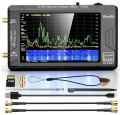
Here is a low-cost spectrum analyzer. It can be set to tell you the signal strength of signals in a range of frequencies. The ones at work cost as much as a car. This is a low-cost "toy" analyzer ($260usd) that will give you information.
1764510777188.png
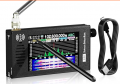
Another thought is Soft Ware Defined Radio. This one has a display. Many are much smaller and use a PC or phone for a display. In one mode the radio will scan looking for signals. It can do almost what the spectrum analyzer does. Some of these are built for the user to modify the software. I have not used this radio, just saying, if you are good at programming this is an interesting option. Most of these do not go to the high frequencies you need.
1764511123671.png
 

Thread Starter

jeanbab

Joined Nov 29, 2025
2
Very well...

I will try to explain the subject based on my previous practical experience, in developing superheterodyne receivers in the UHF band (470-890 MHz).

Your first option: "a custom printed circuit board with multiple antennas, each tuned to a specific center frequency, followed by an envelope detector..."
Seems more suitable to meet the very low power consumption requirement (precondition).

Regarding your questions:

How problematic is it to place multiple antennas on the same printed circuit board?
In your case, the antennas should be arranged on the outer perimeter of the PCB; precisely to keep the coupling under (some) control.

Will the mismatch/coupling be manageable? Indeed?!...

Is this approach realistic for someone with limited experience in radio frequency?
You will still have to study a lot... I, however, continue to study.

What are the practical advantages and disadvantages between PCB trace antennas, chip antennas, and wire antennas for this application?
I think wire antennas are more suitable for the geometry of the board in question, and should be coupled to the envelope detector circuits, via PCB traces designed to reject neighboring frequencies.

Is it possible to prototype envelope detectors at these frequencies (up to ~3.8 GHz) on a breadboard, or is a printed circuit board mandatory due to parasitic capacitances?
The PCB design is of paramount importance. Forget about using breadboards. Furthermore, the board must be made of fiberglass.

Is it feasible to build envelope detectors using discrete components (diodes/capacitors) at these frequencies, or should I opt for integrated RF detectors?
Integrated detectors compromise power consumption. There are discrete diodes, such as BATs, that meet the requirements at the frequency range limit, and capacitors can be "printed" into the PCB design.

Your second option: "using a broadband antenna feeding parallel bandpass filters"
It's best to avoid this, as there will invariably be mixing of the detected signals.

My research points to SAW filters. Are they strictly necessary for frequencies up to 3.8 GHz, or would discrete LC filters still perform well enough?
Forget SAW filters, in this range "strip-lines" will perform better.

Good luck!
Well Mr. you juste made my day ! (And you also have a great mustache)
 

MisterBill2

Joined Jan 23, 2018
27,159
Here is a possible alternative that would not require much RF design: Start with a phone that has physical access to that powerful processor controlling everything inside. Consider that before transmitting on any uplink frequency it needs to verify that the frequency is not in use. That means that it is capable of checking to see if a frequency has a signal present, which, I think, is all that the TS is seeking to know. So it is all a matter of hacking software.

EXPLANATION REMOVED!!! ( it contained information that I am not allowed to share) Sorry folks,, it would have been interesting.
 
Top