I would like some assistance with a few OP amp questions

Thread Starter

Barry1234

Joined Jun 13, 2016
6
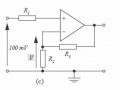
I am trying to find the voltage (v) in the circuit. This looks like a non-inverting op amp, but it has a resistor in series on the non-inverting input.

I have got so far -

The voltage going into V_ is calculated by;

\( V- = \frac{R1}{R1+R2} * V2 \)

And the voltages are equal on both inverting and non inverting input.
V_ = V+

Wasn't sure if the resistor has any influence on the + side of the OP Amp.

If anyone can point me in the right direction, it would be great!

Thanks
 

Attachments

WBahn

Joined Mar 31, 2012
33,079
I am trying to find the voltage (v) in the circuit. This looks like a non-inverting op amp, but it has a resistor in series on the non-inverting input.

I have got so far -

The voltage going into V_ is calculated by;

\( V- = \frac{R1}{R1+R2} * V2 \)

And the voltages are equal on both inverting and non inverting input.
V_ = V+

Wasn't sure if the resistor has any influence on the + side of the OP Amp.

If anyone can point me in the right direction, it would be great!

Thanks
What is V2? You don't indicate it on your diagram?

Why are you using R1 and R2 in your voltage divider equation instead of R2 and R3?

The input resistor, R1, is there to compensate for certain non-ideal behavior in the opamp. To explore them you need to assume that the input current in the input pins is not identically zero, which would mean that V- is not the same as Vin (your 100 mV) and that you don't have a perfect voltage divider for the feedback path.
 

Thread Starter

Barry1234

Joined Jun 13, 2016
6
Hi WBahn.

Sorry i must have put noted down the incorrect resistors for the divider. I should have put

\(V- = \frac{R2}{R2 + R3}\)

I dont have the Voltage supplied for V2,

Is this along the right lines?

\(V- = V+\) As the op amps are ideal

\(V- = \frac{R2}{R2 + R3} * V2\)

\(V+ = 100mV = V-\)

Or is this totally wrong?

Cheers
 

Thread Starter

Barry1234

Joined Jun 13, 2016
6
Hi Eric,

I have just been through these, so the answer is simply that then??

V = 1 + (R3/R2)

The resistor R1 is throwing me, and them providing the 100mV??

Thanks for your help!
 

ericgibbs

Joined Jan 29, 2010
21,541
hi Barry,

You posted V = 1 + (R3/R2)
This should read Av= 1 + (R3/R2) ; as it is the Gain equation.

For Vout = Vin(1 + (R3/R2))

E
 

WBahn

Joined Mar 31, 2012
33,079
Hi Eric,

I have just been through these, so the answer is simply that then??

V = 1 + (R3/R2)

The resistor R1 is throwing me, and them providing the 100mV??

Thanks for your help!
Look at the units.

V has units of volts.

1 + (R3/R2) is just a number.

They can't be equal, so you KNOW something is wrong.

Always, always, ALWAYS check the units! They are probably the single most effective error detection tool available to the engineer.
 

WBahn

Joined Mar 31, 2012
33,079
I dont have the Voltage supplied for V2,
You missed the point.

If I told you that V_fred in that circuit was 1.5 V, you would probably go, "Huh? V_fred? Where is V_fred? There's no V_fred in that circuit! Show me where V_fred is."

Well, I'm going, "Huh? V2? Where is V2? There's no V2 in that circuit! Show me were V2 is."

Sure, I can take a really good guess about which node you mean when you say V2, but engineering is NOT about guessing.
 

PsySc0rpi0n

Joined Mar 4, 2014
1,786
hi Barry,

You posted V = 1 + (R3/R2)
This should read Av= 1 + (R3/R2) ; as it is the Gain equation.

For Vout = Vin(1 + (R3/R2))

E

Maybe that equaiton for Vout is not completely clear for Barry! I did the analysis of the circuit and ended up with this:

\(
V_{o} = V_{in}\cdot \frac{R_{2} + R_{3}}{R_{2}}
\)

Can you understand this equation, @Barry1234 ??? If so, from here to @ericgibbs's final equation for Vo is only mathematical manipulation of the equation!
 

Thread Starter

Barry1234

Joined Jun 13, 2016
6
Hi Everyone,

Thanks for all of your help.

WBahn - Sorry, i think i misunderstood your point, and i shouldn't reference something in my notes which isn't on the diagram i attached.

PsySc0rpi0n and Eric Gibbs. Ye i understand the equation's, i was just getting myself confused, with which one to use, and the reasons for it.

As R3 and R4 are not stated is the answer

Vout = Vin(1 + (R3/R2))

Cheers for your patience with me!
 
Top