I want to use a single power supply to operate two resistors alternately

Thread Starter

Corneliu Nistor

Joined Mar 14, 2018
10
I also need to switch between the two resistors frequently (every minute or so), so I would need a computer-controlled switch. Any ideas on what kind of switch/relay could to the job? I only have a data acquisition card that can output up to 10 V but only 5 mA maximum (and of course USB ports, if they can be of any use). The maximum output of the power supply is 10A / 20V, but during the switching the output voltage and current is brought to zero. The transition time is not critical. Is there anything on the market I can buy for this? Or, if I need to build a circuit, can you please tell me where I can find the circuit diagram (I have only little experience with electronics). Thank you very much.
 

Reloadron

Joined Jan 15, 2015
7,882
What exactly are you trying to do?
I only have a data acquisition card that can output up to 10 V but only 5 mA maximum (and of course USB ports, if they can be of any use).
So does your data acquisition card have digital outputs and you want to switch between two resistive loads on a power supply. Should that be the case I suggest a few logic level MOSFETs.

Describe in detail what it is you are trying to do.

Ron
 
Last edited:

crutschow

Joined Mar 14, 2008
38,430
Is the load simply resistive (a heater)?

Do you require an electrical ground isolation between the data acquisition card and the load?

Isolated Approaches:
You can purchase a DC type (not AC) solid-state relay to switch the load but they can be a little expensive.
You could use a standard mechanical relay with a transistor to drive its coil.

Unisolated:
You could use a power MOSFET, which is the simplest and cheapest.
If you can switch the ground side of the load, it requires only one N-MOSFET per load.
 

WBahn

Joined Mar 31, 2012
32,780
One option is to use solid state relays. For about $25 each (perhaps less) you can get them that you should be able to drive directly from your card.

Probably a better option would be to use a suitable SPDT electromechanical relay. You'd only need one and you could get it for just a couple bucks. You would probably need to use a transistor to get enough coil current, but that is easy enough to do.
 

Thread Starter

Corneliu Nistor

Joined Mar 14, 2018
10
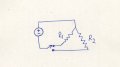
I attached below a simple diagram, I want to switch between the two resistors every minute or so, but bringing the current to zero before switching. The resistors are actually electromagnets who apply fields in different directions to a magnetic film; I do not use a second power supply because it has to be a bipolar supply and these are rather expensive. I would like the acquisition card to be electrically isolated from the electromagnets. The acquisition card also has digital outputs.
Thanks to everbody who replied.
Diagram.JPG
 

dendad

Joined Feb 20, 2016
4,636
you need to specify the voltage and current of the electromagnet solenoids. And they are not resistive loads but inductive.
 

WBahn

Joined Mar 31, 2012
32,780
The current during the switch is zero, I only power up the load after switching.
That's all fine and dandy (and pretty much essential since you do NOT want to open circuit an energized magnet coil).

But whatever device you use has to be able to withstand the full load current between switching times.

Do you have an external supply that can provide a continuous fixed voltage? Something between, say, 5 V and perhaps 24 V, and can deliver at least a couple hundred milliamps?
 

Thread Starter

Corneliu Nistor

Joined Mar 14, 2018
10
you need to specify the voltage and current of the electromagnet solenoids. And they are not resistive loads but inductive.
The current through the electromagnets is up to 10A, the voltage about 10V (the load is inductive), but I do not switch (break the circuit) while running a current, but only after bringing the current to zero.
 

Thread Starter

Corneliu Nistor

Joined Mar 14, 2018
10
That's all fine and dandy (and pretty much essential since you do NOT want to open circuit an energized magnet coil).

But whatever device you use has to be able to withstand the full load current between switching times.

Do you have an external supply that can provide a continuous fixed voltage? Something between, say, 5 V and perhaps 24 V, and can deliver at least a couple hundred milliamps?
I have a power supply that I can set manually up to 30V/3A, would this work?
 

dendad

Joined Feb 20, 2016
4,636
A couple of FETs could do it, or use them to switch relays. Thear are quite a few ways to proceed.
But what is powering the electromagnets at the moment? And How are they wired?
You say the electromagnets are not powered when they need to be switched. Are you powering down whatever you are running before selecting the electromagnets.
It is a bit hard to figure out what you have from your sketchy description. The electromagnets must be already switched so what does that now?

The data card you have could be used to drive a couple of opto isolators to switch FETs or solid state relays, but make sure they are DC capable, not AC only.
Can you write code to run the card to do the switching?
More info is needed.
 
Last edited:

ebp

Joined Feb 8, 2018
2,332
I would avoid electromechanical relays for this. Power relay contacts do not perform reliably when switched "dry" - they need some degree of arcing to burn off oxides. Because the load is nearly purely inductive the current will start a zero even if you switch the relays on with a few volts available. You would certainly get arcing if you opened the contacts while current is flowing. You could recirculate the current in the load with a diode if you can tolerate the prolongation of the time it takes the current to decay. But DC arcing is hard on contacts because it tends to transfer metal from one to the other. You need a little, but not much, so it becomes hard to manage.

You have shown what is typically regarded as "low side" switching, which is really easy to do with FETs. A fifty cent FET will do the job. IF you use a suitable fast diode across the coil and again can tolerate the slow collapse of the magnetic field, you don't need to ramp the voltage up or down. You can speed up the field collapse by using multiple diodes in series, but other techniques to discharge the inductance at higher voltage for faster discharge are a bit messy.
 

crutschow

Joined Mar 14, 2008
38,430
If you want isolation, the cheapest way would likely be an opto isolator driving a power N-MOSFET with a diode for spike suppression.
 

crutschow

Joined Mar 14, 2008
38,430
I would avoid electromechanical relays for this. Power relay contacts do not perform reliably when switched "dry"
That's only a problem if the signal is also "dry".
From Google:
A dry circuit is one in which the voltage and current are limited to levels that can't cause changes in the physical and electrical condition of the contact junction. Generally that means the open circuit voltage is 20mV or less and the short circuit current is 100mA or less.

So if the voltage increases after the relay is switched, then that voltage will break through any oxide and the contacts will conduct normally.
 
A H-bridge with the ability to do FWD, REV, brake and coast inputs.

This https://www.pololu.com/product/2994 doesn't, but they have others. So, you could have each magnet with a high power diode in series. So, fwd is one magnet and reverse is the other. Brake actually shorts the motor, so you may need the ability to coast.

You can always use two drivers. The magnet would get shorted in brake mode. Some boards have 2 drivers.
 

ebp

Joined Feb 8, 2018
2,332
"So if the voltage increases after the relay is switched, then that voltage will break through any oxide and the contacts will conduct normally."

I certainly wouldn't count on this happening at 30 V. A minimum spec for "small" power relays switching is typically 100 mA and 5 V. Silver oxide is conductive. Sulfides are not usually conductive and neither are organic films so for voltage applied after closure to break through it would have to exceed the breakdown voltage of the oxide film. Some films are broken by mechanical forces, either the whacking closed of the contacts or the subsequent short wiping action that occurs due to armature overtravel and spring support of the contacts in smaller relays. If the relay is in constant use the contacts are likely to perform perfectly well. If they sit for a long time they may not. It depends on environmental conditions and the contact alloy. At the current contemplated a sealed relay is not out of the question, but there is an extent to which sealed power relays are self-contaminating (some are sealed for cleaning but the seal must be broken for reliable operation).
 
Top