I Need Your Help....addendum

Thread Starter

KL7AJ

Joined Nov 4, 2008
2,229
I suppose I should have prefaced my experiment solicitation with the following:

How many folks here know how to make an antenna impedance measurement (R+jX)? (This includes any available means, Antenna analyzer, noise bridge, RX bridge, or other means).

If we have a number of folks who can answer in the affirmative, we can proceed with the experiment.

Stay tuned!
Eric
 

Papabravo

Joined Feb 24, 2006
22,082
I can make the measurement, but I have no use for the prescribed antenna. I can measure one of my existing antennas that would be close, a 40M inverted V. It should be close to 67', but I'd have to measure it.

Try posting on Dan Romanchik, KB6NU's, Ham radio blog.
http://www.kb6nu.com/
A lot of those guys have the time and equipment.
 

Thread Starter

KL7AJ

Joined Nov 4, 2008
2,229
I can make the measurement, but I have no use for the prescribed antenna. I can measure one of my existing antennas that would be close, a 40M inverted V. It should be close to 67', but I'd have to measure it.

Try posting on Dan Romanchik, KB6NU's, Ham radio blog.
http://www.kb6nu.com/
A lot of those guys have the time and equipment.
Hi Dan:
Can you lower the antenna to the ground and take a measurement? That would be great.

Thanks!
 

Papabravo

Joined Feb 24, 2006
22,082
I will take the measurement:
Antenna type: 40M Inverted V resonant in the General Class Phone Band, 7.225 to 7.300
Length (including center insulator) 60' 8"
Location: Marion County, Northern Florida
Code:
MHz      Z         ||Z||
7.000  6 + j13  14.32∠65.22
7.050  6 + j12  13.41∠63.43°
7.100  6 + j12
7.150  5 + j12  13.00∠67.38°
7.200  5 + j10  11.18∠63.43°
7.250  5 + j10
7.300  5 + j10
Is that sufficient or do you need more points?

I'm not Dan, but he is a good friend of mine. Send him an email or post on his blog.
KT8TD
 
Last edited:

Thread Starter

KL7AJ

Joined Nov 4, 2008
2,229
I will take the measurement:
Antenna type: 40M Inverted V resonant in the General Class Phone Band, 7.225 to 7.300
Length (including center insulator) 60' 8"
Location: Marion County, Northern Florida
Code:
MHz      Z         ||Z||
7.000  6 + j13  14.32∠65.22
7.050  6 + j12  13.41∠63.43°
7.100  6 + j12
7.150  5 + j12  13.00∠67.38°
7.200  5 + j10  11.18∠63.43°
7.250  5 + j10
7.300  5 + j10
Is that sufficient or do you need more points?

I'm not Dan, but he is a good friend of mine. Send him an email or post on his blog.
KT8TD
Assuming that antenna is lying on the ground, you have VERY good ground conductivity there. If not, something's definitely shorted!

Thanks...data recorded.

Eric
 

Thread Starter

KL7AJ

Joined Nov 4, 2008
2,229
I will take the measurement:
Antenna type: 40M Inverted V resonant in the General Class Phone Band, 7.225 to 7.300
Length (including center insulator) 60' 8"
Location: Marion County, Northern Florida
Code:
MHz      Z         ||Z||
7.000  6 + j13  14.32∠65.22
7.050  6 + j12  13.41∠63.43°
7.100  6 + j12
7.150  5 + j12  13.00∠67.38°
7.200  5 + j10  11.18∠63.43°
7.250  5 + j10
7.300  5 + j10
Is that sufficient or do you need more points?

I'm not Dan, but he is a good friend of mine. Send him an email or post on his blog.
KT8TD
Oh...one other thing...can you give me a description of your terrain?
thanks!
 

Papabravo

Joined Feb 24, 2006
22,082
Assuming that antenna is lying on the ground, you have VERY good ground conductivity there. If not, something's definitely shorted!

Thanks...data recorded.

Eric
That's interesting since Florida is mostly sand it supposedly has worse conductivity than my norther QTH in Michigan. It was laying flat on the ground with the feedline perpendicular to the axis of the antenna. I've been operating QRP with somewhat mixed results. I missed K1N on Navass Island, but easily worked Europe, Africa, the Carribean, and South America in the CQWWRTTY and NAQP events in February.
The antenna is constructed with insulated Flexweave and only the connector shell was touching the grass.
 

Papabravo

Joined Feb 24, 2006
22,082
Oh...one other thing...can you give me a description of your terrain?
thanks!
The terrain is basically flat with a slight upslope to the north. We are surrounded by tall pine trees. Altitude 38' ASL
I'll PM you the Lat/Long coordinates.
KT8TD
 

Thread Starter

KL7AJ

Joined Nov 4, 2008
2,229
The terrain is basically flat with a slight upslope to the north. We are surrounded by tall pine trees. Altitude 38' ASL
I'll PM you the Lat/Long coordinates.
KT8TD
Grazzi! You have fired off the first shot in this grand experiment. :)
Also, just for the record, what instrumentation did you use?
 

Thread Starter

KL7AJ

Joined Nov 4, 2008
2,229
That's interesting since Florida is mostly sand it supposedly has worse conductivity than my norther QTH in Michigan. It was laying flat on the ground with the feedline perpendicular to the axis of the antenna. I've been operating QRP with somewhat mixed results. I missed K1N on Navass Island, but easily worked Europe, Africa, the Carribean, and South America in the CQWWRTTY and NAQP events in February.
The antenna is constructed with insulated Flexweave and only the connector shell was touching the grass.
Just to be sure you don't have an impedance inversion....was your meter right at the feed point, or did you have coax in between?
 

Papabravo

Joined Feb 24, 2006
22,082
The meter was at the end of the coax. I can repeat the measurement with out the coax.
I've never seen that chart before. Would an explanation be to much to ask?
New Data
Code:
   SWR   Mhz       Z
   3.4   4.450  187 + j0
   6.0  15.260  133 + j148
   6.5  26.300   64 - j125

MHz      Z
7.970  670 + j0
8.000  670 + j0
8.100  670 + j0
8.200  594 + j0
8.400  525 + j0
8.600  525 + j0
8.800  465 + j120
9.000  417 + j189
9.200  374 - j233
9.400  337 - j260
9.600  306 - j273
9.800  278 - j282
10.00  254 - j283
The first three lines are asking the instrument to find the minimum SWR in the ranges 1-10,10-20,and 20-30 MHz. The remaining data was taken by starting at 7.000 MHz ( the bottom of the 40 M band) and going up until I could find actual readings. If the impedance is greater than 600 Ohms it justt says ">600"
 
Last edited:

Thread Starter

KL7AJ

Joined Nov 4, 2008
2,229
The meter was at the end of the coax. I can repeat the measurement with out the coax.
I've never seen that chart before. Would an explanation be to much to ask?
Yes...if you can remove the coax, that will remove a big source of error.

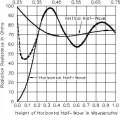
The chart shows the expected radiation resistance VS height of a dipole above perfect ground and above real ground (the dashed portion) in wavelengths. There's also a line for vertical antennas,which you can ignore.
 

Thread Starter

KL7AJ

Joined Nov 4, 2008
2,229
I suppose I should have prefaced my experiment solicitation with the following:

How many folks here know how to make an antenna impedance measurement (R+jX)? (This includes any available means, Antenna analyzer, noise bridge, RX bridge, or other means).

If we have a number of folks who can answer in the affirmative, we can proceed with the experiment.

Stay tuned!
Eric
By the way...if you have the time, could you also measure the antenna at precisely the third harmonic? You should get 0 reactance somewhere around 21.4 MHz or thereabouts.

Thanks!
Eric
 

Papabravo

Joined Feb 24, 2006
22,082
3ed Harmonic data
Code:
   MHz     Z
19.500  93 - j201
19.750  86 - j194
19.990  84 - j191
20.000  84 + j191
20.200  84 + j191
20.400  78 - j184
20.600  77 - j182
20.800  72 - j177
21.000  71 - j177
21.200  72 - j174
21.400  68 - j168
21.600  65 - j167
21.800  66 - j165
22.000  62 - j160
Sorry the resolution of the DDS is 10 kHz. Was the sign flip between 19.990 and 20.000 expected? Is that the actual third harmonic.
 

Thread Starter

KL7AJ

Joined Nov 4, 2008
2,229
3ed Harmonic data
Code:
   MHz     Z
19.500  93 - j201
19.750  86 - j194
19.990  84 - j191
20.000  84 + j191
20.200  84 + j191
20.400  78 - j184
20.600  77 - j182
20.800  72 - j177
21.000  71 - j177
21.200  72 - j174
21.400  68 - j168
21.600  65 - j167
21.800  66 - j165
22.000  62 - j160
Sorry the resolution of the DDS is 10 kHz. Was the sign flip between 19.990 and 20.000 expected? Is that the actual third harmonic.
I'd expect something a lot closer to 0J somewhere near resonance. Did you try redoing the 40 meter readings without the coax?
 

Papabravo

Joined Feb 24, 2006
22,082
As I explained in the second set of readings the instrument shows ">600", meaning greater than 600 Ohms impedance for the entire 40 M band. I moved up from there to see if there were meaningful readings. Maybe I should have moved down from there to see if there were meaningful readings. I've put thing away for the night but I can do lower than 7 MHz tomorrow.
 

Thread Starter

KL7AJ

Joined Nov 4, 2008
2,229
As I explained in the second set of readings the instrument shows ">600", meaning greater than 600 Ohms impedance for the entire 40 M band. I moved up from there to see if there were meaningful readings. Maybe I should have moved down from there to see if there were meaningful readings. I've put thing away for the night but I can do lower than 7 MHz tomorrow.
Roger that.

Well, thanks immensely! We'll see how this compares to my modeling

73!
Eric
 

Thread Starter

KL7AJ

Joined Nov 4, 2008
2,229
The meter was at the end of the coax. I can repeat the measurement with out the coax.
I've never seen that chart before. Would an explanation be to much to ask?
New Data
Code:
   SWR   Mhz       Z
   3.4   4.450  187 + j0
   6.0  15.260  133 + j148
   6.5  26.300   64 - j125

MHz      Z
7.970  670 + j0
8.000  670 + j0
8.100  670 + j0
8.200  594 + j0
8.400  525 + j0
8.600  525 + j0
8.800  465 + j120
9.000  417 + j189
9.200  374 - j233
9.400  337 - j260
9.600  306 - j273
9.800  278 - j282
10.00  254 - j283
The first three lines are asking the instrument to find the minimum SWR in the ranges 1-10,10-20,and 20-30 MHz. The remaining data was taken by starting at 7.000 MHz ( the bottom of the 40 M band) and going up until I could find actual readings. If the impedance is greater than 600 Ohms it justt says ">600"
Hey!

Just for your information (no need to measure anything now) your measurement at 4.45 MHz is right on the money, according to NEC modeling!

So, this shows your method is good. When we get a chance, we can focus around that region!

Eric
 
Top