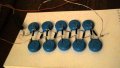
ok Im trying to create a villard cascade/voltage multiplier but i don't know if i can use electrolytic capacitors in replace of ceramic capacitors? any help/advice will be really helpful. I did not create this but want to know if the ceramic capacitors could be replaced by electrolytic capacitors?
The Willard circuit as well (in the lesser extent) the Cockroft-Walton circuit are VERY sensitive about no-load current losses (capacitor self-discharge). I remember too painful I build a "vary much stage" multiplier where to get a cheapness I used some very old 0,015 nF capacitors of 60~ies, just laying into shelves for half century. With 1N4007 from 220V 50Hz it worked just three cascades and then voltage diminished and even fell down. Logically, I tested all diodes, mistakes on wiring, tested capacitance - all is OK. Then I just rearranged circuit be fed by not N1 but n-3 cascade - result: OK about 660V but rather 580 (on non loaded output). Then input is n-6, Output 150, input n-9, output 4 Volts. All is lost somewhere.
I made a new PCB with new capacitors and new diodes what every was individually tested before soldering, the result was same. AND THEN I got an idea to measure the tan(fi) of those capacitors. It was about 0,09. Thus the 9% of energy are going to heat in every recharge cycle!!! Of course, after changing the capacitor kind everything begin to work well.
And You shall get the same problem, as ALL the electrolytes has vary high loss factor alias high self-disharge current. If Your cascade count is some 3-5, You may try, if more, don`t believe You will succeed.
ok ive done some of the research on them and i just have another question when i increase from lets say (stage 1 to stage 2) do i have to increase the capacitence of the caps every stage?
100n will pass 3.5mA It does not matter how many stages you have. But there are some losses in each stage and each stage will only pass about 95% This means that after about 25 stages, the output will be nearly zero.
You only need a few microamps out to create "electric wind." Also called "coronal discharge" Or "particle floculation" or "ozone generation" or "air purifier"
Each cap's voltage is stacked on top of the previous cap. The circuit effectively has the capacitors in series, so each one sees a fraction of the total output voltage.