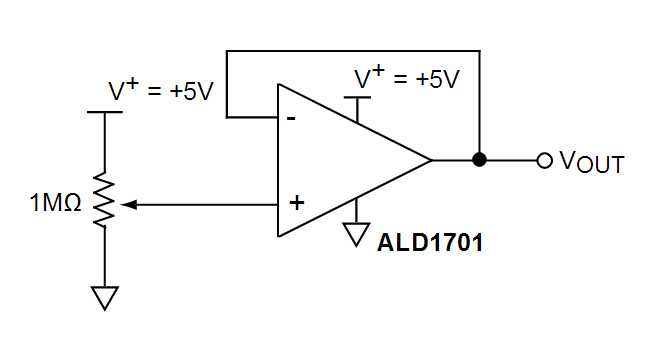
I need a voltage follower with >= 1Amp output for experiments

to3metalcan

Joined Jul 20, 2014
263
What would you suggest in diodes, I am not up with their characteristics and could save some time.
I'm not going to be able to take the time to find a specific part number, but you're going to want a common-anode pair (two diodes on one die in a transistor-shaped package) since they'll be the most similar to one another and will thermally track each other, and you'll want to find something with low leakage and a repetitive reverse-voltage that works for your application.
 

Thread Starter

Gazza_AU

Joined Mar 24, 2017
17
I'm not going to be able to take the time to find a specific part number, but you're going to want a common-anode pair (two diodes on one die in a transistor-shaped package) since they'll be the most similar to one another and will thermally track each other, and you'll want to find something with low leakage and a repetitive reverse-voltage that works for your application.
It has been suggested:
Quote: I think you need a resistor from (-) input of the amp to ground. 10k ??
I want a small amount of current flowing to keep the diode turned on all the time.

How about MUR1620CTRG ULTRAFAST RECTIFIER 16 AMPERES, 200 VOLTS
http://www.mouser.com/ds/2/308/MUR1620CTR-D-79742.pdf

-----------------

To share here, what I shared on another forum on the subject!

I am interested in driving 17x FET (Or Alternative) from picaxe 28X2 outputs,
in replace of: Relay Board Module Optocoupler LED for Arduino PiC ARM AVR
Relay Data Sheet: https://www.ghielectronics.com/downloads/man/20084141716341001RelayX1.pdf
SRD-05VDC-SL-C Rated: 7 Amp Resistive or 3 Amps Inductive at 28V DC.
Volts x Amps = Watts
28v x 7 Amp = 196W DC
3.529v x 55.5A = 196W DC


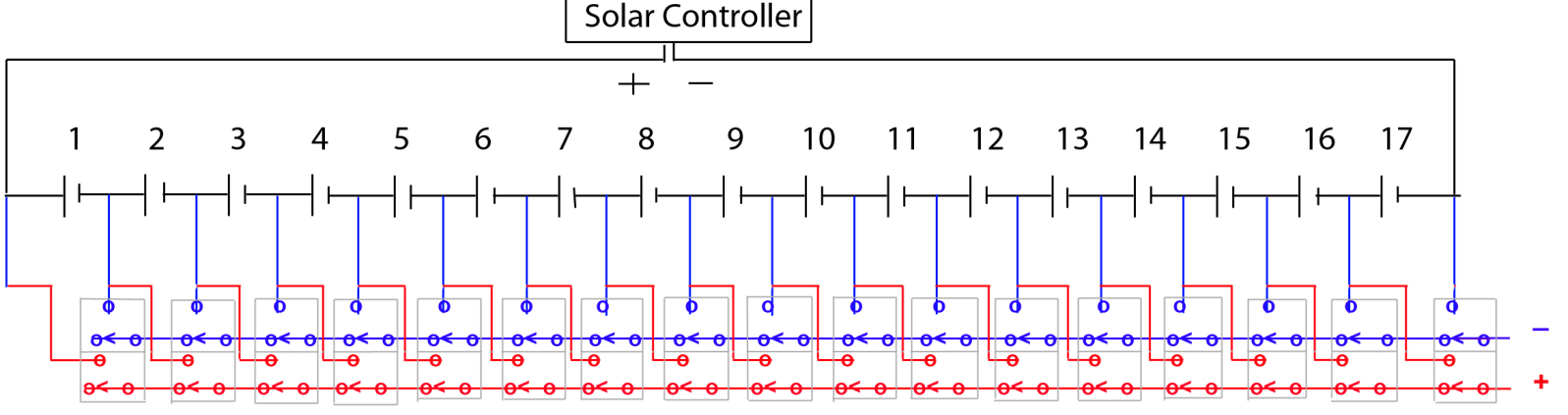
The relays are not easy to replace, as they are tapping into a series string of cells and are bidirectional.
That said, the aim was to top cells as the primary function, which means only one direction.
The bidirectional approach may be better, but simplicity for more reliability rules!

I suspect the same logic can be achieved with solid state if you are smart enough with electronics.
The current flow will be limited and peak as the capacitor charges, after which it is determined by voltage difference between 1/17th divider voltage of Capacitor and the "actual individual cell being tapped" in the 17 series cells.
I am just plodding through and picking stuff up on the way.

-----------------
Let me know if you think this or another option
Thanks,
Gary
 
Last edited:

to3metalcan

Joined Jul 20, 2014
263
If your goal is perfect isolation of the cells, I'm not sure what you gain by going to a solid-state solution. I agree that you need to tie the (+) input to ground.

From what you're describing, it sounds like you're trying to compare the average charge of the cells (the total divided by 17) to the actual charge of the 17th cell?
 

Thread Starter

Gazza_AU

Joined Mar 24, 2017
17
Gazza, you only need a single op amp and transistor like post#6, or Darlington pair for higher current, you will get the same results with either, the Darlington will give upto 10amps, a Tip121, Tip126, 2n3055, Mje3055, any will give you 1amp.
View attachment 124590
I want to build a simple piece of equipment to test for any effect in one-way balance system described.

The logic starts with cheap and simple.
Comparisons:
1/ Using cells in parallel incurs little imbalance. (Connected 100% of time = No imbalance)
2/ A source voltage above another dominates. (Declining over time to equalization) Re: Capacitors and cells!
3/ Work = The Cells initial state and the Capacitor decline time to equalization, and the Cells time connected to Capacitor during charging period.
4/ Different Batteries in Parallel:

My wish is to keep it simple with one-way flow from Cap to Cell.
I would appreciate any input to my circuit and the resistor values.
===============================================================


Circuit Description:
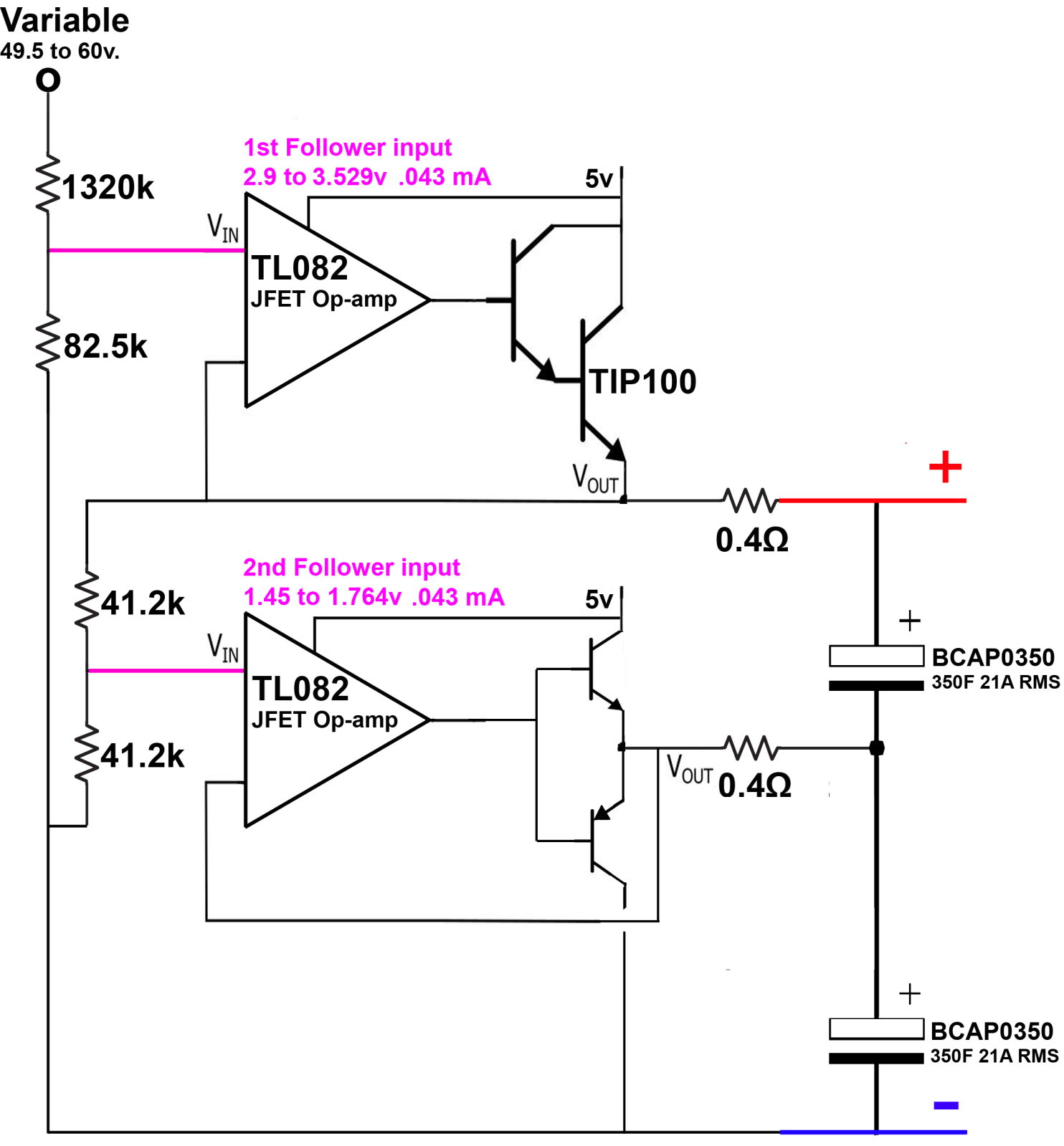
The 1/17th voltage divider is connected across Solar Charger for 17 Lifepo4 Cells.
This follows changes in supply rail during charging, on any set charging voltage.

The 1/17th voltage is obtained with a 1/17 voltage divider connected to Opp Amp as shown below.

The second Opp Amp divides this voltage, in order to efficiently charge 2 series capacitors.

By design, this equipment has no effect unless the capacitor is of higher voltage then cell.
This equipment is to test the effect of a one-way balance system.

Function After Capacitor is Charged:
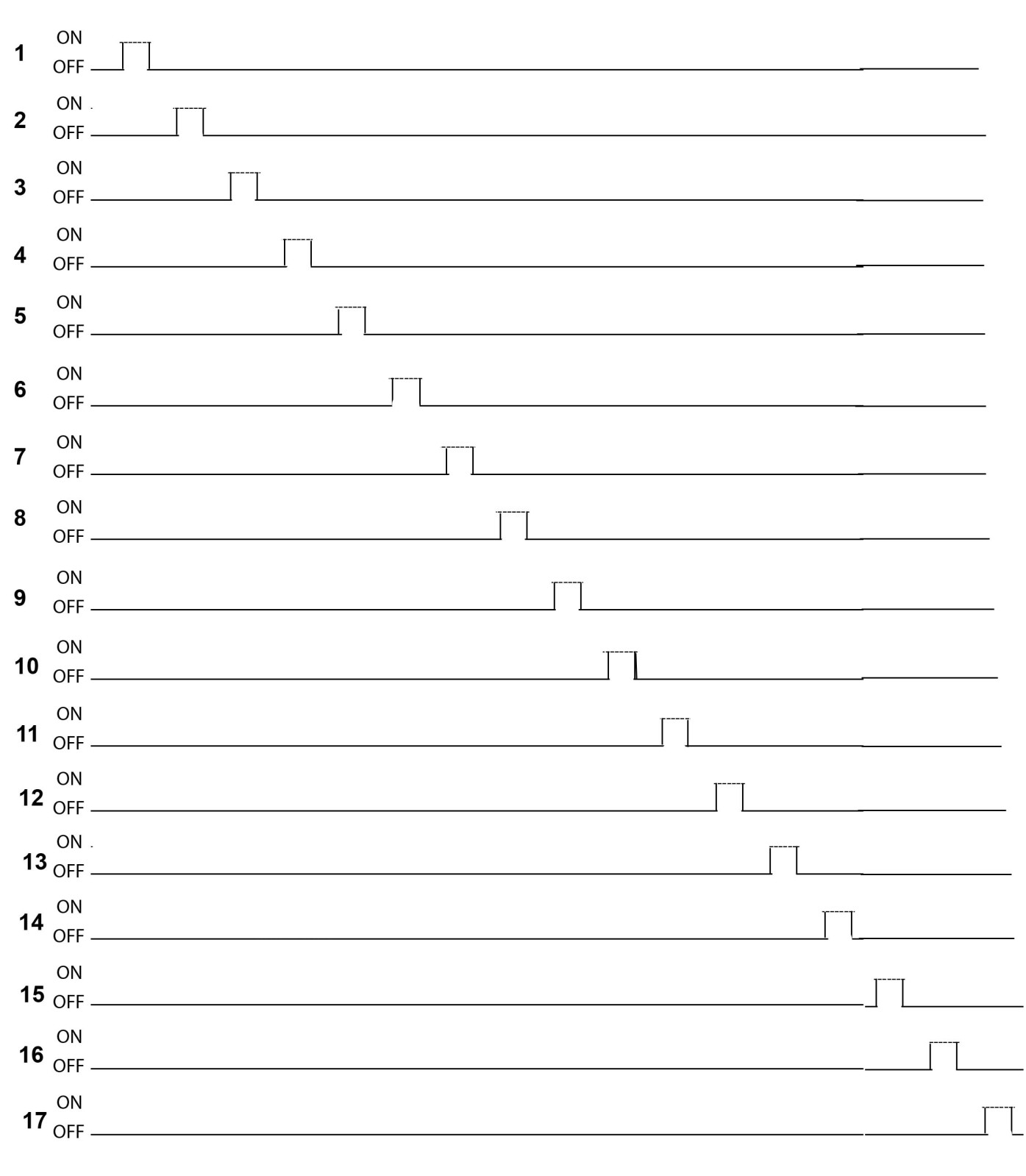
The capacitor will be tapped into a cell in parallel.
During this time, any voltage it holds above the cell will transfer.
Before being disconnected from cell and charged back up to the 1/17th reference.
Repeat process for each cell.

The individual cell sequence runs in conjunction with the banks series voltage charger 49.5 to 60v. The 1/17th voltage division is 2.9v to 3.529v.

===============================================================


Part Selection:

Operational Amplifier (JFET-input) -
TL082
Mouser Part No: 595-TL082IPE4 (not sure if this is the right version?)
http://au.mouser.com/ProductDetail/Texas-Instruments/TL082IPE4/?qs=odmYgEirbwxFprZo7erKcw==
Datasheet: http://www.ti.com/lit/ds/symlink/tl082.pdf
Darlington - TIP100 60v
https://www.onsemi.com/pub/Collateral/TIP100-D.PDF
Collector Current
Continuous 8A
Peak 15A

Capacitor - Maxwell Technologies BCAP0350 $16.07 AUD
http://www.mouser.com/ds/2/257/Maxwell_BCSeries_DS_1017105-4-341252.pdf
350 F
ESR 3.2 mΩ
2.85 V
Leakage Current 0.30 mA
Thermal Characteristics - Maximum Continuous Current 21A RMS @15C.
-
2x Maxwell BCAP0350 Capacitor in Series.
175 F
ESR 6.4 mΩ
5.7v
10.5A RMS
------------------------------------------


Common Anode Dual Rectifier - MUR1620CTRG (Not sure if I need diodes or not???)
http://www.mouser.com/ds/2/308/MUR1620CTR-D-79742.pdf
Average Rectified Forward Current 8A
Peak Repetitive Surge Current 16A
 
Last edited:

ronv

Joined Nov 12, 2008
3,770
I want to do some experimentation with a 60v charger connected to 17x Lifepo4 cells in series.

The idea is the 2 resistor voltage divider will be connected across Battery Bank.
The voltage between resistors is Bank Voltage divided by number of cells.

Shown are (16KΩ + 1KΩ) resistor values for 17 cell Bank
So the voltage between resistors is the equivalent of a single cells charge voltage.
The 1 17th voltage will follow voltage changes across the bank.

What would be the best IC or circuit for at least 1/1.5 Amp output.
If I understand correctly what you are looking for is a balancer
Here is a portion of a switched capacitor balancer. I built for a golf cart.
Using FETs eliminates the concerns over precise voltages since the voltage drop is so small.
What it is is a series of floating half bridges. One set turns on and charges a large cap to the first batteries voltage. On the next 1/2 cycle this capacitor is then switched across battery 2. If battery 2 is at a lower voltage than battery 1 the cap charges battery 2. If battery 2 is at a higher voltage than battery 1 the cap is charged to the higher voltage and on the next 1/2 cycle it charges battery 1. It runs at about 1Khz so the battery voltages converge. In the golf cart I let it run all the time, but you could just run it during the charge cycle.
If this is what you have in mind I would want to review it again as I had a bug the first time.
upload_2017-4-17_12-31-11.png
 

Thread Starter

Gazza_AU

Joined Mar 24, 2017
17
I have taken a glance at components

Just to clarify my plan based on yours.
Where your design has 2x IR2117 per channel/cell.
$3.65 + 40c for MOSFET = Over $136 in these parts alone.

And the design is still not doing what I want do with $1.06 and some resistors>

Compared to My design using 1 595-TL082IPE4 shared with each cell, $1.06
More correctly, the capacitor bank is shared with each cell.

The half bridge would need to supply the series division voltage to top Capacitor,
and the half input output to the second Capacitor in Series.

Op-amps are a very cheap solution providing the voltage division with Capacitor series charger and spare logic gates.

The op-amp solution is simple, the question being reliable design.
Given the voltage division equivalent being fundamental to design and test.

Taken that I deliberately set about to build a circuit to test my design.
I will stick with op-amp design.


Cheers
 
Last edited:

ronv

Joined Nov 12, 2008
3,770
I have taken a glance at components, and often have need to source and sink loads in design.
NTD4856N: Are there source and sink equivalent in N−Channel MOSFET, or can the same be used for both?

Just to clarify my plan based on yours.
Where your design has 1 IR2117 per channel/cell.
My design would use 1 IR2117 shared with each cell,
More correctly, the capacitor bank is shared with each cell.

The half bridge would need to supply the series division voltage to top Capacitor,
and the half input output to the second Capacitor in Series.

Op-amps are a very cheap solution providing the voltage division with Capacitor series charger and spare logic gates.

It has been suggested the 1/17th Solar Charger voltage be derived through a PWM.
This assumes that half bridge was driven by Solar Charger with up to 60V,
and PWM allowed throughput of 1/17th voltage.

It is unclear if only 1 half bridge would be required to track 1/17th of Solar Charger voltage,
and provide Capacitor charging division.

The op-amp solution is simple, the question being reliable design.
The PWM solution could arguably be more reliable?
With more complexity and cost!

Given the voltage division equivalent being fundamental to design and test.
Need to look at the Half Bridge to see how it could be incorporated into design.
Then compare price and complexity, to see how it stacks up.

Cheers
The fact that only the first cell is referenced to ground complicates the design. If you don't take charge from the highest battery won't it get overcharged before the pack is fully charged?
Usually LiFePO4 batteries use shunt balance I think?
 

ronv

Joined Nov 12, 2008
3,770
I am here for help with my circuit design.

You should start your own thread for advice on your design.
There are a few people, likely the same people with different accounts hijacking my thread with the same suggestion.
It is a shame these identities have problems with people not using their design.

Good luck with your design.

My questions for assistance with op-amps is the remaining focus of this thread.
I have used op-amps many times and know the importance of circuit design for reliability.

Old age is making some of the easy stuff a bit harder, just the same,
I appreciate the knowledge of someone that is good in op-amp application.

Thanks,
Gary
My design worked fine. Just trying to help. But you are not making it easy. If you really want help fully explain what you want to accomplish. Otherwise you will waste a lot of time.
 

ronv

Joined Nov 12, 2008
3,770
One last tip.
3. Self balance
Unlike the lead-acid battery, a number of LiFePO4 cells in a battery pack in series connection cannot balance each other during charging process. This is because the charge current stops flowing when the cell is full. This is why the LiFEPO4 packs need management boards.


Thread Starter

Gazza_AU

Joined Mar 24, 2017
17
One last tip.
There are a few people, likely the same people with different accounts hijacking my posts with the same suggestions.
Then comes a string of statements and demands for clarification.

It is a shame these identities have problems with people not using their design.
You should start your own thread to answer your questions.
 

Thread Starter

Gazza_AU

Joined Mar 24, 2017
17
This is what I designed for my specific tests

My questions for assistance with op-amps is the remaining focus of this thread.
I have used op-amps many times and know the importance of circuit design for reliability.

I appreciate the knowledge of someone that is good in op-amp application.


Thanks,
Gary
 
Last edited:

GopherT

Joined Nov 23, 2012
8,009
There are a few people, likely the same people with different accounts hijacking my posts with the same suggestions.
Then comes a string of statements and demands for clarification.

It is a shame these identities have problems with people not using their design.
You should start your own thread to answer your questions.
This is what I designed for my specific tests

My questions for assistance with op-amps is the remaining focus of this thread.
I have used op-amps many times and know the importance of circuit design for reliability.

I appreciate the knowledge of someone that is good in op-amp application.

Thanks,
Gary
I think it will work perfectly. Breadboard it up and give it a go.
 

Thread Starter

Gazza_AU

Joined Mar 24, 2017
17
Last edited:
Top