Facebook
 Google
 GitHub
 Linkedin

Forty-two years since I first used a 555, and today I learned something I didn't previously know.
I think we all know that:
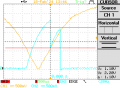 orange is the trigger pulse
blue is the waveform on the capacitor.
The problem is that when the pulse length is controlled by the trigger pulse (i.e. trigger is longer than output pulse) then the output waveform is controlled by just ONE comparator, and so there is no hysteresis, and it jitters just like an LM393 (to which it is closely related) on slow moving waveforms.
When the trigger pulse ends, DISCHARGE should short out the timing capacitor and discharge it, but it only gets halfway before the jitter resets the comparator and it starts charging up again.
The pin 3 waveform is TWO pulses with a very brief interval between them. So small you wouldn't necessarily notice it on the 'scope, but long enough to upset anything that is counting pulses!
The moral of the story is that the "feature" of an output pulse that is as long as the input pulse is a "feature" that is well worth avoiding.
P.S. The real-time clock on my scope is truly hopeless.
I think we all know that:
- 555s always produce clean waveforms, because of the two comparators and the SR latch, and a large amount of hysteresis.
- The output pulse length is the either 1.098RC or the length of the trigger pulse, whichever is longer.
orange is the trigger pulseblue is the waveform on the capacitor.
The problem is that when the pulse length is controlled by the trigger pulse (i.e. trigger is longer than output pulse) then the output waveform is controlled by just ONE comparator, and so there is no hysteresis, and it jitters just like an LM393 (to which it is closely related) on slow moving waveforms.
When the trigger pulse ends, DISCHARGE should short out the timing capacitor and discharge it, but it only gets halfway before the jitter resets the comparator and it starts charging up again.
The pin 3 waveform is TWO pulses with a very brief interval between them. So small you wouldn't necessarily notice it on the 'scope, but long enough to upset anything that is counting pulses!
The moral of the story is that the "feature" of an output pulse that is as long as the input pulse is a "feature" that is well worth avoiding.
P.S. The real-time clock on my scope is truly hopeless.