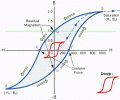
Hysteresis loop. 3 Questions. Heat + Magnetising before saturation.

Thread Starter

Silhorn L

Joined May 2, 2017
7
Hello,
I've got 3 questions.

Question 1.
I am at point F. If I magnetise the material only to 0.5 flux and I remove all current. Since this material can retain up to 1.0 flux then the upon removal of current, the flux should stay at 0.5 correct?

Question 2.
I am at point F. If I magnetise the material only to 1.5 and then remove all current, the flux will drop to and remain at 1.0 correct?

Question 3.
I am at point B, I need to apply reverse current to demagnetise material to 0 flux. This creates heat within the material because of energy being used to demagnetise. If I am at point F and magnetise material to point A, will heat also be created, since energy should be done to magnetise the material? I am saying yes since both procedures change the magnetic flux of the material.
 

MrAl

Joined Jun 17, 2014
13,693
Hi there,

Question 1:
For a symmetrical drive the curve is always a loop that encloses the origin and the progression is relatively smooth except at the far H ends. For non symmetrical drive, the curve is still a loop although the part of the loop where the current changes abruptly will also change fast. This means if you can reduce the current to a low value from a high value, the loop will suddenly 'snap' back to the B axis, but since it's always a loop it does not actually go through the origin and so therefore the ending point is going to be on the B axis. This means there will always be some remnant flux for an abrupt change in current that drops to a very low value like zero. The flux may still drop a little however as we reduce the current, so it could be less than the last value just before the current was reduced. I would think a square BH loop would stay more constant than a softer loop though, but i wont try to pin a numerical value on this.

Question 2:
That's what happens, yes. For currents that take the B higher the loop will snap back to the B axis at the characteristic point for that material.

Question 3:
The energizing energy is higher than the demagnetizing energy. Both are causing physical changes, therefore both would generate heat.

Since this is in the homework section though, you should mention what resources you where given for these questions. You might also want to try to calculate some of this stuff. You should show how YOU would go about solving these problems if this is really some kind of homework.
 

Thread Starter

Silhorn L

Joined May 2, 2017
7
Ok so if I understand correctly, if the material is magnetized at any point above point B and then current removed, it will always snap back to point B, the characteristic point.
If the material would be magnetized at any point below point B and then current removed, the flux will not remain at that point but be lowered to a very low value.

Never thought it would end up like that.

Thanks for your answer.

Yes, it is part of my homework, but the questions were just some I thought up. I was learning about the hysteresis loop and was wondering what would happen in those circumstances.
 

MrAl

Joined Jun 17, 2014
13,693
Ok so if I understand correctly, if the material is magnetized at any point above point B and then current removed, it will always snap back to point B, the characteristic point.
If the material would be magnetized at any point below point B and then current removed, the flux will not remain at that point but be lowered to a very low value.

Never thought it would end up like that.

Thanks for your answer.

Yes, it is part of my homework, but the questions were just some I thought up. I was learning about the hysteresis loop and was wondering what would happen in those circumstances.
Hi again,

"If the material would be magnetized at any point below point B and then current removed, the flux will not remain at that point but be lowered to a very low value."

Sorry, I did not say that. What i said was that if the flux is not taken above the point B then when the CURRENT is reduced to a very low level then the curve will snap back to the y axis at a point that may be lower than B but it depends on the magnetic 'hardness' of the material. For a hard material the curve would stay flatter than for a soft material. For a soft material the curve would lower somewhat but i dont think it would go to nearly zero. Remember the curve is always a loop that encloses the origin unless we take very special steps to get it to zero. Being a loop with the origin in the center, it never goes through the point (0,0). This is even more evident by examining the process of degaussing a magnetic sample. To get the flux to be nearly zero, we have to apply an AC signal that decreases little by little in amplitude. This takes the flux to a lower and lower value until we get near the origin (0,0).

Look at the red BH curve in the attachment. You can see that the loop crosses the B axis at a point lower than your original curve did. That's the point where the current is zero. You can also notice that the point where it crosses the B axis is just slightly lower than where it was at the far right upper point. It's not a lot lower, just a little.

From either BH curve we can see that if we knew the right amount of reverse current to apply we might get the flux to go to zero, but we'd have to know the exact amount of bias needed to do this.
 

Attachments

Last edited:
Top