Facebook
 Google
 GitHub
 Linkedin

I think any process that converts H2 and CO2 into a hydrocarbon fuel is going to have to consume energy, because the energy content per mole of H2 and CO2 is almost certainly significantly less than the hydrocarbon. H2, as the standard state for hydrogen, has and enthalpy of formation of 0, but CO2 has an enthalpy of formation of -393kJ/mol.Thanks for the link.
From their technology page;
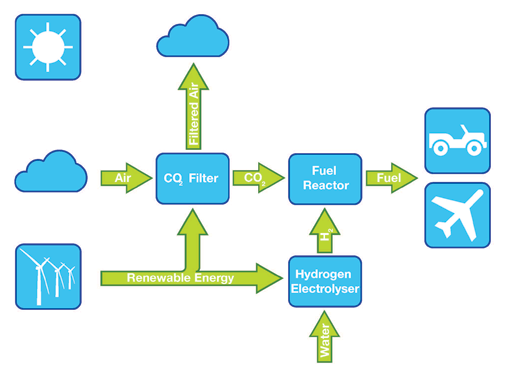
http://airfuelsynthesis.com/technology.html
It looks like they are using renewable energy and standard electrolysis to make H2, then renewable energy to extract the CO2 from air, then another process (that does not consume energy?) to convert H2 + CO2 into a hydrocarbon fuel.
Are there any chemists here who could discuss that? And if the principles could be adapted to a low cost home setup?

If they want to produce propane (C3H8), for instance, it has an enthalpy of formation of -25kJ/mol.
They need:
4H2 + 3CO2 = C3H8 + 3O2
Thus they need to add 1.1MJ/mol of propane produced even if their process is 100% efficient.
There's a LOT of snake oil in this area. I have no idea whether this company is one of them or is for real. A lot of stuff on their site makes me suspicious, though.