Hydrogen as fuel

WBahn

Joined Mar 31, 2012
32,878
Thanks for the link. :)

From their technology page;

http://airfuelsynthesis.com/technology.html

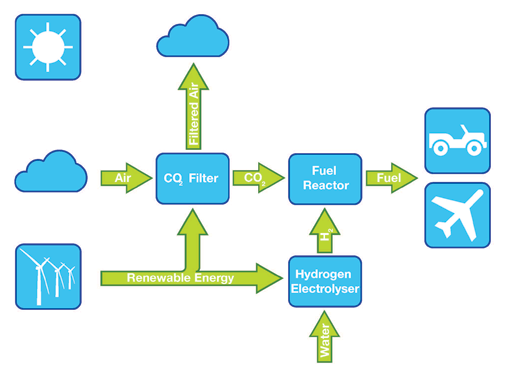
It looks like they are using renewable energy and standard electrolysis to make H2, then renewable energy to extract the CO2 from air, then another process (that does not consume energy?) to convert H2 + CO2 into a hydrocarbon fuel.

Are there any chemists here who could discuss that? And if the principles could be adapted to a low cost home setup?
I think any process that converts H2 and CO2 into a hydrocarbon fuel is going to have to consume energy, because the energy content per mole of H2 and CO2 is almost certainly significantly less than the hydrocarbon. H2, as the standard state for hydrogen, has and enthalpy of formation of 0, but CO2 has an enthalpy of formation of -393kJ/mol.

If they want to produce propane (C3H8), for instance, it has an enthalpy of formation of -25kJ/mol.

They need:

4H2 + 3CO2 = C3H8 + 3O2

Thus they need to add 1.1MJ/mol of propane produced even if their process is 100% efficient.

There's a LOT of snake oil in this area. I have no idea whether this company is one of them or is for real. A lot of stuff on their site makes me suspicious, though.
 

THE_RB

Joined Feb 11, 2008
5,438
Thanks for the info that was much appreciated.

I was not sure if their site was "suspicious" although it did look to me to be rather short on information. It would have been nice to see more info on the processes involved, of course some of the specifics would be secret but I assumed much would be standard practices and could be described in at least some detail.

If I understand you right you are saying the energy contained in H2 and CO2 is less than the energy contained in a hydrocarbon fuel (that has roughly the same H and O proportions) which means significant energy must be added to "join" the H2 and CO2 to make a hydrocarbon fuel?

That might not be a deal breaker, as energy put in to all the processes will be accessible on burning the hydrocarbon fuel. The issues of course are the efficiencies of all the energy steps in making the fuel, and of course things like cost of consumables and plant depreciation etc.
 

Thread Starter

Wendy

Joined Mar 24, 2008
23,798
Thing is, if you can make energy from many sources, but using it for automotive fuel is pretty picky. The Germans were supposed to have done something similar during WWII when they were cut off from the oil fields, but I'm not a believer.

If it is a stable source of fuel, cost becomes less important. It is still important, but not as important as having fuel sometimes. I remember the gas lines (several times), it ain't no fun at all.
 

WBahn

Joined Mar 31, 2012
32,878
Thanks for the info that was much appreciated.
Sure thing, glad it was useful.

I was not sure if their site was "suspicious" although it did look to me to be rather short on information. It would have been nice to see more info on the processes involved, of course some of the specifics would be secret but I assumed much would be standard practices and could be described in at least some detail.
Exactly. Furthermore, you would thing that perhaps the best business model for something like this is to patent the process (which means that all details have to be revealed -- though there may be some exceptions) and then license it world-wide. I think that would return much more profits than trying to hold on to it themselves. But even if this is the best business model, they may not agree.

If I understand you right you are saying the energy contained in H2 and CO2 is less than the energy contained in a hydrocarbon fuel (that has roughly the same H and O proportions) which means significant energy must be added to "join" the H2 and CO2 to make a hydrocarbon fuel?
Exactly, though there was nothing roughly the same in the example I gave, it was a balanced equation (unless I screwed it up).

And a megajoule per mole is a sizeable amount of energy to make up (nature is real good at packing lots of energy into small things). A mole of propane weighs about 44g, so a 5lb propane tank, which is about 2250g, is more than 50 moles, requiring an injection of over 50MJ. Assuming that solar was used and that nearly all of the roughly 6kWh/m^2/day could be captured, then that would be about 22MJ/day/m^2. I have little idea what reasonable efficiencies might be, but I seem to recall that natural photosynthetic processes are typically in the 33% range, so if that's the case you would need to harvest all of the light from about 6m^2 (perpendicular to the sun) on clear days to fill one BBQ propane tank per day. Right now, the sale price of that propane, wholesale, is about $1/gallon and a 5lb propane tank generally holds about 1.2 gallons of propane, so it is worth about $1.20. Assuming a location with very few overcast days, that means that their operation is producing a monthly revenue of about 65 cents per square foot. That's not very good, particularly considering the capital investment and almost certainly considerable operating overhead required to produce it. Even a decade ago suburban office space where I worked produced about $1/sf of monthly revenue and if you have even a pretty modest multistory building, then you can easily exceed that even after including the area of the parking lot and other grounds.

So I have to really question the economic viability of something like this any time soon. Of course, if the government (of whatever country) throws a bunch of subsidies at it in order to pick the winners and losers, then who knows.


That might not be a deal breaker, as energy put in to all the processes will be accessible on burning the hydrocarbon fuel. The issues of course are the efficiencies of all the energy steps in making the fuel, and of course things like cost of consumables and plant depreciation etc.
If they are using strictly renewable energy (or even nuclear), then the energy input is not too relevant (except, as you noted, for the costs involved in harvesting that energy). As their site notes, this is essentially how the natural biological processes worked to turn sunshine into fossil fuels to begin with. But nature had a lot more area (the entire planet) and time to work with and didn't have to turn a profit.

I fully expect (perhaps not in my lifetime) for us to develop bacteria or other organisms that harvest solar energy and secrete useable oil in some form or other. There is nothing magical or prohibitive about the concept, just really hard to figure out how to engineer the little buggers.
 

massive

Joined May 7, 2010
20
hi, I dont think theyd be using solar any time soon in England ,theres not a blue in the sky on any given day!
the do have wind farms off shore , they do got plenty of wind. My sister got a tin of london fog to proove it.

I had a look at CRC handbook of chem + physics 1997
composition of air
N2=78.084%
O2=20.9476%
Ar=.934%
CO2=.0314%
Ne=.001818%
CH4=.0002%
He=.000524%
Kr=.000114%
H2=.00005%
Xe=.0000087%
......note the content of CO2!!! any way I thought all of these have to be calced into the mix too.....
 

WBahn

Joined Mar 31, 2012
32,878
hi, I dont think theyd be using solar any time soon in England ,theres not a blue in the sky on any given day!
the do have wind farms off shore , they do got plenty of wind. My sister got a tin of london fog to proove it.

I had a look at CRC handbook of chem + physics 1997
composition of air
N2=78.084%
O2=20.9476%
Ar=.934%
CO2=.0314%
Ne=.001818%
CH4=.0002%
He=.000524%
Kr=.000114%
H2=.00005%
Xe=.0000087%
......note the content of CO2!!! any way I thought all of these have to be calced into the mix too.....
Why? How? What's your point?
 

massive

Joined May 7, 2010
20
Air is where they claim to get the CO2 , its a SMALL percentage.
How are they planning on collecting CO2 ? thats more energy input/cost.
Id expect them to liquify the air and extract the other chems to sell .

**Ive had a nother look at the basic diagram and it shows filtered air released, I was thinking the nitrogen would have to be in the formula but being on the out side I dont know what theyre doing.
 

Thread Starter

Wendy

Joined Mar 24, 2008
23,798
Small is relative. It still adds up to huge amounts, and the effects of even a little increase is disproportionate to the amount added. What we need is a closed loop, where we don't introduce new sources of CO2, and start using some of the material we have already added.
 

MvGulik

Joined Nov 3, 2011
41
How are they planning on collecting CO2 ?
i) Air is blown up into a tower and meets a mist of a sodium hydroxide solution. The carbon dioxide in the air is absorbed by reaction with some of the sodium hydroxide to form sodium carbonate. Whilst there are advances in CO2 capture technology, sodium hydroxide has been chosen as it is proven and market ready.

ii) The sodium hydroxide/carbonate solution that results from Step 1 is pumped into an electrolysis cell through which an electric current is passed. The electricity results in the release of the carbon dioxide which is collected and stored for subsequent reaction.
Source "Technical Review" page. (direct URL link is giving a 500 error. Silly cookie protection stuff I imagine.)

---

Needles to say that if there is a CO2 source(Other factory rest output) in the area. A CO2 transport pipe system will probably be added.
 
Last edited:

WBahn

Joined Mar 31, 2012
32,878
Air is where they claim to get the CO2 , its a SMALL percentage.
How are they planning on collecting CO2 ? thats more energy input/cost.
Id expect them to liquify the air and extract the other chems to sell .

**Ive had a nother look at the basic diagram and it shows filtered air released, I was thinking the nitrogen would have to be in the formula but being on the out side I dont know what theyre doing.
It's the same small percentage that plants, trees, and other photosynthetic organisms have no trouble getting more than enough CO2 from. But if that were to be come an issue, then there are lots of ways of dealing with it. For instance, form an agreement with a large CO2 producer, such as a conventional power plant, and route the exhaust through the system collectors.
 

WBahn

Joined Mar 31, 2012
32,878
Source "Technical Review" page. (direct URL link is giving a 500 error. Silly cookie protection stuff I imagine.)

---

Needles to say that if there is a CO2 source(Other factory rest output) in the area. A CO2 transport pipe system will probably be added.
That second step, using electrolysis, is going to significantly reduce the therodynamic efficiency of the whole process. They will be spending a lot of energy to get a gas as there starting point that has a highly negative enthalpy of formation to begin with. But, again, if they can use renewable energy then that is not a big concern in and off itself, but it further reduces the return on investment and profit per area and profit margin and every other economic measure of viability.
 

THE_RB

Joined Feb 11, 2008
5,438
But doesn't this first step release energy as heat?;

"i) Air is blown up into a tower and meets a mist of a sodium hydroxide solution. The carbon dioxide in the air is absorbed by reaction with some of the sodium hydroxide to form sodium carbonate. "
 

WBahn

Joined Mar 31, 2012
32,878
But doesn't this first step release energy as heat?;

"i) Air is blown up into a tower and meets a mist of a sodium hydroxide solution. The carbon dioxide in the air is absorbed by reaction with some of the sodium hydroxide to form sodium carbonate. "
I'm not sure. You have mechanical and chemical processes going on simultaneously and would have to analyzed as a system. For the chemical side, the enthalpy of formations are as follows:

NaOH (aqueous): -470 kJ/mol
Na2CO3: -1130 kJ/mol
CO2: -394 kJ/mol
H20 (gas): -242 kJ/mol

2NaOH + 2CO2 => 2Na2CO3 + H2

I don't know if this is correct or not. If it is, then the chemistry would release about 250 kJ/mol. The sodium carbonate is much lower in energy than the CO2 that they eventually need, so they are going to have to add energy to get back to something that they will need to then add much more energy to get to what they eventually want.

Seems like they are digging themselves an awfully deep hole.
 

THE_RB

Joined Feb 11, 2008
5,438
Thanks WBahn, interesting info for sure!

I'm wary about companies whose "returns will be in the long run" and "the value is in the IP rights" etc...

This is not really rocket science it's basic chemical processes. So if something works then right now they would have a setup that consumes X electrical energy and produces Y amount hydrocarbon fuel.

An absolutely quantifiable input:result ratio, and reputable companies would probably be promoting those base figures along with realistic predictions of future gains in efficiency, all part of an honest marketing plan. We expect that from photosolar developers.

Someone in the alternative energy industry that does NOT release those base figures usually has something that does not work, or something that works so badly they need to sell the concept instead of the reality... Like fusion.
 
Hydrogen is a good fuel it releases a lot of energy and can do it quite fast and at high temperatures. It is also good being an element it does not degrade over time and go off (or change characteristics) as many hydrocarbon fuels tend to do.

However it is not easy to store with current technology being very bulky and requiring more energy for compression prior to storage. Hopefully some of the new work on storing hydrogen in metal substrates or other forms will be good, but I personally think the big breakthough will come with some discovery of how to turn the hydrogen into a liquid fuel like gasoline which can be transported, handled and used with the same ease.

I really see that as the future vehicle energy system; renewable energy (solar etc) used to generate the hydrogen, then the hydrogen converted to a liquid fuel, then cars being fairly similar to what we already have (internal combustion) with some hybrid electric capability.
Reading your post I remember hearing about how some R&D Team that was part of a U.S. Government/Fuel Crop Farmers Union and this R&D Team was specifically sited and pointed to as A Waste of U.S. Tax Dollars by members of Congress in at first a Closed Door Committee Session and then this Team and the Huge amount of money they were getting was pointed out again in Open Session.

I haven't found a LINK to this yet but I will keep trying but if anyone here remembers...this happened at a time when there was a HUGE debate going on about the ridiculous amount of U.S. Tax Dollars being spent on Farm Subsidies specific for Crops used to produce Ethanol and how the amount of money and the amount of energy and Fuel Burned as well as the amount of CO2 being created just to Grow, Maintain, Harvest, Convert Crop to Ethanol, Have it Shipped to where it would be Mixed with Gasoline as well as the fuel and energy required to do that, the Cost of Public Awareness Programs about Ethanol Mixed Gasoline...etc...etc...Members of Congress where trying to show how the amount of Money and Fuel Burned to create the necessary Energy to do all this, the CO2 created as well as the money put aside to alert the public...was MUCH GREATER THAN IF WE HAD JUST BURNED STRAIGHT GASOLINE!

Anyways...this R&D Team after appearing before Congress in a called hearing and after they were LAMBASTED as they could not provide a reasonable counter point to a member of Congress asking the Question...Considering all the Tax Dollars spent just to grow the crop and make Ethanol never mind the amount of Fuel being used to do this as well...will there be at any point in the future when the cost and energy needed to produce Ethanol will be lower than the cost CO2 and pollution spent or created NOT TO DO SO?

The R&D Team knew there would not be such a point in the future so they tried to get around the issue but were pinned down in a very public way as they could not answer in the manner that the PEOPLE WHO WERE MAKING MONEY OR GETTING DONATIONS WANTED THEM TO BE ABLE TO ANSWER.

So a year latter from what I can remember this R&D Team...that now had a few new members and a new Group Leader...came out and stated they were working on a method of...and forgive me here because I am not fully aware of the proper terminology in chemistry for this process...a method of infusing H2 within ETHANOL along with another additive...which I cannot remember...that is used as a kind of Bonding Agent or some chemical solution which allows Gasoline to hold H2 in kind of the same manner that CO2 exists in a can of soda due to pressure...but in this case...it was not pressure that kept the H2 in suspension within the Gasoline.

The R&D Team reported both successes and failures but it was said that they were on the right path in that the added H2 in suspension in Gasoline...if it was at a proper level as to not release too much energy when ignited...would GREATLY INCREASE by a vast percentage both Fuel Economy as well as it was said Cars would no longer need Gas Tanks greater than 6 Gallons.

If anyone knows or remembers about this...I would appreciate them posting and I will keep trying to find something on this as I have not thought about it for over 10 years.

Split Infinity
 

MrSalts

Joined Apr 2, 2020
2,767
1) Carbon fiber hydrogen cylinders are NOT heavier than a gasoline tank (see funny sculpture below of several tanks shown at CES2023).
2) She compares the energy content of hydrogen to gasoline but fails to discuss the EFFICIENCY differences between Internal combustion and Fuel Cell Stacks in converting the fuel to mechanical energy.
3) she says, solar production of hydrogen can be "inefficient" because of cloudy days and dismisses solar generated hydrogen as if her point is proven. In efficient compared to what? Time? Surface area of solar cell vs hydrogen produced? Who cares, no greenhouse gas is emitted into the environment when a cloud comes overhead. Again, once the hydrogen is used in a fuel cell, way more efficient than gasoline used in a vehicle.
4) she is giving up because of cost when making hydrogen via solar or wind. The cost can easily be equalized vs coal by forcing producers of coal-generated hydrogen to capture the CO2. Not so cheap, right? Also, since all CO2 is not captured, they need to pay a penalty to discourage them from doing it in the first place. There, now we have parity between the cost of hydrogen via fossil fuel and renewable electricity sources.
5) she dismisses Nuclear power because it is not"popular". Apparently, she hasn't acrossed the English Channel because it is extremely popular in France and a source of National pride. In any case, popularity is a mute point, 20-years ago, battery powered cars were not popular either and now one of the richest men in the world made most of his money on battery powered cars. Attitudes change and they change quickly.
6) the argument that hydrogen generation takes too much water ind she claims it will take up to 4% of the water used for irrigation in one of the most arid farm lands in the world is grasping at straws.
7) her comment about freezing membranes and the need to pre-heat is also rediculous. One side of the membrane uses the same sulfuric acid used in lead acid batteries and the membranes only have to be heated enough to avoid condensation once the hydrogen starts getting consumed. This takesno more energy or time than ore-heating a glow-plug on a Diesel engine. Less than one minute - in extreme cold. Most fuel cell vehicles will have some battery reserve and that can be used to roll out of your driveway.
8) her argument about platinum and iridium are weak as well. These metals are already used in catalytic converters - in fact, the largest use of platinum is catalytic converters. Ruthenium and Rhodium are also used in catalytic converters and the supply chain was quickly developed as the need for a Cat on every car was mandated. Also, her headline in the video literally reads, "Platinum Market SURPLUS drops by 47% in 2022 as market continues to grow".
The fact that inventory levels dropped in 2022 has nothing to do with new demand for platinum for fuel cell vehicles. It has to do with high energy costs to mine platinum. Since car production has dropped considerably since the chip shortage started in 2020, platinum inventories grew in 2020 as did inventories of nearly every other raw material used to make cars - nobody was expecting the slowdown. Now, jump to 2022, high fuel costs have caused mining and refining to be paused until the stockpile of platinum was depleted. Fuel cell vehicles are not going to create a significant demand that the platinum mining industry cannot support - and every fuel cell vehicle produced will be one less catalytic converter required. Finally, just like catalytic converters were optimized as time goes on, each fuel cell plate will require less and less precious metal and better mixtures of these catalyst metals will be found.
5) her I'll-informed commentary about hydrogen embrittlement only applies to iron and low carbon steel. Hydrogen reacts with carbides in the interstitial spaces between iron grains in the steel to make methane and iron hydrides and steel loses its strength.

Here is a nice, modern sculpture presented at CES 2023 from the Global Tier 1 automotive supplier and largest producer of light weight tanks. No hydrogen embrittlement. Some small loss if hydrogen over time but no damage done. These tanks are used for compressed natural gas on your clean city bus as well.

1673759864367.jpeg

Not that one person can pick up the sculpture up out of that and move it around.
8) her conclusion is as premature as the gaps she fears are mostly supply chain related - she had no concerns about the effectiveness of generating electrical current from hydrogen.

Supply chain of all components snd hydrogen will follow now that Honda, Toyota snd Kia Hyundai have demonstrated the effectiveness over the last 10 years. Toyota and Honda each ran 3-year fleet tests in california from 2015-2020. Infrastructure for H2 generation was their concern as was manufacturing capacity for the tanks. If you were at CES 2023, you'd know that many companies and billions in investment is coming to solve these issues.
 

drjohsmith

Joined Dec 13, 2021
1,609
Hydrogen is a great gas,
I've done a bunch of work using it over the decades,
its so dammed light, that if a tank punchers is hard to set fire to
the only bad I have seen of it is suffocation risk in a small room , and a few burnt eye brows,
Any way

The basis I see,
is we can't keep taking old stored carbon out the ground,
there is more than sufficient power hitting earth from the sun

Its "just" a way needs to be found to utilise this energy.

It was only 1958 that the UK started a national grid, to share power around the country
Till then, if an area needed more electricity than it could generate, the lights went dim

Hydrogen generation and usage is a way of storing sun light,
it has advantages over a battery, lighter and much quicker to re fill a remote source
it has dis advantage, its a storage medium, so lower efficiency than direct usage

Other ways exist to store sun energy,
H is one of them that has many applications.
 
Top