Howland current pump issue

Thread Starter

hstetina

Joined May 2, 2025
4
Hi, im running in to issues wihth Howland current pump with OPA544. Here is my schematics:
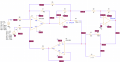
1746221395171.png

When i set the positive currents, everything works fine. Waveform on coil is as expected.
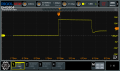
1746221609185.png
But when i try to push negative currents, circuit goes to saturation and only fix is to power cycle. See the waveform
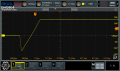
RigolDS25.png

Power supply is -+16V and seems to be stable.

Do you have any hint what can cause this type of behavior? I tried to strip down to basic circuit by removing U3 and behavior is the same.

Thank you,
Hynek
 
Last edited by a moderator:

Thread Starter

hstetina

Joined May 2, 2025
4
Why so many op amps for a Howland current-pump, when it typically only has one?
Main goal was for accuracy. U4 is for fixing the U2 offset. U5 again, to limit the current through R8 = more accurate current through load.
U3 was just for testing and does not make sense in this application. My spec is simple, just to drive constant DC current +-0,75A through 270mH inductor. In simulation, everything works fine, but not in the real circuit. I dont have much experience in analog, and I'm not able to figure out why it goes to saturation.:)
 

Thread Starter

hstetina

Joined May 2, 2025
4
Supply voltage is given. It is a DC current where in later stage will be superimposed small ac signal below 5 Hz. According to positive waveform, peak current in positive direction is set in 6 ms, perfectly fine.
But back to my original question, why negative currents leads to opamp saturation? I have same circuit only with Opa593 for smaller currents where negative currents are ok.
 

crutschow

Joined Mar 14, 2008
38,322
why negative currents leads to opamp saturation?
Difficult to determine by just looking at the circuit.
You need to probe the circuit nodes with the oscilloscope or observe the simulation to see where the saturation is occurring, by varying the current pulse until the saturations starts.
 
Last edited:

0ri0n

Joined Jan 7, 2025
161
But back to my original question, why negative currents leads to opamp saturation?
Why do you have 2 control voltages (V4/V5)? Usually only V5 (+/-2.5V) is needed and R6 is connected to ground.

The current source abruptly puts as much voltage across the load as the supply rails allow if a positive or negative voltage step (V5) is applied at the input. Current into the inductive load then increases/decreases in a linear fashion. The voltage across the load goes back to (close to) zero when the preset current value is reached.

Looks like you experience phase-reversal in the OPA2544 power op amp because the almost rail to rail output voltage of the OPA593 exceeds the common mode input voltage range (VCC,VEE-/+4V) of the OPA2544. This happens in some op amps when configured as non-inverting unity gain buffers and for input voltages in the negative range. Both conditions apply in your case. The need for power cycling also fits as the outputs of both op amp are now permanently stuck at opposite rail voltages.
 
Last edited:

crutschow

Joined Mar 14, 2008
38,322
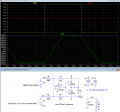
For your interest, below is the LTspice sim of a single op amp, Howland type circuit driving your load, showing the expected response (about 13ms to go between 750mA and -750mA):
It also shows a small, superimposed AC current.

What is the resistance of the inductor?

1746295019851.png
 
Last edited:

tonyStewart

Joined May 8, 2012
231
It would help if you plotted every node and examine the input error (Vin+-Vin-) and observe the non-linear behaviour of saturation followed by loop lockup.

Normally you have a linear negative feedback loop, but there are two conditions when you lose all your gain.
1) output goes to supply rail (near zero gain)
2) exceeding valid input CM range (near zero gain and possible reversed output polarity)

1746303350203.png
Without seeing the plots, I imagine this.

You must limit the output to prevent invalid input CM range.
a) reduce U1 +ve supply by 3.5 V min with a Zener or two Red/Yellow LEDs (4V), and add 0.01 uF shunt cap. This limits the control of Vin+ for U2 limits the drive of the Op Amp below it, U5 input to (V+) - 3.5 min. This demands less current than limiting the output V of your 2A driver, U2 and keep it from inverting the output from input invalid operation. This is a common fault of Pch input Op Amps and may be true for this one.
 

Thread Starter

hstetina

Joined May 2, 2025
4
@0ri0n, @crutschow, @tonyStewart
Thank you very much, with your help I was able to solve the issue and also learn a new stuff.

Nice explanation for me was section 4 from TI app note:
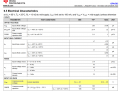
https://www.ti.com/lit/wp/sboa583/sboa583.pdf

Also now i finally fully understand meaning of CM voltage.

Quick fix was to put 6 diodes and lower V- of U4 by ~2V
I tried also limiter with Zener diodes, but only with partial luck.

I know that I'm still not on safe side since CM voltage of OPA544 could be in extreme case -+6V from the rail.

I see a few solutions for next version.
1. Lower the supply voltage of U4
2. Find the power opamp with no phase reversal.
3. Find the opamp which match or exceed CM voltage of OPA593


@ 0ri0n: I use two control voltages, because it will be placed on noisy environment. Output from DAC is differential and placed on another board.
@crutschow: DC resistance si 18 Ohm.

Thanks Hynek
 
Top