How would you find the equivalent resistance for question numbers 25?

WBahn

Joined Mar 31, 2012
33,075
So if the answer is R when a piece of wire, and the answer is R with a resistor in place of the wire, what does that tell you must be true regarding that bottom path? Hint, what is the equivalent resistance if you replace it with a 4R resistor or remove the wire entirely?
 

Thread Starter

donaldparida

Joined Dec 16, 2016
26
@WBahn That it is ineffective. In one way or the other the potential difference across its ends is zero ( In the first case by applying V=IR and in the second case by a applying a result of Ohm's law, i.e., by applying the Wheatstone bridge principle, i.e., the potential difference across the bridge is zero if and only if, the resistances around it are proportional) Right?
 

WBahn

Joined Mar 31, 2012
33,075
@WBahn That it is ineffective. In one way or the other the potential difference across its ends is zero ( In the first case by applying V=IR and in the second case by a applying a result of Ohm's law, i.e., by applying the Wheatstone bridge principle, i.e., the potential difference across the bridge is zero if and only if, the resistances around it are proportional) Right?
Correct. As seen between points A and B, the points at which the wire is connected are balanced and have no potential difference across them; so regardless what size resistor is placed across those points there will be no current flow and hence the resistor might as well not be there.

Now, change one of the four resistors and that situation no longer applies.
 

WBahn

Joined Mar 31, 2012
33,075
@WBahn If the resistors have unequal resistances, how will you find the equivalent resistance?
Through analysis.

That really needs to be your immediate focus. That circuit is a good starting point, but redraw it as a classic Wheatstone bridge. Then make all of the resistors different (and just call them R1 through R5). There are several ways to find the equivalent resistance, but one way that won't work is combining series and parallel resistors because there aren't any.

The most basic approach, and one that is pretty much guaranteed to always work, is to apply a known voltage, Vtest, across A and B and then analyze the resulting circuit to find Itest, the current in that voltage source. The equivalent resistance is then just Req = Vtest/Itest. Do the analysis using branch currents and loop voltages, applying KCL and KVL as needed and using Ohm's Law to relate the currents and voltages in the resistors.

If you don't know how to do this, go find out. There are LOTS of tutorials on the Internet, including on this site, for you to slug your way through it.
 

Thread Starter

donaldparida

Joined Dec 16, 2016
26
0bFCV.jpg
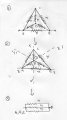
@WBahn, The question was the find the equivalent resistance of the circuit between A and B. I simplified the circuit as: The triangular circuit is electrically symmetrical along XX', YY' and ZZ'. Therefore A, B and C are equi-potent points. I thus reduced them to a single point. I am stuck here. How can current flow from A to B as they are equi-potent?
 

dannyf

Joined Sep 13, 2015
2,197
My answer is R. I simplified the circuit by redrawing the nodes in a convenient manner and then applied the Wheatstone bridge principle.
just some common sense: there is at least one route between A and B - the resistor you have just added. Anything else would have reduced the total resistance.

So if anything, the resistance between A and B is NOT R.

or more precisely, it should be less than R.

without knowing any fancy mumbo jumbo.
 

WBahn

Joined Mar 31, 2012
33,075
just some common sense: there is at least one route between A and B - the resistor you have just added. Anything else would have reduced the total resistance.
When you say that "adding anything else would have reduced the total resistance," how is that possible? He inserted a resistor into a branch that consisted of just a wire, so anything he inserted could not reduce the total resistance; it might leave it unchanged, but if it changed it, it could only increase it.

So if anything, the resistance between A and B is NOT R.

or more precisely, it should be less than R.

without knowing any fancy mumbo jumbo.
More precisely, "it can be NO MORE than R", "not it should be less than R". There is the possibility that it can still BE equal to R, which it is in this case. The resistor that is added in the bottom leg (of Problem #23) has no effect because, even if the bottom wire were removed, the circuit is balanced and the voltage on both ends of where the wire was would be the same.

Bottom line, his answer is correct. The total resistance is R because you have Req = (2*R) || (2*R).
 

WBahn

Joined Mar 31, 2012
33,075
View attachment 117738
@WBahn, The question was the find the equivalent resistance of the circuit between A and B. I simplified the circuit as: The triangular circuit is electrically symmetrical along XX', YY' and ZZ'. Therefore A, B and C are equi-potent points. I thus reduced them to a single point. I am stuck here. How can current flow from A to B as they are equi-potent?
Which question are we talking about now? We WERE discussing a variant of Problem #23, which consisted of the four original resistors plus a fifth one inserted into the bottom path and allowing for all of them being unequal. The circuit you have here consists of six resistors in a very different configuration to anything that has been discussed or anything that is on that problem sheet. Have you moved on to yet another problem entirely? If so, then it really should be in a different thread. A good rule is that one thread should be limited to one problem, otherwise the responses get all jumbled up since you never know which problem a specific post is referring to. If you HAVE started talking about a new problem, let me know and I will split it into a new thread for you.
 

WBahn

Joined Mar 31, 2012
33,075
View attachment 117738
@WBahn, The question was the find the equivalent resistance of the circuit between A and B. I simplified the circuit as: The triangular circuit is electrically symmetrical along XX', YY' and ZZ'. Therefore A, B and C are equi-potent points. I thus reduced them to a single point. I am stuck here. How can current flow from A to B as they are equi-potent?
Since we are looking between A and B, any lines of symmetry must be symmetric with respect to A and B. Only X-X' satisfies that constraint.

Also, the conclusion that all of the end points are equipotential is totally flawed. Consider the case of a two resistors connected in series between A and B. Now draw a line of symmetry between the two resistors. Does this mean that A and B are at the same potential and, hence, no current can flow between them?

All the line of symmetry tells you is that the voltage at each point along that line is half way between the voltages at A and B. But in this case that is extremely valuable information because it allows you to identify one of the resistors that DOES have the same voltage on either end and, hence, has no current flowing in it and, hence, can be removed from the circuit without affecting any of the other voltages and currents. Doing so makes the resulting circuit solvable by inspection yielding a total resistance of R/2.
 

dannyf

Joined Sep 13, 2015
2,197
I am getting R by using the approach which i have stated.
your approach is wrong.

when trying to calculate the resistance between A and B, the two resistors on the sides of A are in parallel, as are the two resistors on the sides of B. So those four resistors are reduced to two serial resistors, each R/2, making the total resistance between A and B R.

When you add another resistor between A and B, it is in parallel with the equivalent resistance of the four resistors (=R, as calculated above). So the total resistance between A and B, with the new resistor added, is R/2.
 

WBahn

Joined Mar 31, 2012
33,075
your approach is wrong.

when trying to calculate the resistance between A and B, the two resistors on the sides of A are in parallel, as are the two resistors on the sides of B. So those four resistors are reduced to two serial resistors, each R/2, making the total resistance between A and B R.

When you add another resistor between A and B, it is in parallel with the equivalent resistance of the four resistors (=R, as calculated above). So the total resistance between A and B, with the new resistor added, is R/2.
But he's not adding a resistor between A and B; he is inserting a resistor in place of the wire at the bottom.
 
Top