how to use device safely by reading specification

Travm

Joined Aug 16, 2016
363
So, power dissipation of an LED, Pd=Pd=I (anode) x V(anode-cathode) - you agree with that formula?

But, where I am making a mistake is in calculating I(anode). Instead of the subtraction from resistor only vs resistor + LED, I should have taken the current measured with the resistor and the LED in the circuit?

Is that correct?
Yes. When you add the LED it fundamentally changes the circuit.
Current measured with teh LED and resistor in circuit is correct.
If you measure the Vf (LED anode - LED Cathode) while the circuit is running, and then measure the current (anywhere in the circuit, it will be the same) that will give you the actual LED Pd = Vf x I
 

WBahn

Joined Mar 31, 2012
32,878
Let me first stipulate that understanding is frequently limited because of knowledge level. So, I am reading what you are saying and much of it is understandable but an explanation for how to calculate the Pd of an LED is not perceived as being forthcoming - again, perhaps because of my knowledge level.

So, I hooked up a resistor measured as 324 Ohm to a power supply, measured at 4.99V. One end of the resistor goes to + and the other end of the resistor goes to one lead of my meter (set to read mA) and the other lead goes to power supply GND. Ok, I read 14.94 mA. That is reasonable and they are not soldered connections, just me touching the leads.
Sketches of the circuits involved would be a BIG aid in communication.

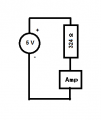
Based on your verbal descriptions, I get this for your first circuit.

Fig1.png
A reading of 14.94 mA seems a bit on the low side as it means that, between them, the source and the meter have about 11 Ω of resistance. But that's not high enough to rule it out without more information about each. So we'll assume that they do, indeed, have about 11 Ω of resistance between them.

Now I keep the top of the resistor connected to + on the power supply and the bottom to one lead of an LED and I use my meter leads to the other lead of the LED and to power supply GND. The LED glows and I read 5.93 mA.
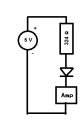
Your second circuit should be this:

Fig2.png
It seems to me that the power dissipated by the LED, not the resistor, is represented by the difference between 14.94 mA and 5.93 mA. IOW ~ 9 mA is being used by the LED.
This makes no sense whatsoever -- I recommend that you spend some time with basic circuit stuff.

The three devices are in series, so they HAVE to have the same current flowing through them. The fact that a DIFFERENT circuit happened to have 14.94 mA flowing in it is irrelevant -- THIS circuit has 5.93 mA flowing in it. There's 5.93 mA flowing in the supply, in the resistor, in the LED, and in the meter.

The reason that the current went down in because you introduced an element (the LED) into the circuit that has a voltage drop across it. That results in less voltage drop across the resistor, which is what is setting the current.

With 11 Ω for the supply and the meter, there is a total drop of about 65 mV across them. With 5.93 mA flowing in the 324 Ω resistor there's about 1,920 mV across that. By Kirchhoff's Voltage Law, that means that there's about

V_led = 4.99 V - 1.92 V - 65 mV = 3.00 V across the LED (which is a pretty common forward voltage for a blue or white LED).

If I try to turn that into a wattage, so I can compare it to Pd, is it 4.99V X 9.01 mA = 44.96 mW or is it 3.3 (the rated Vf of the LED) X 9.01 = 29.73 mW? Or is it something else?
The power dissipated by a component is the voltage across THAT component multiplied by the current through THAT component. In this case it is

P_led = V_led · I_led = 3.00 V · 5.93 mA = 17.8 mW
 
Sketches of the circuits involved would be a BIG aid in communication.

Based on your verbal descriptions, I get this for your first circuit.

View attachment 171968
A reading of 14.94 mA seems a bit on the low side as it means that, between them, the source and the meter have about 11 Ω of resistance. But that's not high enough to rule it out without more information about each. So we'll assume that they do, indeed, have about 11 Ω of resistance between them.


Your second circuit should be this:

View attachment 171969


This makes no sense whatsoever -- I recommend that you spend some time with basic circuit stuff.

The three devices are in series, so they HAVE to have the same current flowing through them. The fact that a DIFFERENT circuit happened to have 14.94 mA flowing in it is irrelevant -- THIS circuit has 5.93 mA flowing in it. There's 5.93 mA flowing in the supply, in the resistor, in the LED, and in the meter.

The reason that the current went down in because you introduced an element (the LED) into the circuit that has a voltage drop across it. That results in less voltage drop across the resistor, which is what is setting the current.

With 11 Ω for the supply and the meter, there is a total drop of about 65 mV across them. With 5.93 mA flowing in the 324 Ω resistor there's about 1,920 mV across that. By Kirchhoff's Voltage Law, that means that there's about

V_led = 4.99 V - 1.92 V - 65 mV = 3.00 V across the LED (which is a pretty common forward voltage for a blue or white LED).


The power dissipated by a component is the voltage across THAT component multiplied by the current through THAT component. In this case it is

P_led = V_led · I_led = 3.00 V · 5.93 mA = 17.8 mW
Sincere thanks for taking the time to go over all this.

his makes no sense whatsoever -- I recommend that you spend some time with basic circuit stuff.
I will ignore your unsolicited recommendation and will resist providing you with my recommendations, which as you know, I have done pretty clearly in the past. I just figure that such "recommendations" come with the territory

Here is a point that I want to stress. I repeatedly asked for a formula to calculate power dissipation for an LED with respect to that measure on the data sheet. Nobody came up with that. After I came up with it (from the quoted source), it has been explained further and I appreciate that, I really do, especially the efforts of @Travm, who did so first and also @WBahn who confirmed the explanation.

Good deal, I learned something :)
 

WBahn

Joined Mar 31, 2012
32,878
Sincere thanks for taking the time to go over all this.


I will ignore your unsolicited recommendation and will resist providing you with my recommendations, which as you know, I have done pretty clearly in the past. I just figure that such "recommendations" come with the territory

Here is a point that I want to stress. I repeatedly asked for a formula to calculate power dissipation for an LED with respect to that measure on the data sheet. Nobody came up with that. After I came up with it (from the quoted source), it has been explained further and I appreciate that, I really do, especially the efforts of @Travm, who did so first and also @WBahn who confirmed the explanation.

Good deal, I learned something :)
Take a look again at what I said about the power dissipation in my first response to your query:

The device specs for the LED can only talk about power dissipation limits in the LED, not the entire circuit.

Since the max forward voltage is 3.6 V (at 20 mA), a first cut at the max current you can run the diode at for any length of time (since max power dissipation is normally a thermal issue, which requires a bit of time to build up), you would have about 28 mA. The voltage will be a bit higher at a higher current, but probably not appreciably more. This is likely where the 30 mA absolute max continuous forward current spec comes from, since the typical voltage is less than 3.6 V, specs are given in round numbers, and there's always some headroom allowed.

If the diode is going to be allowed to zener, that requires a different calculation since the zener voltage is different than the forward voltage.
Multiply 28 mA and 3.6 V and what do you get? 100.8 mW.

The reason you weren't getting things spelled out in such super fine detail is because we all made what turned out to be a bad assumption -- namely that you understood basic circuit concepts such as power being a current flowing through a voltage differential and the notion that the current in a series circuit is the same in all of the elements. It wasn't until you provided enough of YOUR attempt to do the calculations that it became evident that you don't understand these basic concepts, and so we were THEN able to tailor our explanations to better match your level of knowledge in this area. Not coincidentally, this is also why we strive so hard to get students to show their best attempt at working a problem.

The recommendation still stands -- you can choose to ignore it all you want. But you've demonstrated a severe weakness in your comprehension of basic circuit concepts. That's not a put down, it's merely an observation. By ignoring the recommendation, you simply ensure that you will continue to lack that basic understanding far, far longer than you would if you were to take the recommendation and set out to do something about it. But that's completely your choice.
 
Take a look again at what I said about the power dissipation in my first response to your query:


Multiply 28 mA and 3.6 V and what do you get? 100.8 mW.

The reason you weren't getting things spelled out in such super fine detail is because we all made what turned out to be a bad assumption -- namely that you understood basic circuit concepts such as power being a current flowing through a voltage differential and the notion that the current in a series circuit is the same in all of the elements. It wasn't until you provided enough of YOUR attempt to do the calculations that it became evident that you don't understand these basic concepts, and so we were THEN able to tailor our explanations to better match your level of knowledge in this area. Not coincidentally, this is also why we strive so hard to get students to show their best attempt at working a problem.

The recommendation still stands -- you can choose to ignore it all you want. But you've demonstrated a severe weakness in your comprehension of basic circuit concepts. That's not a put down, it's merely an observation. By ignoring the recommendation, you simply ensure that you will continue to lack that basic understanding far, far longer than you would if you were to take the recommendation and set out to do something about it. But that's completely your choice.
You never need to advise me as to what my choices are - that is not and will never be your jurisdiction. You may rest assured of that.

You go back and read what I asked. Don't just try and justify your response as though it answered the question, because you don't see me asking for a "rough cut" of anything. Now read and think about your inability to say anything without be abrasive - AFTER the resolution has occurred. That is what you responded to - that the formula for Pd came out and was worked out without you. That is what gave rise to your over-used, self-serving and supremely disingenuous "advice" - and you are transparent in that regard. The resolution was not approved by you, so you are going to give me a piece of your mind - I get that. Go back and read what I wrote - no where do you see me ANSWERING the TS's questions, you see me, instead ASKING questions.

But, I tried. I asked you specifically about the formula. I did not ask you about bonding to substrates. I get it, you once worked at an IC factory, dude, respect. But, you were dead set on answering questions that were not asked. My expectation is that you are "Dr. Formula" and I had hoped that you would have stated it outright and I could start to work on understanding from there. Now, you are dead set on providing advice when none was asked for and to bolster your position, you seek the "likes" and recruit the royal "we" - I get all that.

Do you have any idea how many times I have laughed and wanted to recommend to you that you take an Introductory Psychology class let alone some basic biology, neurobiology or neuroscience? Hundreds of times - almost every time I read your many off-topic positions and proclamations on behavior. I do not [always] call out such savagely ignorant positions that defy even a basic understanding of the data on the subject. I do not do it because I do not expect you to understand those subjects the way I understand them. I also do not expect you to take any sort of correction on this forum - remember, I have seen your CV and I have read hundreds of your posts.

What I do try to do, in my better times, is pose some guidance to lead you to where I am already at in those areas.

You on the other hand can simply not see your way to toning it down, realizing that I am not an EE and don't want to even play one on TV. You could have done so much better and I and many others reading it might have said, "I wondered about that to". Instead, well you know.

When you respond, AFTER seeing the formula and AFTER someone else corrected my initial attempt at solving it, with a classic,
This makes no sense whatsoever -- I recommend that you spend some time with basic circuit stuff.
But, what you did not say is even a single word about WHY it makes no sense, you simply blurted it out. as though it were a papal decree. I have seen that same scenario play out so many times in the forum and, particularly the review forum that at this point it is almost humorous, if not for the sadness. The sadness is because you do not have even the slightest clue as to how that would be received. Why the ^%#$@ would I listen to you after that? That is what I am trying to get you to understand.

My recommendation to you is that you learn how to interact in a positive manner, especially if you ever hope to successfully be part of a research team that is eclectic in nature and one in which you must communicate respectfully and meaningfully with people who are not your subordinates and do not share your particular education and experience background. Otherwise any decent technician will do and is much more valuable.

I know of what I am telling you as I have done that and much more, including running a laboratory successfully for many years. Including collaborating with neuroanatomists, biochemists, statisticians, pathologiists and a wide variety of MDs, including Psychiatrists and I can tell you, whether you want to believe me or not - If there is any recommendation that you should take today, it is the one that I just gave you.

Again, thank you for the time that you took to go through the question as best as you were able. It is unfortunate, but not unexpected, to end it on such a sour note.
 

Thread Starter

anukalp

Joined Jul 28, 2018
158
cool..

If I have 5V DC @ 2A
5V – 3V = 2 V
We need resistor 100 ohms that would drop voltage 2V
2V /0.020 A = 100 ohms

If I have 12V DC @ 1A
12V – 3V = 9 V
We need a resistor 450 ohms that would drop voltage 9V
9V /0.020 A = 450 ohms

If I have 24V DC @ 5A
24V – 3V = 21 V
We need a resistor (1050 ohms) that would drop voltage 21V
21V /0.020 A = 1050 ohms

so what wattage resistor is needed?
 

WBahn

Joined Mar 31, 2012
32,878
cool..

If I have 5V DC @ 2A
5V – 3V = 2 V
We need resistor 100 ohms that would drop voltage 2V
2V /0.020 A = 100 ohms

If I have 12V DC @ 1A
12V – 3V = 9 V
We need a resistor 450 ohms that would drop voltage 9V
9V /0.020 A = 450 ohms

If I have 24V DC @ 5A
24V – 3V = 21 V
We need a resistor (1050 ohms) that would drop voltage 21V
21V /0.020 A = 1050 ohms

so what wattage resistor is needed?
A general rule of thumb is to use a resistor that is rated at least for twice the power you expect to dissipate.

The instantaneous power is the voltage across the resistor times the current through the resistor. Since Ohm's Law relates the two, we can write the power in several different and equivalent ways.

P = V·I = V²/R = I²·R

Since you are fixing your current at 20 mA, the last one is probably the most useful.

P(100 Ω) = (20 mA)²·(100 Ω) = 40 mW
P(450 Ω) = (20 mA)²·(450 Ω) = 180 mW
P(1050 Ω) = (20 mA)²·(1050 Ω) = 420 mW

Depending on the kind of resistor you are using, such as surface mount or through hole, you might have power ratings such as 1/8 W, 1/4 W, 1/2 W and so on available.

For the first, nearly any resistor will work, so go with a 1/10 W or 1/8 W.

For the second one, a 1/4 W resistor will probably work, as it's not violating the 50% rule too bad.

For the third one, a 1/2 W should technically work, but a 1 W would be much better.

Now this is assuming that you will be running the LED for long enough at any one time for it to heat all the way up. If that's not the case, then you can take that into account and ease off the rating needed.
 

WBahn

Joined Mar 31, 2012
32,878
If Power supply rated 24 V DC @ 5 A
P = I * V = 0.20 A * 24 = 0.48 W

We need 1050 ohms with 0.48 W
That's the total power delivered by the supply, but some of it is dissipated in the resistor and some in the LED.

Using the full supply voltage is a conservative approach, particularly if you then double the power and go with the next highest rated resistor. But it may be too conservative given other constraints, such as size and cost.
 

Thread Starter

anukalp

Joined Jul 28, 2018
158
A general rule of thumb is to use a resistor that is rated at least for twice the power you expect to dissipate.
.
a million thanks to you for explaining in details

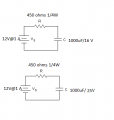
I looked into datasheet of the capacitor and found that if the working voltage of cap is less then supply voltage. the capacitor will damage to excess voltage

upload_2019-3-10_11-51-29.png

if the capacitor rated 1000uF/25 V will work fine but what would happen if it rated 1000uF/16V. Will it work?

I don't think it would be work. so if I have 12 V DC Power supply then I have to use capacitor rated more then 24 V DC
 
Last edited:

atferrari

Joined Jan 6, 2004
5,012
If a read this right up to here, a constant current was not even mentioned.

Any time I consider LEDs, constant current is the first that comes to mind.
 

Thread Starter

anukalp

Joined Jul 28, 2018
158
If a read this right up to here, a constant current was not even mentioned.

Any time I consider LEDs, constant current is the first that comes to mind.
Post #35 is different than previous posts

I wanted to know at what condition capacitor can damage in the given circuit. see post #35

if the working voltage of the capacitor is less the supply voltage, it would be damaged
 

atferrari

Joined Jan 6, 2004
5,012
Post #35 is different than previous posts

I wanted to know at what condition capacitor can damage in the given circuit. see post #35

if the working voltage of the capacitor is less the supply voltage, it would be damaged
My post was related to the thread in general, not to post #35.
 

WBahn

Joined Mar 31, 2012
32,878
a million thanks to you for explaining in details

I looked into datasheet of the capacitor and found that if the working voltage of cap is less then supply voltage. the capacitor will damage to excess voltage

View attachment 171986

if the capacitor rated 1000uF/25 V will work fine but what would happen if it rated 1000uF/16V. Will it work?

I don't think it would be work. so if I have 12 V DC Power supply then I have to use capacitor rated more then 24 V DC
It's not the supply voltage that matters, it's the maximum voltage that will ever appear across the capacitor. Many people use the supply voltage just because it's a quick voltage to grab that, for most circuits, is on the safe side. But if your capacitor is in a part of the circuit that will never see more than a fraction of the supply voltage (including reasonable failure modes), there's no reason not to use a lower rated capacitor. Similarly, if your circuit produces higher voltages than the supply, such as a boost converter, then you need correspondingly higher rated caps.

In theory, if a capacitor has a working voltage of 50 V, then you can use that capacitor up to 50 V and nothing bad should happen. In practice, you could probably go a bit further since manufacturers always pad their specs with a safety margin. But generally accepted practice is that you not push the limits and, as is often the case, the factor-of-two rule of thumb is widely used. It is not a standard by any means and there are times when other considerations take precedence driving for a different decision.

If you exceed the working voltage of the cap (and whatever margin that cap happens to have), then the capacitor will be damaged (the point at which it is damaged marks where you've run out of margin). The nature of that damage and how it manifests itself depends on the type of capacitor, its history, and the environment at the time of the event. You may simply reduce the life expectancy, you may permanently change the value of the cap, or it may explode and/or catch fire.
 

dl324

Joined Mar 30, 2015
18,336
if the capacitor rated 1000uF/25 V will work fine but what would happen if it rated 1000uF/16V. Will it work?
Even though manufacturers will pad their maximum specs, you shouldn't exceed the stated maximum.

When you use the maximums, you have to worry about other variables (ambient temperature, heat sinking, etc). If derate by 50%, your design would be fairly conservative and you could ignore those things.
 
Last edited:
Top