how to measure dc current through device

Thread Starter

Fanfire174

Joined Mar 13, 2018
240
hi,
If a charger is rated at 19Vdc out at a maximum current of 3Amps, thats Watts= 19V * 3A = 57Watts Maximum

E
I have already calculated this value look post #113

Practically What should be the minimum and maximum power rating of load? I
 
Last edited:

ericgibbs

Joined Jan 29, 2010
21,460
hi Fanfire,
I do not want to appear unhelpful but,
may I ask which subject you are student in.? and what year level? so that I can give answers that you can understand.

Eric
 

Thread Starter

Fanfire174

Joined Mar 13, 2018
240
hi Fanfire,
I do not want to appear unhelpful but,
may I ask which subject you are student in.? and what year level? so that I can give answers that you can understand.

Eric
I am student of electronics second year. I understand the calculation but when it comes practically I am little bit struggling
 

ericgibbs

Joined Jan 29, 2010
21,460
hi,
OK, no problem.
So to answer your question
Practically What should be the minimum and maximum power rating of load? I

0Watts thru to 57Watts, for that charger specification

E
 

Thread Starter

Fanfire174

Joined Mar 13, 2018
240
hi,
OK, no problem.
So to answer your question
Practically What should be the minimum and maximum power rating of load? I

0Watts thru to 57Watts, for that charger specification

E
how to use device safely by reading specification

Bulb specification
12 Volt Dc
26 Watts

Whats the power source voltage/current rating required to operate bulb for given specification ?

P = V * I
I = P / V = 26 /12 = 2.16 A

12 volt at 2.16 A rated power supply required for Bulb

Is it correct calculation so practically 12 V @2 A supply will use for Bulb?

if I use 12 V @3 A spply bulb would be damage ?
 

bertus

Joined Apr 5, 2008
22,937
Hello,

The 12Volts @ 2A will have to short power for the bulb.
The 12Volts @ 3A will likely work fine with the mentioned bulb.
The bulb will not be damaged by the 3 A powersupply.
The powersupply will deliver the needed current.

Bertus
 

Thread Starter

Fanfire174

Joined Mar 13, 2018
240
Hello,

The 12Volts @ 2A will have to short power for the bulb.
The 12Volts @ 3A will likely work fine with the mentioned bulb.
The bulb will not be damaged by the 3 A powersupply.
The powersupply will deliver the needed current.

Bertus
Minimum current should be 3 A. What's would be the maximum current for bulb so it can work safely or at what current rating bulb can be damage
 

Thread Starter

Fanfire174

Joined Mar 13, 2018
240
I'm learning too many things here I appreciate all of you

I will come to main question. I have posted block diagram to measure DC current in circuit post #101. I want to make sure is it cable to measure current between 0.2 A to 30 A

Do I need any other part in circuit to measure 30 A DC current ?
 

Reloadron

Joined Jan 15, 2015
7,892
Do I need any other part in circuit to measure 30 A DC current ?
Just make sure your conductor wires can handle up to 30 amps of current. That is about 2.59 mm with a cross sectional area of 5.26 mm ^ 2 of Cu (Copper) wire. Your supply needs to be capable of supplying 30 amps to your load and you need wire capable of delivering 30 amps.

Ron
 

Thread Starter

Fanfire174

Joined Mar 13, 2018
240
Just make sure your conductor wires can handle up to 30 amps of current. That is about 2.59 mm with a cross sectional area of 5.26 mm ^ 2 of Cu (Copper) wire. Your supply needs to be capable of supplying 30 amps to your load and you need wire capable of delivering 30 amps.

Ron
so it means i don't need any other part's it can measure 30 A

my another doubt, sensor can sense AC or DC current so if i replace battery with AC main Is that circuit capable to measure AC current ?
 
Last edited:

Reloadron

Joined Jan 15, 2015
7,892
so it means i don't need any other part's it can measure 30 A

my another doubt, sensor can sense AC or DC current so if i replace battery with AC main Is that circuit capable to measure AC current ?
Yes, you said you had the 30 Amp version. They make a 5.0 Amp, 20.0 Amp and a 30 .0 Amp version.
ACS712ELCTR-05B-T
ACS712ELCTR-20A-T
ACS712ELCTR-30A-T

Yes, we went over this previously. The sensor can measure AC and DC current but remember when measuring AC you get AC out. Read the data sheet. All of this has been covered in this thread. AC in and AC out so you need some form of signal conditioning. You can't just run an AC signal on a 2.5 VDC offset into your A/D Converter.

Ron
 

nsaspook

Joined Aug 27, 2009
16,340
In this case it's a pulsating DC signal at the AC current frequency so you can directly connect tot he ADC and then offset process away the DC component for DSP in the controller with proper sampling of the AC component.
 

Reloadron

Joined Jan 15, 2015
7,892
In this case it's a pulsating DC signal at the AC current frequency so you can directly connect tot he ADC and then offset process away the DC component for DSP in the controller with proper sampling of the AC component.
That's not what I get using the ACS 712. Here is what I get.

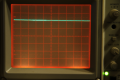
The zero current DC Offset baseline, the vertical gain is 1 Volt/Div so I have about 2 VDC
ACS 712 Baseline.png

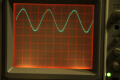
Using a Variac and a few power resistors for the load here is what I get:
ACS 712 AC Current.png

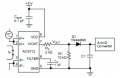
I get a 60 Hz (US) sine riding on my DC offset. The ADC in this case is a MCP3008. The sample and hold is onboard and the thread starter is using a Raspberry Pi to read the serial data from the ADC. A popular circuit to condition the ACS 712 output is along these lines:

ACS 712 AC Rect..png

Anyway when measuring AC the ACS 712 outputs a sine wave on a DC offset based on what I have here. So while I agree how will this work out using the ACS 712 feeding the ADC the thread starter plans to use, the MCP 3008?

Ron
 

nsaspook

Joined Aug 27, 2009
16,340
At 3.3 Vdd you can use a SPI clock of 1Mhz with the MCP3008. The analog input sample time is 1.5 clocks (with 24 total clocks per sample transferred) so we can easily capture the near instantaneous values of a 60hz sine riding on a DC offset during a sampling period of a few cycles of the signal at 10X or more of the signal frequency. We could also under-sample the signal for a longer signal time period for the same data because we don't care about signal reconstruction, only instantaneous values for peak to peak measurements.

Example: 200 Hz signal, sampled at 2000 Hz, 12-bit ADC


Under-sample for data points:


During the sampling we can calculate +Vpk, -Vpk from a simple inspection of Max, Min ADC counts during the data stream. For a single sine wave signal we can use this data for the peak, avg, rms and signal DC offset (using the quiescent zero current offset count) values of current during scaling.
 
Last edited:

Reloadron

Joined Jan 15, 2015
7,892
At 3.3 Vdd you can use a SPI clock of 1Mhz with the MCP3008. The analog input sample time is 1.5 clocks (with 24 total clocks per sample transferred) so we can easily capture the near instantaneous values of a 60hz sine riding on a DC offset during a sampling period of a few cycles of the signal at 10X or more of the signal frequency. We could also under-sample the signal for a longer signal time period for the same data because we don't care about signal reconstruction, only instantaneous values for peak to peak measurements.

Example: 200 Hz signal, sampled at 2000 Hz, 12-bit ADC


Under-sample for data points:


During the sampling we can calculate +Vpk, -Vpk from a simple inspection of Max, Min ADC counts during the data stream. For a single sine wave signal we can use this data for the peak, avg, rms and signal DC offset (using the quiescent zero current offset count) values of current during scaling.
You make a hell of a good argument that it should work. I confess I never thought it through that far. I would try it as it should work. Well based on all of that I think it should work.

Thanks
Ron
 

Thread Starter

Fanfire174

Joined Mar 13, 2018
240
That was my doubt but I just want to measure DC current only

I did the experiment with acs712 I took the reading with multimeter at the output sensor for checking offset voltage. it gives 2.5

I connected 5 ohms 10 ohms and 20 ohms resistor one by one with 5V at 2 A supply But the three resistor were burnt after few second. I think its because power rating of resistor

I had another 5 ohms resistor When I use it, it does not burn but it gives the same reading when load is connected

I have three supply and some resistor without any information of power

5v at 1 A
5v at 2A
20 at 4.5 A

Please advice me for practical experiment
 

ericgibbs

Joined Jan 29, 2010
21,460
I have three supply and some resistor without any information of power
A clear photo of the resistors would help.:rolleyes:

EDIT:

Their wattage must be at least:
5v at 1 A = 5W
5v at 2A =10W
20 at 4.5 A= 90W
 
Last edited:

Thread Starter

Fanfire174

Joined Mar 13, 2018
240
A clear photo of the resistors would help.:rolleyes:

EDIT:

Their wattage must be at least:
5v at 1 A = 5W
5v at 2A =10W
20 at 4.5 A= 90W
I don't have good quality camera on mobile I can't send you good quality of picture at night

5v at 1 A = 5W
5v at 2A =10W

Can i make it cell phone as load with above supply so manually I can calculate how much current flowing throw the cell phone

I know the formula but difficult part is how to find the resistance of mobile
 

ericgibbs

Joined Jan 29, 2010
21,460
hi,
The apparent 'resistance' of the mobile will not be constant, it will depend upon what the mobile is doing, ie: transmitting, receiving etc.

You will have to get some resistors of known value and with a suitable wattage rating if are going to try to do a calibration check of the project.

E
 
Top