how to measure dc current through device

Thread Starter

Fanfire174

Joined Mar 13, 2018
240
Hello,

The second post on this forum shows the possible wire colors:
https://forum.videohelp.com/threads/286593-How-to-connect-internal-USB-2-0-card-reader-in-older-PC
Is there a red and black wire is your cable?
If so, measure the voltage on them when connected to the adapter.

Bertus
Thank a lot for the link

5 V Dc adopter with max 2A current
At 0.2 A using 5 Volts the load resistance will be 5 Volts / 0.2 Amp = 25 Ohms.
At 2 A using 5 Volts the load resistance will be 5 Volts / 2 Amps = 2.5 Ohms

theoretically I can connect any load between 2.5 ohms to 25 ohms

voltage = 5 Volts
Load = 20 Ohms

the current will be

I = 5/20 = 0.25A

First I want to measure the voltage at the output of ASC sensor. Then I will calculate current manually. After that I can calculate what the ADC output

if I want to take some reading with sensor using multimeter then practically i don't have any idea what size of resistor's would be best to take at least three readings to see the big difference in load current
 

Reloadron

Joined Jan 15, 2015
7,892
I have searched http://pinouts.ru/Slots/USB_pinout.shtml but I don't understand vcc and ground wire.

I have multimeter how to identify wires by multimeter
USB stands for Universal Serial Bus, and there are four wires inside of it — usually, it's a red, green, white, and black cord. Each of these wires has a corresponding code: Red color indicates the positive wire with 5 volts of DC power. Black has always been the ground wire in almost all electronic devices.
That is not always the color code but pretty common. When I suggested "ring it out" that means measure the point to point resistance. I place a ohmmeter probe in the USB connector and look for continuity from pin to the wire ends. The pin out is a known.

Ron
 

Thread Starter

Fanfire174

Joined Mar 13, 2018
240
I don't have CSA-1V what size of resistor's would be best to take at least three readings to see the big difference in load current
 

bertus

Joined Apr 5, 2008
22,937
Hello,

Put your sensor in the coil like with the CSA-1V and use the coil to measure the current instead of the pins of your sensor.

Bertus
 

Travm

Joined Aug 16, 2016
363
I don't have CSA-1V what size of resistor's would be best to take at least three readings to see the big difference in load current
You don't have a large enough power supply. Your sensor is not ideal for measuring between 0 and 2A.
You will not have a big difference in readings and are likely to melt your power supply or start a fire.
 

Reloadron

Joined Jan 15, 2015
7,892
I don't have CSA-1V what size of resistor's would be best to take at least three readings to see the big difference in load current
You are not going to see a "big difference" using what you have. All of this has been well covered. You only have a Vsupply of 5 Volts with a maximum current of 2.0 Amps.
5 V Dc adopter with max 2A current
At 0.2 A using 5 Volts the load resistance will be 5 Volts / 0.2 Amp = 25 Ohms.
At 2 A using 5 Volts the load resistance will be 5 Volts / 2 Amps = 2.5 Ohms
OK, you have a 10 bit A/D converter using a 5 Volt reference. So 2^10 bits is as good as it gets. That gives you 1024 quantization levels. So if we divide 5.0 by 1024 we get 4.88 mV per step change and that is as good as it gets as to resolution. You have a current sensor which outputs 66 mV per amp with a 2.5 Volt offset. Now at 66 mV per Amp I see 6.6 mV for 0.1 Amp. Therefore at a low level like 200 mA you are trying to resolve about 13.2 mV. How is that going to get resolved, especially considering things like noise? Your sensor is the wrong sensor for measuring low current levels. This was your original post:

I want to measure DC current (0.2 A to 30 A) through device. I did the research on internet and found some information that I can use ACS712 to measure current and mcp3008 ADC

current through load --> ACS712---->ADC---->Microcontroller ---> LCD

I have doubt in two questions

1. Do I need any other part to measure DC current (0.2 A to 30 A) through device?
2. ADC give output value. It gives voltage value or current value ?
Do not expect much from an ACS 712 with a maximum current of 30 Amps when trying to measure 0.2 Amps. We choose a sensor based on things like range and uncertainty and there is no all in one. You have been given countless links and encouraged to read data sheets and choose to ignore the data sheets. You can't make a silk purse from a sows ear and you can't make a +/- 30 Amp ACS 712 into something it isn't. You also can't make a 10 bit A/D converter into a 12 or 16 bit A/D converter.

Several post ago I mentioned resistors and power dissipation.

"5 V Dc adopter with max 2A current
At 0.2 A using 5 Volts the load resistance will be 5 Volts / 0.2 Amp = 25 Ohms.
At 2 A using 5 Volts the load resistance will be 5 Volts / 2 Amps = 2.5 Ohms"

So with 5 Volts applied across 2.5 Ohms the current will be 2.0 Amps and how much power will the resistor be dissipating? Then once you have the power that is actual dissipated power so what wattage resistor is needed? Tell me the power dissipated in both of your examples above?

Bertus gave you a very good suggestion. Place your ACS 712 in a coil. The ACS 712 works on the principal of a magnetic field being sensed. The device is based on a Hall Sensor. Wind a coil using magnet wire (enamel coated wire) and place your ACS 712 in the coil. Pass a current through the coil and see what happens. Ignore the ACS 712 current terminals. You won't likely get great accurate numbers but you should come away with an idea of how things work.

Ron
 

bertus

Joined Apr 5, 2008
22,937
Hello,

For a test, you could take a matchbox sleeve and turn say 30 turns of magnet wire around it and put the sensor inside the sleeve.
Put the current through the wire and see what signal changes are seen on the sensor output.

Bertus
 

Thread Starter

Fanfire174

Joined Mar 13, 2018
240
Your sensor is the wrong sensor for measuring low current levels.
Ron
Thank you for helping here

I am not asking for any calculation. Is it possible to measure the output 2 A current of Mobile charger. can i connect output of charger to acs sensor directly without any load.
 

bertus

Joined Apr 5, 2008
22,937
Hello,

I do not know if the adapter has a current limiting circuit build in.
As the sensor will have a very low resistance, it is wise to use a huge 2.5 Ohms resistor as load.
The resistor will dissipate 2 Amp X 2 Amp X 2.5 Ohms = 10 Watts.
Use a resistor of 20 Watt for the test.

Bertus
 

Reloadron

Joined Jan 15, 2015
7,892
Thank you for helping here

I am not asking for any calculation. Is it possible to measure the output 2 A current of Mobile charger. can i connect output of charger to acs sensor directly without any load.
Yes, in a word, yes. 2 Amps should be the 2.5 Volt offset plus 0.132 Volt = 2.632 Volts which is about 539 bits. Again, remember that when looking for two amps at 5 volts you get 10 watts so as mentioned a few times make sure you use a resistor rated for at least 20 Watts. If your load gets hot the resistance will increase and as that happens the current will decrease and you will see drift. Also keep in mind your supply has a 2 amp maximum which means it may or may not actuallt support 2 amps.

Ron
 

Thread Starter

Fanfire174

Joined Mar 13, 2018
240
Yes, in a word, yes. 2 Amps should be the 2.5 Volt offset plus 0.132 Volt = 2.632 Volts which is about 539 bits. Again, remember that when looking for two amps at 5 volts you get 10 watts so as mentioned a few times make sure you use a resistor rated for at least 20 Watts. If your load gets hot the resistance will increase and as that happens the current will decrease and you will see drift. Also keep in mind your supply has a 2 amp maximum which means it may or may not actuallt support 2 amps.

Ron
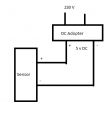
My friend is saying that we can connect like the given diagram without no load
upload_2018-9-11_23-10-19.png

Can we connect like this, I don't think because we have to connect resistor as load
 

Thread Starter

Fanfire174

Joined Mar 13, 2018
240
Hello,

That will only work if you are sure that there is a current limiting ciruit in the adapter.
Otherwise the adapter might fry.

Bertus
In place of adopter if we use mobile power bank then I think we don't need any resistor. Is it correct?
so we can measure output current of power bank without any load? I think it will not damage anything?
 

Travm

Joined Aug 16, 2016
363
In place of adopter if we use mobile power bank then I think we don't need any resistor. Is it correct?
so we can measure output current of power bank without any load? I think it will not damage anything?
Lithium ion batteries have been known to catch fire when shorted. If you KNOW there is a current limiting circuit in your power bank it won't explode. If not it might explode, catch fire, or otherwise destroy itself. Be safe, use a resistor.
 

Reloadron

Joined Jan 15, 2015
7,892
My friend is saying that we can connect like the given diagram without no load
View attachment 159715

Can we connect like this, I don't think because we have to connect resistor as load
A little about the ACS712:
"The device consists of a precise, low-offset, linear Hall sensor circuit with a copper conduction path located near the surface of the die. Applied current flowing through this copper conduction path generates a magnetic field which is sensed by the integrated Hall IC and converted into a proportional voltage".

That copper conduction path is pretty much a 0.1 Ohm or less resistance. Now if your supply, as mentioned, is current limiting then fine it will limit like working into a short. Measure across the IP(+) and IP(-) resistance of your ACS712. Using the current sensor as a load is not a good idea. The source will deliver its maximum current and the sensor will produce what amounts to a short across the source. I wouldn't do it but it's your sensor and your body if something goes wrong.

Ron
 

Thread Starter

Fanfire174

Joined Mar 13, 2018
240
A little about the ACS712:
"The device consists of a precise, low-offset, linear Hall sensor circuit with a copper conduction path located near the surface of the die. Applied current flowing through this copper conduction path generates a magnetic field which is sensed by the integrated Hall IC and converted into a proportional voltage".

That copper conduction path is pretty much a 0.1 Ohm or less resistance. Now if your supply, as mentioned, is current limiting then fine it will limit like working into a short. Measure across the IP(+) and IP(-) resistance of your ACS712. Using the current sensor as a load is not a good idea. The source will deliver its maximum current and the sensor will produce what amounts to a short across the source. I wouldn't do it but it's your sensor and your body if something goes wrong.

Ron
I am measuring output current of dc adopter with no load using multimeter but it show 0.0
I have set multimeter at 10 A dc I have connected positive end of multimeter with positive end of battery and com of multimeter with com of batter. Is something the wrong with wiring

https://www.laserlevelhub.net/how-to-test-a-battery-with-a-multimeter/
 

Travm

Joined Aug 16, 2016
363
With no load you will have no current. Batteries have positive and negative terminals. You can measure the voltage across the terminals with no load, but to measure current you will need a load.
I would assume you're multimeter has short circuit protection. If not you would likely have just burnt it up.

I'm not sure why you chose to ignore the advice provided at almost every step, but I'd you want this to work and learn anything you should
 

Reloadron

Joined Jan 15, 2015
7,892
I am measuring output current of dc adopter with no load using multimeter but it show 0.0
I have set multimeter at 10 A dc I have connected positive end of multimeter with positive end of battery and com of multimeter with com of batter. Is something the wrong with wiring

https://www.laserlevelhub.net/how-to-test-a-battery-with-a-multimeter/
Your link is very misleading and incorrect. They are using the meter as a load for the battery.

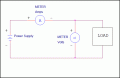
Meters.gif

Note in the above how the load current is measured in series with the load and the load voltage measured across the load. You never place a multi meter to measure current across the load. Unless of course you want the meter to serve as the load which is not a good practice.

I have set multimeter at 10 A dc I have connected positive end of multimeter with positive end of battery and com of multimeter with com of batter. Is something the wrong with wiring
No, that would be incorrect and just like placing a short across the battery. I don't know what meter you have but look at your meters data sheet. Under specifications the meter should show a "burden voltage" for the current ranges. My meter's burden voltage for the 10 Amp range is 0.03 V/A. That tells me the input resistance is very low, about 30 milli-Ohms.

Again, the link is very misleading and poorly written. Do not try to measure current across any power supply. Not for what you are looking to do anyway. You do not want to use your meter as a load!

Ron
 
Top