How to measure Copper coil Inductance

Thread Starter

mohan.n2293

Joined Jan 23, 2017
60
Hi All,
I have wind a coil with a copper ,air as a core and made a LC oscillator circuit with 640nF capacitor but when i see the oscillating frequency it was around 240K Hz.when i measure the inductance using LCR meter the value shown was 2.2uH .
But when i calculate the inductance using formula F=1/(2*pi*sqr(lc)) i got 700nF .
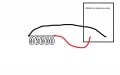
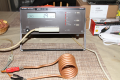
find the attached image to know my test setup .
Please let me know how to measure inductance value of a pure copper coil
 

Attachments

kubeek

Joined Sep 20, 2005
5,796
Can you show your oscillator circuit? So far the numbers don´t match, and I would trust the LCR meter more than the oscillator.
 

Alec_t

Joined Sep 17, 2013
15,105
Don't forget the connections to your LCR meter also have inductance. How did you connect your coil to the meter?
 

AlbertHall

Joined Jun 4, 2014
12,619
What is the specified tolerance of the capacitor?
What is the accuracy specification of the LCR meter?
(The frequency counter will also have an accuracy spec but it is probably the most accurate thing in this set up.)
Your total measurement error is less than 10%.
 

Reloadron

Joined Jan 15, 2015
7,862
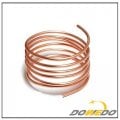
Post an image of the circuit. Use the formula in the link from Bertus to calculate what the inductance should be for your coil as the image you labeled My Coil is not, it is an image taken off the Internet. The below coil has an inductance of 1.9 uH so your number does not surprise me.

Coil I.png

What is the purpose of your circuit? The above coil is used as a part of an induction heater. The coil is 1.9 uH and used with 6 0.33uF capacitors (2.0 uF). This offers a resonant frequency of about 258.183 KHz which is close to what you mention.

Ron
 

KL7AJ

Joined Nov 4, 2008
2,229
Hi All,
I have wind a coil with a copper ,air as a core and made a LC oscillator circuit with 640nF capacitor but when i see the oscillating frequency it was around 240K Hz.when i measure the inductance using LCR meter the value shown was 2.2uH .
But when i calculate the inductance using formula F=1/(2*pi*sqr(lc)) i got 700nF .
find the attached image to know my test setup .
Please let me know how to measure inductance value of a pure copper coil
Your measurements are in fairly reasonable agreement with normal measurement skill...better than 10% tolerance. I would FIRST suspect the accuracy of your capacitance measurement if you're using a DMM....they are notoriously sloppy on small value capacitors. I would more likely trust a good impedance bridge.
 

kubeek

Joined Sep 20, 2005
5,796
...But when i calculate the inductance using formula F=1/(2*pi*sqr(lc)) i got 700nF .
Just reiterating what I said earlier, the units here are wrong, and the numbers don´t match.
240kHz with 2.2uH needs 2uF capacitor.
240kHz with 640nF needs 687nH inductor.
OP says he has 640nF cap and 2.2uH inductor, therefore the frequency cannot be 240kHz at the same time, but would be 134kHz. The tolerance here is definitely not 10%.
 

Janis59

Joined Aug 21, 2017
1,894
Last about 20 years I am working with such few-turns coils every day. Firstly, the formula for large coil and short coil differs rather much. One of the instruments giving the best results are the software named Coil but even more accurate is `inductance coil calculation v.1`. Need to bold that using a simple solenoid formula give a rather high discrepancy.
Next possibility is to use a straight measurement data. The nice meassurement may not be done with ordinary LC meter, as for few nanoHenries small inductance the inaccuracy is `just` the order of magnitude. Yet there exists in the ebay a specialized China nanohenries measurer what costs about 10 bucks and is capable to measure even 1 nH, so for the 300 it`s accuracy is rather high.
Another but even nicer way to act is by using the DIP-meter. I was doing that lot of occasions when there is need to evaluate induction heater position, do we are below or over the resonance. The synonym of dipmeter is the heterodyne indicator of resonance, You may buy it for few tens of bucks.
The other reason for Your discrepancy very much seems the transistor own parasythic capacitances, C(ce) and in larger extent the C(be). Surplus to this, capacitor and Your resonant tank itself has a parasythic (wire caused, 10 nH per cm of length) inductance, what is in series with the coil and capacitor, as well the parasythic capacitance of coil turns, switched in parallel to tank capacitor. Therefore only measurement with DIP-meter may be counted as about exact, and even then, just variating the oscillator voltage or current sure some displacement of resonant peak occurs. The best approximation made from just measuring the L and C if You get +/- 20% in frequency, one must say he have an accurate hand.
 
Top