How to make Heat controller?

Thread Starter

Ichirokaga

Joined Jul 29, 2024
4
Hello everyone.:)
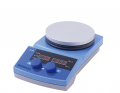
I have a homework to make 1 product to sell, i decided to make some laboratory magnetic stirrer, but i use some 12V PLC that can generate heat up to 120ºC and there's no heat controller that small enough for my design.

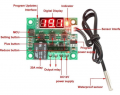
can anyone help me how to make heat controller when i can turn with only 1 potentiometer when i want to rise the temperature and it stable in that temperature, and it equipped with a temperature monitor. if it can, i want the temperature monitor can display up to 150 celsius. i see many products in amazon, etc. that sell heat controller but it use 3 button to set, up, and down. i use 12v 2A adapter for this project.

I am still have 16 week to finish it, but i need it too for my chemistry project, i want to buy a magnetic stirrer with heated plate, and it soooo expensive.
thankyou.
 
Last edited:

Alec_t

Joined Sep 17, 2013
15,111
Welcome to AAC!
As this is a Homework Help forum, post your best design so far, so that we can give guidance where necessary.
 

bertus

Joined Apr 5, 2008
22,897
Hello,

@liaifat85 , the DS18B20 you mention will go upto 125 degrees.
The TS wanted 150 degrees as upper limit.
I think that a PT100 with the amplifier will be a better choice.

Bertus
 

crutschow

Joined Mar 14, 2008
38,352
Another possibility is to buy one of the temperature control modules with push-button controls and add a digital quadrature encoder pot to send a signal that closes a relay contact or opto-coupler output across the push button connection for either up or down setting of the temperature.
The circuit would also have to send a "Set" contact closure during the time the pot is being turned.

Of course that may not be considered a "product to sell" per you homework requirement.
 

Thread Starter

Ichirokaga

Joined Jul 29, 2024
4
What size do you want?
hmm,
i think the board can up to 30x30mm but the important things are the potentiometer and display monitor have a long enough(5-10cm) cable that not soldered in place like this image.

1722339636096.png
because if it soldered in place, it will take a lot of space.
1722339756216.png
this is my reference design.
 

Thread Starter

Ichirokaga

Joined Jul 29, 2024
4
Hello,

@liaifat85 , the DS18B20 you mention will go upto 125 degrees.
The TS wanted 150 degrees as upper limit.
I think that a PT100 with the amplifier will be a better choice.

Bertus
I'm sorry if i not good as everyone here, can you give me your recommended material for me to make some? like the relay,microcontroller, display, etc. and some circuits diagram.
i still new to electronics material altough i am studying mechatronics in my highschool now.

My PLC is 12V 2,5A
what the best power supply for me to use?

thankyou

1722340563041.png

"You don't have to know everything, if you know where to find it.
When you do ask questions, you may look stupid.
When you do NOT ask questions, you will STAY stupid."
-Bertus
 

Jerry-Hat-Trick

Joined Aug 31, 2022
792
I'm wondering if you are familiar with the Arduino series of processor boards? You can very easily make a temperature controller with a small Arduino type board like the Seeeduino XIAO. The potentiometer connected to ground and the 3.3V line with the wiper into an A/D input.

Whatever temperature sensor you choose probably needs to be processed before being read by another A/D pin and you can serial output the measured temperature into a 4 digit serail display and drive a relay via a transistor to turn the heater on and off. It'd be nice to display the target temperature too - there are modules which display 2 x 4 digits which are serially programmed.

Controlling temperature with a processor is relatively simple - what temperature accuracy are you looking to hold? It's more of a "state machine" than PID control, in spite of the insistance of most temperature control suppliers claiming to use the century old PID method.
 
If a simple on/off control like a house thermostat gives too much overshoot in the set point, you can add some simple If-Then-Else type Fuzzy Logic commands to minimize that.
Exactly right. Years ago I controlled the temperature of water in an electric kettle to a constant 80 degrees Celsius to within +/- half a degree. It's why I asked the TS what temperature accuracy he's try to hold. My simple algorithm turned off the heater when the temperature reached 79.5C and logged the time it took to reach it's highest temperature and how long it took to get back to 80.0C (if it exceeded that on the way up, otherwise back to 79.5C). Knowing this, and the slope of the temperature rise when the heater is on whilst first approaching 79.5C there is sufficient data to have a heater on/off mark/space ratio to keep within the specified band. A wider allowed band allows the frequency of on/off to be reduced, preferable if using a relay.
.
 

atferrari

Joined Jan 6, 2004
5,002
To control the heating process of a 2" x 2" aluminum plate I used a TIP??? transistor PWM driven by signal coming from a PID controller based on Bob Pease's circuit.

Proved to be a docile circuit adjusted with just 3 simple presets.

Heating element was a ??ohm 10W resistor and temp sensor was an LM135 (should check).

Optocoupler to kill noise from PWM.

One of the most satisfying proof of concept I ever built.
 

Thread Starter

Ichirokaga

Joined Jul 29, 2024
4
I'm wondering if you are familiar with the Arduino series of processor boards? You can very easily make a temperature controller with a small Arduino type board like the Seeeduino XIAO. The potentiometer connected to ground and the 3.3V line with the wiper into an A/D input.
yes i know arduino, but for this thermostat i use analog.
change my mind, who is better, analog or digital?
i think analog is cheaper than digital
 
i think analog is cheaper than digital
Actually, if you are trying to do anything more complex than a very rudimentary temperature control then digital is cheaper. The processor could cost less than a dollar and it can do very accurate temperature control, linearise the temperature sensor, drive some kind of display etc. The ATtiny85 has sufficient I/O, with 10 bit ADC resolution and for a quick prototype use the Digispark ATtiny85 board which plugs directly into the USB port of your computer for programming using the Arduino IDE.

The simplest display would be markings on the circumference of a potentiometer knob to indicate selected temperature with an RGB LED to show over temperature, in range, and under temperature respectively
 
Top