How to get +/- 15VDC from AC outlet to PCB?

Thread Starter

rmjr99

Joined Feb 23, 2022
3
I want to power an op amp on a PCB using split supplies of +/- 15VDC from the AC outlet using this AC/DC Converter:
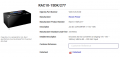
1645603368651.png
It has
2 inputs: IN_Neutral and IN_Line
3 outputs: +VDC, -VDC, Common

What type of connector should be used on the PCB in order to get those two inputs for the converter?
Would using a 3 prong cable from the wall and stripping the cable on the other end to use on the connector be the best approach?
Any help would be appreciated.
 

Thread Starter

rmjr99

Joined Feb 23, 2022
3
From the photograph it appears that the power supply is to be soldered directly onto the circuit board.
I understand that. The part I am confused on is how to wire from the wall to the PCB. What wiring do I need and what connector is safe to put on a PCB?
 

DickCappels

Joined Aug 21, 2008
10,661
Oh....! Unless there is a fuse internal to the power supply module you should provide on between it and the line (hot) input. Unless your project creates radio interference you only need to add an AC plug and a power cord with proper strain relief.

A grounded plug gives you a ground return for your project and if needed, and radio frequency interference (RFI) filter.

You might want to add a pilot light to one or both of the outputs for convenience.
 

Ya’akov

Joined Jan 27, 2019
10,226
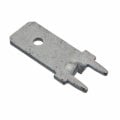
PCB mount spade lugs, also called (see EDIT at end) quick disconnects like these are a common way to get mains voltages onto a PCB. There are many varieties so this one is just an example, if you search there you will find many options.

1645612590632.jpeg

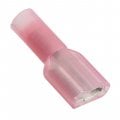
The mating connector must be insulated of course. There are a lot of varieties, but this is an example.

1645612714505.jpeg
Properly installed, and placed in a good spot on the PCB, these will keep the mains voltages way from casual touching of the PCB.

[EDIT: I don't know why I called these "spade lugs" I am very aware of the difference, just a brain spasm. But, it didn't help that when I search Google for "PCB mount spade lugs" Mouser had an ad for these, at the top.]
 
Last edited:

Ian0

Joined Aug 7, 2020
13,098
You can just solder wires to pads on the pcb, but bear in mind that soldered wires must be physically attached to the board, as well as soldered to meet safety regulations (two holes in the board and a cable tie, or a big splodge of silicone). Also, the wires must be rated for mains voltage and appropriately colour coded.

Also check the datasheet for your power supply as to whether it needs additional interference filtering (as @DickCappels) said, because some do and some don’t. Also bear in mind that just because the PSU has an EMC certificate it doesn’t guarantee that the finished product will pass.

If you don’t need mains inside the product for any other reason, consider a plug-top or in-line power supply, as they save you a lot of trouble!
 
Last edited:

Ian0

Joined Aug 7, 2020
13,098
And if you have a metal case, don’t forget the clearance distance under the pcb. You will need 5mm clearance between the case and top of the solder joint, and that applies whether you solder on wires, or use a connector.
 

ElectricSpidey

Joined Dec 2, 2017
3,313
My preference for AC to PCB is always a wire to board screw terminal with a hard point/strain relief at the place where the wire enters the case.

Then possibly a connection to the case with a self-threading screw for the ground if needed. (and a lock washer if not part of the screw)
 

Ian0

Joined Aug 7, 2020
13,098
PCB mount spade lugs, also called quick disconnects like these are a common way to get mains voltages onto a PCB. There are many varieties so this one is just an example, if you search there you will find many options.


The mating connector must be insulated of course. There are a lot of varieties, but this is an example.

Properly installed, and placed in a good spot on the PCB, these will keep the mains voltages way from casual touching of the PCB.
What do we call these connectors? In days of yore, it didn't matter because we just flicked through the catalogue until we saw the picture.
Now we have the internet and we need something to type into the search box.
Now, I call one part a “quarter inch blade” and the other half a “Faston connector” (somebody‘s trade name, do doubt), but they also could be ”Lucar” connectors as they were made by Lucas for the automotive industry.
 

dl324

Joined Mar 30, 2015
18,223
Welcome to AAC!
I want to power an op amp on a PCB using split supplies of +/- 15VDC from the AC outlet using this AC/DC Converter:
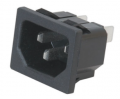
You're going to want to mount it in a box so line voltage isn't exposed. I'd use something like this:
1645636033660.png
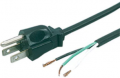
Or run a power cord with pigtails through a hole in the enclosure.
1645636218825.png
Then solder wires to your board or use connectors of your choosing.
 

Ya’akov

Joined Jan 27, 2019
10,226
What do we call these connectors? In days of yore, it didn't matter because we just flicked through the catalogue until we saw the picture.
Now we have the internet and we need something to type into the search box.
Now, I call one part a “quarter inch blade” and the other half a “Faston connector” (somebody‘s trade name, do doubt), but they also could be ”Lucar” connectors as they were made by Lucas for the automotive industry.
Faston is used in some industries, like "Hoover" is used in the UK. It's a brand name but it's been lost to general use.

I should have called them spade lugs, though. It was a lapse of concentration. A spade lug is like a flat sided open-ended ring terminal. I don't know why I did that. But, "quick connect" is what I first heard them called, then fastons, I think from manufacturing plant service techs or maybe auto mechanics.

Anyone would buy an electrical connector named after Lucas deserves what they get.
 

Thread Starter

rmjr99

Joined Feb 23, 2022
3
Thanks everyone for the help and suggestions. This makes the solution much clearer. I had the right idea of connecting it the way mentioned by you all, but I did not know which connectors were typically used for AC to PCB. I also did not think about adding strain relief.
 
Top