How to find diameter of wire if i have length of wire and resistance only i can not use measuring tool because wire is thinner then 0.1mm

Thread Starter

moneshrathod

Joined Dec 19, 2023
13
As the title suggests; I am trying to calculate the diameter of a wire given its length and resistance.

Specifications Length: 30.4CM (0.3 M) Resistance (30.4 Centimeter): 17 ohms
 

drjohsmith

Joined Dec 13, 2021
1,549
You can't use resistance to work out wire diameter, unless you know exactly what the wire is, in which case you would not have to measure it .
Why do you want to measure diameter ?
Is it a home work question?,
 

WBahn

Joined Mar 31, 2012
32,703
As the title suggests; I am trying to calculate the diameter of a wire given its length and resistance.

Specifications Length: 30.4CM (0.3 M) Resistance (30.4 Centimeter): 17 ohms
First and foremost, you need to know what the wire is made of -- and what the resistivity of that material is.

30.4 cm is almost exactly 1 ft = 30.48 cm. so let's call it a foot.

IF it is "normal" copper wire, then the resistivity is generally considered to be 17.24 nΩ·m at 20°C, but this value varies a few percent depending on the material and processes used by a given wire manufacturer.

A good approximation is that #10 AWG has a resistance of 1 mΩ/ft and that this goes up by a factor of ten for every increase of ten in the wire size. So #40 AWG will have about 1 Ω/ft and #50 will have 10 Ω/ft. Thus, IF your wire is copper, it is smaller than #50.

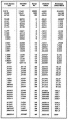
You can use this factor-ten-for-change-in-size-of-ten with the table provided to see that the wire size would likely be #52, where you would expect a resistance of about 16.4 Ω.

But you say that your wire is between #42 and #46. How sure are you of this? If that is the case, then your wire isn't copper since the resistance copper wires in that range would fall between 1.6 Ω and 4.2 Ω.

FWIW: My understanding is that the AWG wire sizes only go up to #40, so anything smaller than that is not "official", however, the chart is very clearly defined and structured so that it can easily be extended to arbitrarily high (or low) wire sizes.
 

Thread Starter

moneshrathod

Joined Dec 19, 2023
13

Thread Starter

moneshrathod

Joined Dec 19, 2023
13
First and foremost, you need to know what the wire is made of -- and what the resistivity of that material is.

30.4 cm is almost exactly 1 ft = 30.48 cm. so let's call it a foot.

IF it is "normal" copper wire, then the resistivity is generally considered to be 17.24 nΩ·m at 20°C, but this value varies a few percent depending on the material and processes used by a given wire manufacturer.

A good approximation is that #10 AWG has a resistance of 1 mΩ/ft and that this goes up by a factor of ten for every increase of ten in the wire size. So #40 AWG will have about 1 Ω/ft and #50 will have 10 Ω/ft. Thus, IF your wire is copper, it is smaller than #50.

You can use this factor-ten-for-change-in-size-of-ten with the table provided to see that the wire size would likely be #52, where you would expect a resistance of about 16.4 Ω.

But you say that your wire is between #42 and #46. How sure are you of this? If that is the case, then your wire isn't copper since the resistance copper wires in that range would fall between 1.6 Ω and 4.2 Ω.

FWIW: My understanding is that the AWG wire sizes only go up to #40, so anything smaller than that is not "official", however, the chart is very clearly defined and structured so that it can easily be extended to arbitrarily high (or low) wire sizes.
I have a wire of 36 AWG and I compare it with that so I think that the AWG of the wire is 44 to 46. And the wire is metallic silver in color I think it's made of NICKEL OR electrical steel not sure between both. My calculation is giving a value that is near to nickel.

Thank you for your reply.
 

Beau Schwabe

Joined Nov 7, 2019
186
Wind the wire on a spool and use a scanner to image the spool ... if you know or set the resolution of your scanner 300dpi, 1200dpi, 2400dpi ... etc ... You can use almost any Graphical editing tool (Paint, Gimp, etc.) to give you the number of pixels. Then it's just a matter of using cross multiplication to determine the width (diameter) of the wire.
 

Janis59

Joined Aug 21, 2017
1,894
That was one kind of measurement I learned when became a 7 year old. The teacher said - now You have a stangel and must measure the 0.03 mm wide wire with three digits accuracy. After some painful brain inquisition minutes I said - I have no idea how, You have to show it. So, take the ball pen. Screw it to parts and take the inner ink-stick out. Depending on wire diameter wind on it accurate turn to turn gapless 10 or 25 or 100 turns with wire under test. Take stangel and squeeze coil longitudinally with moderate force. Read stangel. Divide the result to correspondingly 10 or 25 or 100. Write down the result.
 
Top