How to discharge a capacitor at a given voltage?

Thread Starter

leolinyes

Joined Jul 19, 2023
10
Hello,

First, this question should be very easy for most members here. Sorry for asking this question that is maybe way too stupid or easy. I am a 3rd year high school student and it's my first time posting using my brother's account. I really need some assistance with this problem !!

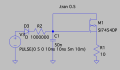
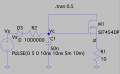
This is my small project. I am trying to discharge the capacitor at a given voltage, let's say, 3.2V. V3 will keep charging the capacitor, and the diode will prevent the capacitor from discharging.
Screenshot 2023-07-20 at 1.09.46 PM.png


Before the cap reaches 3.2V, it will keep charging and never discharge (the diode blocks it from discharging).

Once the cap reaches 3.2V, it will turn the MOSFET on. The capacitor is also connected to the drain. So supposedly, it should discharge at a rate of 50n * 10 sec. I wanted it to discharge in a separate circuit that is built by MOSFET.

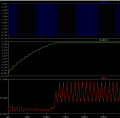
I ran the simulation and it didn't look too good. V(n002) is the input pulse. V(n001) is the capacitor voltage, and I (R1) is the current through the drain.
Screenshot 2023-07-20 at 1.08.45 PM.png

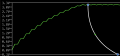
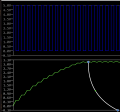
How can I make it to discharge like this ( ignore the green line after the white line):
1689883627946.png

Thank you for your help. Any comment will be appreciated. I am very into electronics and I believe you can help me more on this problem!!

- Liam
 

WBahn

Joined Mar 31, 2012
32,927
It would be helpful for you to post the circuit you have been working with. You refer to things like V3 and V(n002) and I(R1), but we have no reference for what those are.
 

Thread Starter

leolinyes

Joined Jul 19, 2023
10
It would be helpful for you to post the circuit you have been working with. You refer to things like V3 and V(n002) and I(R1), but we have no reference for what those are.
Hi, WBahn,

Thank you for your reply, and sorry about that. I will update the namings.
 

Thread Starter

leolinyes

Joined Jul 19, 2023
10
Hello,

First, this question should be very easy for most members here. Sorry for asking this question that is maybe way too stupid or easy. I am a 3rd year high school student and it's my first time posting using my brother's account. I really need some assistance with this problem !!

This is my small project. I am trying to discharge the capacitor at a given voltage, let's say, 3.2V. V3 will keep charging the capacitor, and the diode will prevent the capacitor from discharging.

Screenshot 2023-07-20 at 1.52.39 PM.png

Before the cap reaches 3.2V, it will keep charging and never discharge (the diode blocks it from discharging).

Once the cap reaches 3.2V, it will turn the MOSFET on. The capacitor is also connected to the drain. So supposedly, it should discharge at a rate of 50n * 10 sec. I wanted it to discharge in a separate circuit that is built by MOSFET.

I ran the simulation and it didn't look too good. V(n002) is the input pulse. V(n001) is the capacitor voltage, and I (R1) is the current through the drain.
Screenshot 2023-07-20 at 1.53.06 PM.png

How can I make it to discharge like this ( ignore the green line after the white line):
Screenshot 2023-07-20 at 1.54.55 PM.png

Thank you for your help. Any comment will be appreciated. I am very into electronics and I believe you can help me more on this problem!!

- Liam
 

BobTPH

Joined Jun 5, 2013
11,555
Do you think the MOSFET starts fully conducting at 3.2V and then continues conducting after the voltage is lower?

What is the voltage in the MOSFET gate when the capacitor is discharged to 3.1V?Is the MOSFET still conducting?

There are several devices that act like that, but the MOSFET is not one of them.
 

WBahn

Joined Mar 31, 2012
32,927
As BobTPH states, with your approach, you start to turn the MOSFET on (meaning that it is conducting just a bit), but then as soon as the capacitor discharges just a little bit, it shuts back off. So the capacitor essentially stalls (is clamped) somewhere near the threshold voltage of the MOSFET.

But let's say that it did someone continue to conduct and managed to discharge the capacitor. What then? Should the capacitor start charging up again? Should it stay discharged? How is the circuit supposed to know what it should do and when it can start letting the capacitor charge again?

What you need is some element that acts like a latch that has two states. In one state, it allows the capacitor to charge and in the other if forces a discharge. What you then need to do is decide how to switch the latch between these two states. You've stated what event should trigger the change from charging to discharging -- the cap voltage reaching 3.2 V. What event should trigger the change from discharging back to charging.

But it is possibly worth taking a step further back and asking what problem is it that you are actually trying to solve. WHY do you want the capacitor's voltage to behave this way? There may well be a much better solution to the underlying problem.
 

dl324

Joined Mar 30, 2015
18,362
This is my small project. I am trying to discharge the capacitor at a given voltage, let's say, 3.2V. V3 will keep charging the capacitor, and the diode will prevent the capacitor from discharging.
What are you trying to achieve?

If you simply want to charge and discharge a capacitor, as Dick mentioned, a 555 timer does this.

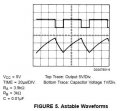
This is the timing capacitor voltage in astable mode (bottom trace) from a National Semiconductor datasheet:
555CapVoltage.jpg

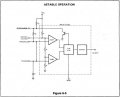
This is the circuitry that the timers uses to achieve this (from Signetics):
555Astable.jpg

Charging is controlled by Ra+Rb, discharge is controlled by Rb. It you want more symmetry, you make Rb >> Ra. The discharge point is 2/3 Vcc. The 555 timer gives you a convenient way to change that voltage.
 

crutschow

Joined Mar 14, 2008
38,537
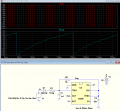
Below is a circuit using a 555, as Dick suggested:
The THRES trip point is 2/3 of Vcc or 3.33V here.
When it exceeds that voltage, the DIS pin is connected to ground, discharging the capacitor.
A voltage at the TRIG below 1/3 Vcc resets the 555 for another charging period.
R2 and C1 delay the TRIG voltage slightly so C2 is totally discharged before another charge period.

The circuit constantly charges and discharges the cap.
Is that what you want?

1689896457606.png
 

BobTPH

Joined Jun 5, 2013
11,555
The simplest device to get that kind of behavior is a neon light bulb. The little orange ones that used to be used as indicators in line voltage circuits.

When placed across a charging capacitor, as your MOSFET is, they do not conduct until they reach a certain voltage, I think is is about 90V, then the gas in them is ionized, and the capacitor discharges almost completely with a flash of light. Once the current stops, it goes back to non-conducting and the cycle starts over.

This is called a negative resistance device, because an increase in current caused a decrease in voltage drop.
 
Top