Facebook
 Google
 GitHub
 Linkedin
Hi im trying to find static hazards from circuit diagram:
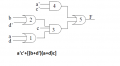
the Full question of diagram is :
1) Find out that if circuit has static 1 hazard or not.
2)For static 1 occuring what is the sorting order of the Gates ( sorry for my lame translation what i mean is in which gate sorting that static one occurs for ex: 1-3-5-2-3-5-4-5 etc.) .
3)What is the circuit to eliminate static 1 (asking for circuit eq. to avoid static 1 thats why i try to place it in karnaugh but failed sadly).
4)Also whhat can we tell about the static 0 hazard in this circuit.
sorry this question wasn't English i tried to translate it. but basicly my question is how to find static 1 hazard and avoid it. i tried to find circuit equation then place it on karnaugh but it really confused me and its probably not the proper way to do it ?
the Full question of diagram is :
1) Find out that if circuit has static 1 hazard or not.
2)For static 1 occuring what is the sorting order of the Gates ( sorry for my lame translation what i mean is in which gate sorting that static one occurs for ex: 1-3-5-2-3-5-4-5 etc.) .
3)What is the circuit to eliminate static 1 (asking for circuit eq. to avoid static 1 thats why i try to place it in karnaugh but failed sadly).
4)Also whhat can we tell about the static 0 hazard in this circuit.
sorry this question wasn't English i tried to translate it. but basicly my question is how to find static 1 hazard and avoid it. i tried to find circuit equation then place it on karnaugh but it really confused me and its probably not the proper way to do it ?