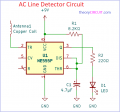
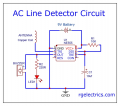
Circuit to detect underground power ie 50HZ AC no powe is been drawn but cable is active at a depth off 500mm

MisterBill2

Joined Jan 23, 2018
27,362
If it is possible to connect both , or all, of the conductors together to the source of the 50 hz power, then it should be possible to probe the general area where the cable is buried and to sense the electric field produced by the voltage in the cable. The field should be strongest in close proximity to the cable.
If the connection to the different conductors is not changed, the field will be much weaker, but the same scheme should work.
 

AnalogKid

Joined Aug 1, 2013
12,091
The RG Electrics link triggered my virus scanner and produced an SSL error. If you got it to open, can you post the schematic?

ak
 

MisterBill2

Joined Jan 23, 2018
27,362
OK, two similar circuits for an electrical field sensor. And the coil is sensing the electrical field, not any magnetic field. While the theory is correct, I doubt that that it will sense an active cable 50 CM (almost two feet) underground. That will take an amplifier with good low-frequency gain, and a pickup disk close to the ground.
 

Pyrex

Joined Feb 16, 2022
502
If it is possible to connect both , or all, of the conductors together to the source of the 50 hz power, then it should be possible to probe the general area where the cable is buried and to sense the electric field produced by the voltage in the cable. The field should be strongest in close proximity to the cable.
If the connection to the different conductors is not changed, the field will be much weaker, but the same scheme should work.
If the soil is moist, there will be almost no electric field.

To detect a cable, you need to pass a sufficiently strong current through it. Then use a magnetic field detector
 

drjohsmith

Joined Dec 13, 2021
1,584
Circuit to detect underground power ie 50HZ AC at a depth off 500mm no power is been drawn but cable is active
We need a lot more info to provide more than approximations.

When you say, no power is drawn, do you mean no current is flowing in the cable our detecting , or no power to the detector?

There are three immediate techniques

a. detect an AC field from the cable
b metal detect
c ground penetrating radar
d inject your own signal onto cable and detect

C is way outside the forums ability to tell you how to make, and is dammed dangerous , but is proably a great way to find the cable

The problem with A is that the field from the cable with no current flowing is going to be very low, there is plenty of fields already in the air for interference , and the soil is deep, so the small signal is going to be even more attenuated. There are many "mains detector" wands around , designed to detect cable sin walls, only 10 mm or so away, and these cna have problems if no current flows in the cable

b. is easy, plenty of circuits on line to make metal detectors, but you dont knoe if its "your" cable

d. Is what is done by the electricity companies, they inject a "tone" that can then be detected, a radio by all other names,
a few circuits around on web, but mainly for safety reasons aimed at low voltage not mains, but cna be adapted if you get the frequencies right.
 

MisterBill2

Joined Jan 23, 2018
27,362
I own a "wire tracer" package that uses the scheme described in option "D", and it does provide an impressive amount of sensitivity. It is called "Fox and Hound", and made by the TRIPLLET company. It is marketed as a LIVE WIRE tracer, although it works just as well for non-powered wires. I have not used it for under ground tracing, but certainly the principle is quite valid. So that could be an option to explore.
 

Pyrex

Joined Feb 16, 2022
502
I own a "wire tracer" package that uses the scheme described in option "D", and it does provide an impressive amount of sensitivity. It is called "Fox and Hound", and made by the TRIPLLET company. It is marketed as a LIVE WIRE tracer, although it works just as well for non-powered wires. I have not used it for under ground tracing, but certainly the principle is quite valid. So that could be an option to explore.
Interesting device. How deep can it detect a cable in a wall? Is there a difference in sensitivity when the cable is energized and when it is not? Do nearby live cables have a significant effect on sensitivity?
 

drjohsmith

Joined Dec 13, 2021
1,584
Interesting device. How deep can it detect a cable in a wall? Is there a difference in sensitivity when the cable is energized and when it is not? Do nearby live cables have a significant effect on sensitivity?
Signal injector tools.
cabel in plaster board wall , 100mm of fibre glass insulation . Much less in concrete wall
Near by cables affect quiet a bit , un quantifiable, but more of false positive .
 
Top