Facebook
 Google
 GitHub
 Linkedin
I have an old tuner I want to convert to shortwave. plenty of room to work in.

my plans were to add L in parallel with the coil on the bar antenna to reduce it, according to
Lt = (L1*L2)/(L1+L2)
then, given the equation f^2= 25,330/(L*C) and the fact that the AM band on this radio covers 520-1620 kHz, whatever L was, the same range of C but a different L would receive shortwave. specifically, if L was a typical 250 uH, adding 2.0095 uH in parallel changes the frequency range to 5.8-18.0 MHz.
later I can update it to switch between 2 fixed L's in parallel with the bar antenna to switch between 2 shortwave ranges.
I could do the same exact thing to C instead (in series) but that would make tuning all wacky because of the properties of
Ct = (C1*C2)/(C1+C2)
L is fixed and wouldn't have that problem.
so now my problem is actually doing it. I tried using an LCR meter on the bar antenna to get a reading, to determine which wires to add the L in parallel with. but no combination of wires gave any reading.

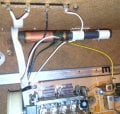
maybe I couldn't get a reading because it was in a circuit. so I used test leads to connect L in parallel with various wires on the bar antenna, and none of them changed the frequency of reception at all.
? it should!
why wouldn't this work? is there some other method?
next question:
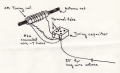
I came across a video where some guy did a variation of that by wrapping a loose wire around the coils on the bar, about 1/4" spacing between turns, then simply connecting the ends together. attach to that a random wire antenna. it works. I'm not sure exactly how.
the closed circuit of the wrapped wire must be forming an inductor, inductively coupled to the AM bar antenna, and the random wire injects shortwave signal. but I don't see how it can do that since it's a closed circuit without a ground. the current doesn't circulate. maybe what's going on is it acts as a step-up transformer that changes the frequency? I don't know.
I tried it with the loose wrapping and it worked, but was pretty lacking. many AM stations bled through. absolutely plagued with ghost images. high noise floor and low sensitivity. I would rate the reception about as good as the worst shortwave portable radio.
then contrary to all the instructions and this guy's video, I wrapped it tightly to increase inductive coupling even if it would shift the frequencies too far down. fastened the wires to the case with clothespins to prevent them from unravelling.
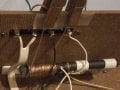
the results were good. only the strongest AM stations bled through, sensitivity improved noticeably and noise floor decreased slightly. fewer ghost images. on the dial it runs 8.2 to 15 MHz which is acceptable. still doesn't compare to a decent cheap radio but it was fast and easy. and I got to convert a stereo to a shortwave radio.
so, the question is, why does this work at all? it shouldn't do anything.
my plans were to add L in parallel with the coil on the bar antenna to reduce it, according to
Lt = (L1*L2)/(L1+L2)
then, given the equation f^2= 25,330/(L*C) and the fact that the AM band on this radio covers 520-1620 kHz, whatever L was, the same range of C but a different L would receive shortwave. specifically, if L was a typical 250 uH, adding 2.0095 uH in parallel changes the frequency range to 5.8-18.0 MHz.
later I can update it to switch between 2 fixed L's in parallel with the bar antenna to switch between 2 shortwave ranges.
I could do the same exact thing to C instead (in series) but that would make tuning all wacky because of the properties of
Ct = (C1*C2)/(C1+C2)
L is fixed and wouldn't have that problem.
so now my problem is actually doing it. I tried using an LCR meter on the bar antenna to get a reading, to determine which wires to add the L in parallel with. but no combination of wires gave any reading.
maybe I couldn't get a reading because it was in a circuit. so I used test leads to connect L in parallel with various wires on the bar antenna, and none of them changed the frequency of reception at all.
? it should!
why wouldn't this work? is there some other method?
next question:
I came across a video where some guy did a variation of that by wrapping a loose wire around the coils on the bar, about 1/4" spacing between turns, then simply connecting the ends together. attach to that a random wire antenna. it works. I'm not sure exactly how.
the closed circuit of the wrapped wire must be forming an inductor, inductively coupled to the AM bar antenna, and the random wire injects shortwave signal. but I don't see how it can do that since it's a closed circuit without a ground. the current doesn't circulate. maybe what's going on is it acts as a step-up transformer that changes the frequency? I don't know.
I tried it with the loose wrapping and it worked, but was pretty lacking. many AM stations bled through. absolutely plagued with ghost images. high noise floor and low sensitivity. I would rate the reception about as good as the worst shortwave portable radio.
then contrary to all the instructions and this guy's video, I wrapped it tightly to increase inductive coupling even if it would shift the frequencies too far down. fastened the wires to the case with clothespins to prevent them from unravelling.
the results were good. only the strongest AM stations bled through, sensitivity improved noticeably and noise floor decreased slightly. fewer ghost images. on the dial it runs 8.2 to 15 MHz which is acceptable. still doesn't compare to a decent cheap radio but it was fast and easy. and I got to convert a stereo to a shortwave radio.
so, the question is, why does this work at all? it shouldn't do anything.