How to connect a relay coil in parallel with other components without it shorting?

WBahn

Joined Mar 31, 2012
33,069
R!f@@, I am trying to use as few batteries as possible, and only CR2032s as they fit better. so should I connect two cells in parallel to increase mAh capacity and then put another cell in series to get 6V?
Then I can put a resistor in series with 3V relay coil to prevent short.
Would this work, and is it possible to use less batteries (i originally planned to use 1)?
That won't increase your current or current capacity, because you will be limited by the single cell that you have in series with the other two. You would need to use four coin cells, two separate series pairs that are then put in parallel.

But that won't solve your problem. You want to drive a relay that needs 150 mA. You want to do it with a battery that doesn't like delivering even 15 mA. This is like someone wanting to use only a kitchen match to cook a 20 lb turkey.

Instead of trying to throw components around hoping that, at some point, something will happen to work, take a step back and decide what you really NEED (not what you WANT). What kind of square wave signal to you NEED for what you are doing? What frequency? What amplitude? What duty cycle? What amount of current does it need to deliver?

How long does it need to work on a set of batteries?

If you eliminate the relay and the transformer and use something like a 555 timer IC (or an 8-pin MCU, but there's additional development overhead in that), you will almost certainly save more than enough room to us appropriate batteries.
 

ericgibbs

Joined Jan 29, 2010
21,529
Hi Danko,
That's a good idea, but he wants it to be a very small power source.
I would suggest a 3.7V Li-Ion battery, say 1Ahr or so.
E
 

WBahn

Joined Mar 31, 2012
33,069
@ericgibbs thanks a lot for that, I understand now. Could you give some advice on what power source would be best for my application? Are 3 AAAs suitable?
AAA datasheet EP92: https://data.energizer.com/pdfs/ep92_eu.pdf
It has max capacity >1.2Ah, and can be used multiple hours with little resistance load.
Three AAA cells in series?

Look at that data sheet more carefully. It has a 1.2 Ah capacity with a 25 mA load, which equates to about 60Ω. That's not a "little resistance" load, particularly in comparison to your relay coil, which appears to be somewhere around 20 Ω. At 150 mA load, it has somewhere in the neighborhood of 800 mAh of capacity, which means you are looking at perhaps five to six hours of service (assuming all other current draw for the entire rest of your square wave generator and whatever it is driving is negligible in comparison). Is that sufficient "multiple hours" for your needs?
 

WBahn

Joined Mar 31, 2012
33,069
R!f@@, what li-on battery would work? the circuit requires >3V and high amp-hours.
What will work depends on what your need is. What is "high" amp-hours? How much current is needed? Be sure you fully understand the difference between current (mA) and capacity (mAh).
 

WBahn

Joined Mar 31, 2012
33,069
Hi Eric,
TS can use CR2032 with supercapacitor, connected in parallel.
I don't think that's going to work very well. 210 mAh is about 0.75 C capacity. After drawing out that much charge, the terminal voltage is probably down to about 2 V, which is likely well below what he needs (but maybe not).

Whatever supercapacitor is used is going to make whatever charge is needed to bring that cap up to the 2 V point (or whatever minimum voltage the TS needs) unavailable. The only thing the cap will do is allow a higher current, but for a significantly shorter time because only a fraction, perhaps well less than a third, of the cell's capacity will be usable.
 

Thread Starter

circit!#$$101

Joined Jul 5, 2024
12
@BobTPH I'm very sorry if I was being unclear. I am building a small square wave generator and was having problems with the relay coil drawing too much current. Others have suggested using a resistor in series with the coil, but the battery cannot supply enough power, so I asked for help choosing a suitable battery that is compact & can deliver enough power. I know that obviously I should use the 555 timer, but I like making things from scratch.

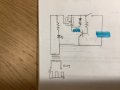
image.jpg
Highlighted is the proposed resistor and the battery.
 

R!f@@

Joined Apr 2, 2009
10,007
@BobTPH I'm very sorry if I was being unclear. I am building a small square wave generator and was having problems with the relay coil drawing too much current. Others have suggested using a resistor in series with the coil, but the battery cannot supply enough power, so I asked for help choosing a suitable battery that is compact & can deliver enough power. I know that obviously I should use the 555 timer, but I like making things from scratch.

View attachment 326293
Highlighted is the proposed resistor and the battery.
How is this square wave generator?
A micro will be smaller and better
 

Thread Starter

circit!#$$101

Joined Jul 5, 2024
12
How is this square wave generator?
When the switch is closed, the transistor turns on & activates the relay, which supplies power to the led (that serves as indicator light) and transformer. The transformer primary (which has low resistance) then acts like a short, drawing all the current and leaving none for the base of transistor. this shuts the transistor off, which turns the relay off (the relay coil discharges through flywheel diode), inducing a huge voltage into the primary (which doesn't have flywheel diode). This repeats over and over.
the primary has very few turns to ensure it will short, and the relay coil has resistor so it won't short.
 

MisterBill2

Joined Jan 23, 2018
27,979
First, this is not really a "square wave generator" at all, it is a crude electro-mechanical buzzer, and a rather poor design at that. stating the goal would have resulted in better answers. an actual relay with an NC contact can produce close to the same result, but not with a battery of that sort.
A larger version that does work has been presented as "The Tickle Stick" on other sites. The concept is far from new.
I offer no comment on the application of the desired device as it would not be appropriate for this site.
In addition, counting on the battery voltage dropping with the applied load is depending very much on the battery condition to allow the desired function. THat is certainly a poor design choice. There are much better small battery choices available than the CR2032 battery.

BUT would the TS be willing to share the intended application of this very small voltage pulse generator?? My guess is that it is for some rather "Kinky" application.
 
Last edited:

Thread Starter

circit!#$$101

Joined Jul 5, 2024
12
First, this is not really a "square wave generator" at all, it is a crude electro-mechanical buzzer, and a rather poor design at that. stating the goal would have resulted in better answers. an actual relay with an NC contact can produce close to the same result, but not with a battery of that sort.
A larger version that does work has been presented as "The Tickle Stick" on other sites. The concept is far from new.
I offer no comment on the application of the desired device as it would not be appropriate for this site.
In addition, counting on the battery voltage dropping with the applied load is depending very much on the battery condition to allow the desired function. THat is certainly a poor design choice. There are much better small battery choices available than the CR2032 battery.

BUT would the TS be willing to share the intended application of this very small voltage pulse generator?? My guess is that it is for some rather "Kinky" application.
Hi @MisterBill2, I using this circuit to power a transformer with large winding ratio to get high voltage output. The output would then be fed through a voltage multiplier to be stepped up even higher. However, i think multipliers only work with AC that has both positive and negative half-cycles, so i'm trying to design a driver circuit based on this.

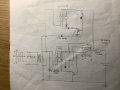
Maybe something like this for driver? (Two of them joined by latching relay)
image.jpg
(join up the + wires and - wires)
 
Last edited:

MisterBill2

Joined Jan 23, 2018
27,979
With either circuit, using a relay and transistor and depending on the voltage drop of the battery is quite limiting. I have seen an antique "medical device" called a "health battery" that used a single coil assembly like a buzzer with a secondary winding to boost the voltage from a single large 1 1/2 volt dry cell, up to produce an unpleasant tingle. That was the mechanically switched version of the tickle-stick circuit. But none of those are small, nor do they use a small battery.
 

Thread Starter

circit!#$$101

Joined Jul 5, 2024
12
Hi Eric, I will be using it for future projects / experiments, for example, a tesla coil, cold plasma, other cool things, that i haven't had the chance yet.
 
Top