How to calculate the value of Zin and Zout???

Thread Starter

samy555

Joined May 24, 2010
116
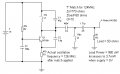
Can you please, help me in the calculation of input and output impedance of the following circuit:​


This stage operates as the oscillator in a FM transmitter, and I want to put a matching Pi network between it and the 50 Ω antenna, so I need to calculate its input and output impedances.
Thanks​
 

t_n_k

Joined Mar 6, 2009
5,455
My guess is that you would probably need to do a direct measurement using a network analyzer to obtain useful values.

With respect to load matching to 50Ω you would need to focus on the output impedance rather than the oscillator input impedance.

Designing the PI network therefore wouldn't be particularly easy.

Perhaps a simple RF transformer match might be a simpler solution. Suppose the dominant output impedance at oscillation was resistive - let's say ~3kΩ as a guess.

Your impedance ratio would then then be 60:1 which would require a turns ratio of about 7.75:1. You could probably use a small ferrite toroid as the transformer core.

The actual turns requirement per winding would depend on the operating frequency and a suitable choice of magnetizing inductance [say at least 10x the collector tuning inductance] to minimize reactive loading of the oscillator output.
 

t_n_k

Joined Mar 6, 2009
5,455
Re Figure 1:

The 30cm antenna will have a low radiation resistance at 27MHz and probably presents as a dominant capacitive reactance - hence the need for the series loading inductor [8 turns]. Even with the inductive loading the effective radiation resistance will still be low and I assume that's why an attempt is made to improve matters via collector loading through the 4:1 transformer. I'm guessing the PI network probably serves as both harmonic filter and loading match. I'm not sure how well the circuit is optimized for radiated power.

In these cases with a simple low power device as shown I think it's a case of build and tweak rather than particularly careful attention to design.
 

Thread Starter

samy555

Joined May 24, 2010
116
Is the following true?
1- The 2nd transistor acts as an oscillator, so the 1n cap made it a common base?
2- Since the 1st stage is a voice preamplifier so it supply a low frequency signal to the 2nd, that is the 1st see the 2nd as a common emitter?
thanks
 

t_n_k

Joined Mar 6, 2009
5,455
Is the following true?
1- The 2nd transistor acts as an oscillator, so the 1n cap made it a common base?
2- Since the 1st stage is a voice preamplifier so it supply a low frequency signal to the 2nd, that is the 1st see the 2nd as a common emitter?
thanks
1 - True. Some folk regard this as a Colpitts oscillator - I don't until convinced otherwise.

2 - I suppose it's possible to think of the circuit that way but it makes little sense since the second stage is operating as an oscillator - not a CE amplifier.
 
Last edited:

t_n_k

Joined Mar 6, 2009
5,455
Why not to measure the V out and I out and divide them V/I????
That's one approach. One would presumably load the oscillator with a range of capacitively coupled resistances and plot the V-I characteristics to derive a resistive output impedance. The use of network analyzer would give a more complete picture in that it would provide the complex output impedance rather than a purely resistive value.

You are not talking about a high output transmitter here - it's pretty Mickey Mouse.

I've done some simulations based on your schematic [somewhat modified] using your suggested method and then applied a matching network for a 50Ω antenna load at 27MHz. One can get a feel for the issues involved. Mind you - obtaining a practical antenna with 50Ω impedance isn't a trivial task in itself. For instance, a modest length of wire pointing upwards isn't going to give you nice predictable 50Ω load.
 

Thread Starter

samy555

Joined May 24, 2010
116
You are not talking about a high output transmitter here - it's pretty Mickey Mouse.
What is the difference between pretty Mickey Mouse and a high output transmitter???
I think that the scientific base is one.

I've done some simulations based on your schematic [somewhat modified] using your suggested method and then applied a matching network for a 50Ω antenna load at 27MHz. One can get a feel for the issues involved. Mind you - obtaining a practical antenna with 50Ω impedance isn't a trivial task in itself. For instance, a modest length of
wire pointing upwards isn't going to give you nice predictable 50Ω load.
I meant this circuit:

It works on a bout 110MHz frequency
thank you
 

t_n_k

Joined Mar 6, 2009
5,455
I've attempted a simulation of an oscillator [per your topology] with a T-matched 50Ω load. Schematic attached.

The attachment is what I manged to get working in simulation. I used the BF199 transistor which worked in this situation and which presumably has a higher transition frequency.

The 'actual' operating frequency I obtained was 126MHz after the match was added. It shifted upwards from the 124MHz I obtained when attempting to deduce Zo using variable loading resistors [5k and 10k].

The Zo turned out to be about 770Ω. I was surprised at the dramatic increase in output [load] power when the supply was changed from 3V to 5V.
 

Attachments

Last edited:
Top