how this oscillator works !?

AlbertHall

Joined Jun 4, 2014
12,625
Applying 3.5V across the base-emitter of a transistor is surely going to blow the transistor. Are you sure there isn't a resistor in there somewhere?
 

Thread Starter

oussama borbon

Joined Apr 21, 2018
9
[QUOTI'm soryAlbertHall, post: 1269000, member: 240904"]Applying 3.5V across the base-emitter of a transistor is surely going to blow the transistor. Are you sure there isn't a resistor in there somewhere?[/QUOTE]
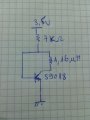
Oh!? i'm sory i did a mestake I forgot to draw the 7 kohm risistor
 

ian field

Joined Oct 27, 2012
6,536
Applying 3.5V across the base-emitter of a transistor is surely going to blow the transistor. Are you sure there isn't a resistor in there somewhere?
I think there's some trick oscillator using reverse biased B/E junction - that could be a messed up representation of it.
 

BR-549

Joined Sep 22, 2013
4,931
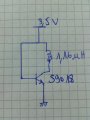
What is the transistor? What does an upside down V mean? S G O something 8? What is an inverted V6 uH?

Have you built this? Can you show us on a scope?
 

Thread Starter

oussama borbon

Joined Apr 21, 2018
9
BR-549 said:
What is the transistor? What does an upside down V mean? S G O something 8? What is an inverted V6 uH?

Have you built this? Can you show us on a scope?
the transistor is npn S9018
the coil is 1.16uH
 

BR-549

Joined Sep 22, 2013
4,931
The output cap of transistor is about 1.3 pF. With 1.6 uH....that should resonate around 110 MHz. If you are seeing 104 MHz......that is reasonable.

The coil will separate base phase with collector phase ~90. The capacitance between the base and collector must supply the other 90....to get 180 needed for oscillation.

Most old people would call it parasitic. But hey....why not put it to work? Talk about efficiency!

Have you tried acquiring any power from it? It would seem finicky....might make a good sensor.

Just guessing....not a transistor expert.
 

Thread Starter

oussama borbon

Joined Apr 21, 2018
9
[QI OTE="BR-549, post: 1269064, member: 218447"]The output cap of transistor is about 1.3 pF. With 1.6 uH....that should resonate around 110 MHz. If you are seeing 104 MHz......that is reasonable.

The coil will separate base phase with collector phase ~90. The capacitance between the base and collector must supply the other 90....to get 180 needed for oscillation.

Most old people would call it parasitic. But hey....why not put it to work? Talk about efficiency!

Have you tried acquiring any power from it? It would seem finicky....might make a good sensor.

Just guessing....not a transistor expert.[/QUOTE]

i built this circuit and i tested it with an FM radio it was oscillate at 104 MHz ... i made this circuit by accident ... that why i don't know how does it oscillate ... i want to know how it oscillate and how I can calculate the frequency i tested it without antenna the range was 10 meters ...


i
 

Thread Starter

oussama borbon

Joined Apr 21, 2018
9
i built this circuit and i tested it with an FM radio it was oscillate at 104 MHz .... I made this circuit by accident that why I don't know how does it oscillate ... I want to know how does it oscillate and how I can calculate the frequency ... I tested it it without antenna the range was 10 meters
 

ebp

Joined Feb 8, 2018
2,332
"What does an upside down V mean?"
Ein.


That is a common way for Germans to write "1" - which is why "7" typically has a cross stroke to clearly distinguish it. I presume it is not exclusive to Germany. Commas and periods in numbers are used opposite of how they are many places. 1.000 is one thousand. 1,000 is one, to four significant digits.
 
Top