How many Watt are these LEDs?

Ya’akov

Joined Jan 27, 2019
10,259
Guys, I have a question ........ I bought 70 m of this EL Wire stuff, glow in the dark. It's 12 Volt. Weird thing is that none work ........

I got a few 12 V power supplies, put some crocodile clips on the wire and ......... nothing! Got another wire, nothing!

Then I did some reading and read that these things are AC, not DC! I remember that many years ago I bought a kind of Pizza pan in Japan, 110V so we bought a 220 V to 110 V converter at home. The thing was equipped with a large steel handle to carry it, bloody heavy! It was also very expensive!

These EL Wire things are often used in cars, 12 V and that's DC as far as I know. I don't get this!

But if AC, how do I scale back from 220 V to 12 V without spending a fortune or was this 220 v to 110 V converter years ago so expensive because the Pizza pan was something like 3000 Watt and therefore the converter was powerful?

Or should I use one of the 12 V power supplies I have and convert the DC output with a ??? to AC?

EL Wire is like some 1/3rd of a Watt per meter only so 70 m is still only 23 Watt.
EL Wire runs from 60-120V at hundreds of Hz. You need something like this: https://www.adafruit.com/product/448
 

Thread Starter

Sofa

Joined Dec 24, 2020
250
Thank you sir!

I am going to find a source from which I can buy!

So I can hook this up to a regular 12 Volt power supply, right?

It says 40 feet so that's 12 meters, I'd need 6 of these then. (70 meters) As we are still talking a few Watt only could I hook up the 6 units to one 2A 12V power supply?

Looking at this one now: (just as an example) would it be safer to buy just ONE that drives the whole 70 m (so a more powerful and expensive inverter) OR a few that each do 10 meters or so? 7 cheapies also give you more problems if one stops working but replacing just 1 cheapy after a while is cheaper than replacing a powerful inverter. No idea how reliable these things are.

Mind you, many seem to drive 5 or 10 meters and my EL Wires are 10m (3 psc) and 20m (2 psc)

https://www.aliexpress.com/item/400...earchweb0_0,searchweb201602_,searchweb201603_

Also inexpensive but able to drive 80 to 120 meters!

https://www.aliexpress.com/item/328...7565#788_668#3164#9976#329_668#3468#15608#104
 
Last edited:

wayneh

Joined Sep 9, 2010
18,125
EL lighting is like a capacitor, but one that makes light when charging. Like any capacitor, it has a maximum rated voltage. Most EL products fall in the range of 100-200V.

Since it makes light only while charging, you need AC to provide many charging cycles = lighting pulses.

Brightness depends on both the degree of charge (voltage) and how many pulses per second (frequency). 2kHz is a typical upper limit.

Unfortunately EL products degrade over time and the degradation is also a function of voltage and frequency. The brighter you run it, the less life it will have.
 

Thread Starter

Sofa

Joined Dec 24, 2020
250
That's all correct! Not that I know much but I read the same on Wiki.

I won't 'brighten them up', just having that many meters of a soft red glowing thin tube running along the premises will create a great atmosphere. Most seem to live for about 12.000 hours and for me that's 3 or 4 years. This stuff is all cheap to buy, very cheap to run so definitely worth it.

Going to test the mini LEDs tonight (that was the subject after all) and will post the outcome. Only just got home, on the way back got my first AZ shot too.
 

Thread Starter

Sofa

Joined Dec 24, 2020
250
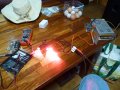
Ok, the power supply I took home is 12.95 Volt when measured. It's the very small one, next to the much bigger 24 V.

I connected 4 spots in parallel, they came on nice and bright and the meter read (hooked up after so in series) 235 milliampere.

So, 0.235 x 12.95 is 3.04 Watt divided by 4 units is 0.76 Watt per LED.

Is that correct?

P1060398.JPG

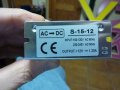
I got an even smaller power supply, match box size, rated as 1.25 A so for the price of a cup of coffee that tiny thing should be able to run 20 LEDs if my calculation is right.

P1060400.JPG
 
Last edited:

wayneh

Joined Sep 9, 2010
18,125
Ok, the power supply I took home is 12.95 Volt when measured. It's the very small one, next to the much bigger 24 V.

I connected 4 spots in parallel, they came on nice and bright and the meter read (hooked up after so in series) 235 milliampere.

So, 0.235 x 12.95 is 3.04 Watt divided by 4 units is 0.76 Watt per LED.

Is that correct?
Looks good to me.
I got an even smaller power supply, match box size, rated as 1.25 A so for the price of a cup of coffee that tiny thing should be able to run 20 LEDs if my calculation is right.
I'm reluctant to say yes. I was working with a "12V" supply recently that was really a 24V square wave at 50% duty cycle. For a light bulb or many other loads, that's fine because the average voltage over time is what matters. For the IC I was powering, it was an instant fire and puff of smoke! Only then did I take the time to look and realize what I'd done. That supply in your photo might be exactly the same thing, and LEDs won't like seeing those 24V peaks, even for an instant.

It's easy to sort out if you have a capacitor and a diode to make yourself a peak detector. (Or if you have an oscilloscope.) Just measure that peak voltage on the capacitor to see.
 

Thread Starter

Sofa

Joined Dec 24, 2020
250
Hello Wayneh,

I'll put it here again, I run a business to be able to pay the bills, make a lot of things from wood, can build a bathroom, consider myself a good plumber (easy!) and maintain the cars myself. I can also understand the 24V at 50% duty cycle as that sounds logical but once we get to capacitors and diodes you've become an inhabitant from a far away planet .......

As a matter of fact, as I am such a dummy, I completely overlooked the fact that the large power supply is 24 V (so not 12 V like all the others I have) and by mistake I ran the mini LEDs at first on that one. Only later I realised it was the 24 V supply running 12 V LEDs! Anyway, nothing happened. Tonight I hooked them up to the 12V one.

My conclusion therefore is that even if the power supply is a piece of shit and the 12 V goes a bit up or down the LEDs will be fine, else they'd have blown up on the 24 V unit.

This is just my guess right, 'farmers' wisdom' as we say in Dutch. Common sense. If you disagree please let me know because knowing is knowing and making assumptions is where I am in the field of electronics.
 

wayneh

Joined Sep 9, 2010
18,125
This is just my guess right, 'farmers' wisdom' as we say in Dutch. Common sense. If you disagree please let me know because knowing is knowing and making assumptions is where I am in the field of electronics.
I suspect you, rather your LEDs, were saved by the current-limiting built into the LEDs. You're probably
right that the problem I warned about may not be much of a problem if they survived a steady 24V.

You have a meter. Do you have any components like diodes and capacitors? If you do, I can walk you through doing the test. If you don't, and feel comfortable going forward, go for it. The very worst thing that might happen is your LEDs don't last as long as they might otherwise. Not a big deal.
 

Audioguru again

Joined Oct 21, 2019
6,826
The tiny 12V power supply might not be isolated then it is not safe to touch its output wires and will electrocute you.
Its 12.95V might drop (to 10V?) when loaded plus more voltage drop when the current meter was connected in series with the lights. If your connections dropped the voltage then they also dropped the current and the current will be higher without the current meter or with a regulated voltage.
 

Thread Starter

Sofa

Joined Dec 24, 2020
250
I do have some left over stuff which I hit with a hammer upon advice of Anniel747 (who was involved in a chicken project) but not sure whether that left over mess contains any diodes or capacitors.

These LEDs are so cheap that I thought 'may as well buy 50 then'.

My main concern was that I didn't want to connect too many LEDs to a cheap/under powered power supply but I also didn't want to buy a 10 A one if 3 A is plenty. That is a waste of money and for the money I have 'saved' I have now bought a multi meter!

I actually measured the Voltage and the Wattage and I am immensely proud of myself! But seriously, these spot LEDs consume extremely little so that's good to know as it was important to know!
 

Thread Starter

Sofa

Joined Dec 24, 2020
250
Audioguru

Thanks for the warning. I often touch 12 V wires, never feel anything! (220 V, YESSSSSS!)

I measured the voltage without the LEDs hooked up so directly on the power supply. After that I connected the LEDs and then the meter at the end of the line to figure out how much power they use.

Or do you mean I should measure the output voltage again but this time with the 4 LEDs on as well?

Just did that ........

Measured 12.9 V, with 4 lights on measured 12.9 V

Obviously there will be a voltage drop depending on the thickness and length of the, to be used, cable.
 
Last edited:

Thread Starter

Sofa

Joined Dec 24, 2020
250
Aaaaaaah..........of course!

How about if I take an extension wire most of us use at home. Let's say 20 meters. I connect that to the transformer, at the end of the 20 meters I attach the 4 LEDs (I am using 4 as these are connected together but I could use more) and then the multi meter to measure the voltage.

Would that be useful?
 

Thread Starter

Sofa

Joined Dec 24, 2020
250
Right, test!

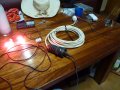
Picture 1. White extension cable plugged into power supply, at the end 4 LEDs and the multi meter. The current how now dropped from 12.9 to 12.4.

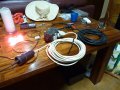
Picture 2. Black extension cable plugged into power supply, white extension cable plugged into the black one (LA SF distance by now) and again 4 LEDs and the multi meter. The current has now dropped to 11.7.

P1060401.JPG

P1060402.JPG
 

Thread Starter

Sofa

Joined Dec 24, 2020
250
Then I would like to add a question: I read that voltage drop, if a lot, is bad for several reasons but there always is a bit of voltage drop of course if you are building a line with LED spots connected every few meters, especially with 12 Volt.

Now, lets say I start putting in some cables and connect some LEDs and measure that the voltage has dropped after 15 meters and 10 LED's to 10V but the LEDs still work fine. Is that ok? I mean, WHEN do I have to decide to stop the cable length and add no more LEDs, what Voltage should I NOT go below?
 

Audioguru again

Joined Oct 21, 2019
6,826
If your lights have three white LEDs in series and each LED needs 3.6V to be bright then they are dim with 10V.
Use thicker wires for less voltage drop. Some of your low voltage but high current wires appear to be very thin..
 

Thread Starter

Sofa

Joined Dec 24, 2020
250
The cable extension is just household cable, simply there to carry out some measurements and to see what happens. The only thin cable I can think of is from the LEDs themselves. Are you referring to that? It's so thin that stripping the wire is impossible, no matter how careful you are, you strip the copper along with the PVC. The only way is holding the wire above the gas jet and then pull off the PVC. So yes, that part is very thin!

I have bought by the way, a thick halogen free cable which I will use for the 12 V stuff. Don't ask me how thick, it's at the shop but it definitely is thick.
 

Thread Starter

Sofa

Joined Dec 24, 2020
250
What's with the hat?
That's the sunny Spain hat. My wife is getting spots and things in her face and each year she looks a year older too. To prevent her face from shrivelling up to a state that I may file for a divorce she is wearing a hat outside.
 
Top